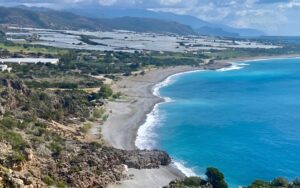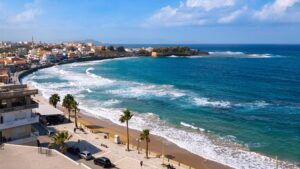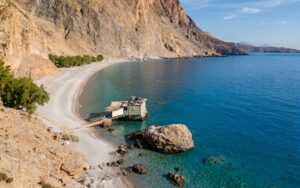
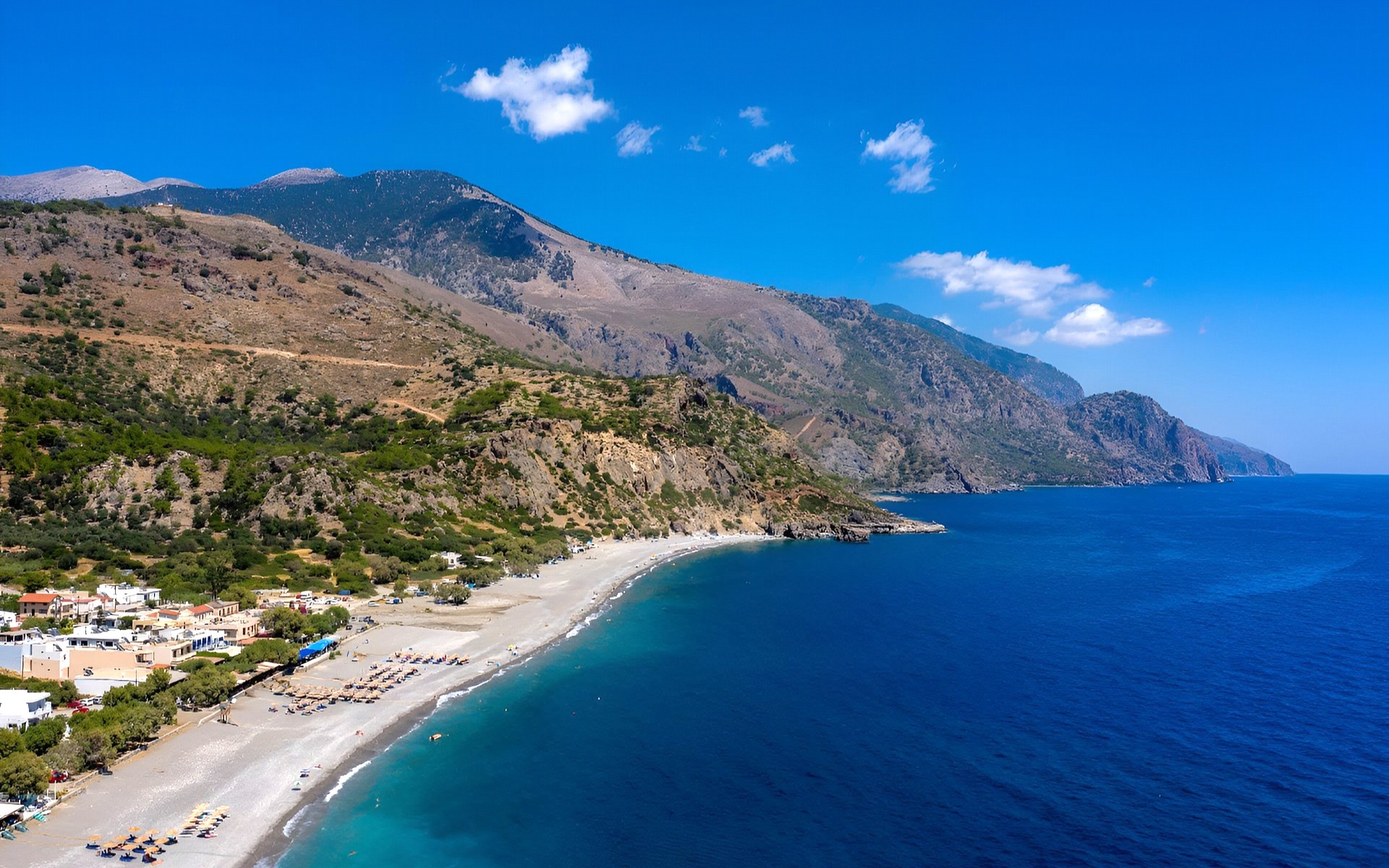
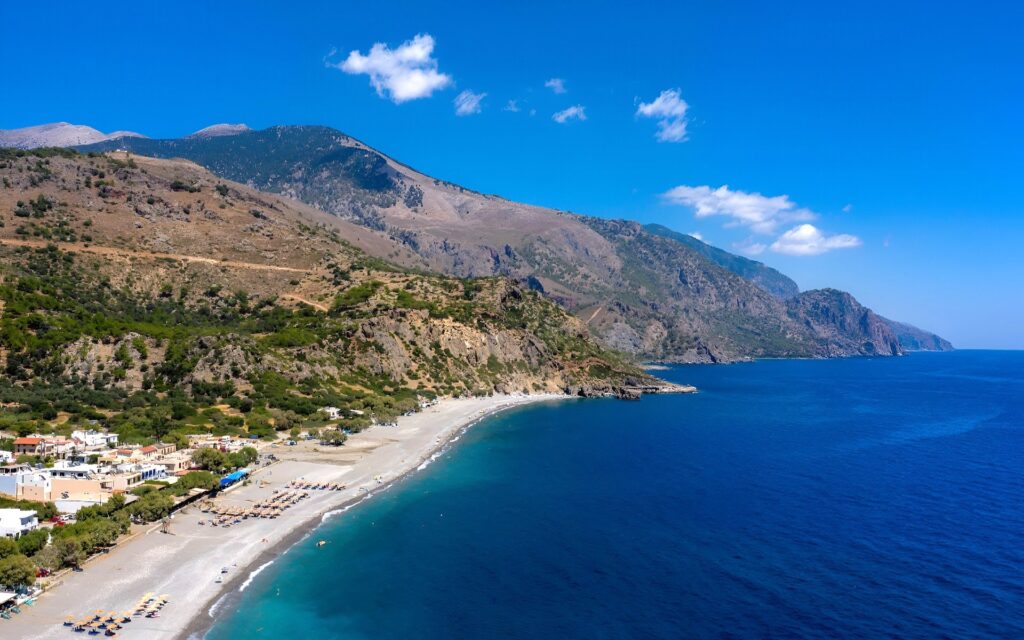
Sougia Beach Chania is one of those places that gets described in hushed tones by people who have been there and do not particularly want it to get crowded. A kilometre and a half of pebble beach on the Libyan Sea, backed by mountains, with tavernas along the waterfront and almost no development beyond that. It is not the most dramatic beach on the island. It is not the most photogenic. But it is genuinely one of the most relaxing, and that is harder to find than you might think.
What makes Sougia different is the combination of things it is. It is a beach, yes. But it is also a base for hiking, a working village, a ferry stop on the southern coast route, and a place where people come for a week and end up extending their stay. The small village has managed to remain largely unaffected by the growth of mass tourism. It still has good accommodation and excellent places to eat. It sits at the foot of a mountain road, at the end of the Agia Irini Gorge, facing south toward Africa. The light in the afternoon is something else.
This is not the beach you go to for beach clubs and watersports instructors and frozen cocktails. If that is what you are after, you are in the wrong place and you will know within ten minutes of arriving. If you want space, quiet water, good food, and something to do beyond lying on a sunbed, Sougia will make a lot of sense.
Quick Summary
| Distance from Chania | 70 to 75km, about 90 minutes by car |
|---|---|
| Best season | May, June, September, October |
| Parking | Free along the beachfront road |
| Entrance fee | None for the beach |
| Rental car needed? | Strongly recommended |
| Family friendly? | Yes, with some caveats (pebbles, deep water) |
| Nudist area? | Yes, eastern end of beach |
| Facilities | Tavernas, sunbeds (limited), showers, lifeguard, ATM, mini-market |
What Sougia Beach Chania Is Actually Like
The beach is approximately 1.08 kilometres long and up to 70 metres wide in some areas, making it the longest beach in southwestern Crete. That width matters. Even on a reasonably busy August day, the beach feels spacious enough that you will not feel crowded.
The shore is a mix of coarse sand and small pebbles. Some of those pebbles are worth looking at closely. Some of the stones are white and orange marble. People collect them. They make good souvenirs, better than the ones in the shops.
The seabed drops off quickly, resulting in deep, transparent water. The sea is one of the cleanest in all Crete and safe, with no currents, although in some points it deepens abruptly. That last part is worth noting if you have young children. The entry into the water requires some care. A few steps in and you are already out of your depth in places.
The beach section in front of the village is equipped with umbrellas, showers, sports facilities, and a lifeguard tower. Beyond that organised stretch, the beach is free and open. About 90% of the beach is free from rented umbrellas and sunbeds.
The eastern end of the beach is known locally as “Matala,” a nod to the famous hippie destination of the 1960s, where nudism is tolerated. The east end also has tents and free camping. This is all perfectly normal and nobody pays much attention to it. If you want to be far from that scene, the western end near the tavernas is the spot.
Warning: The water deepens very quickly from the shore. Children who cannot swim confidently should be closely supervised, particularly beyond the first metre or two. There is a lifeguard on the main organised section, but most of the beach is unguarded.
Tamarisk trees dotted along the beach provide some shade. On a hot July day this is genuinely useful. Most pebble beaches on Crete offer zero natural shade, so the tamarisks are an advantage.
Local tip: Water shoes are worth packing. The pebbles are manageable on the flat beach but the entry into the water can be slippery and sharp. Bring them or pick up a cheap pair from one of the village shops when you arrive.
The Village Behind the Beach
In Sougia you will find restaurants, tavernas, rooms, coffee shops, bars, and a mini-market. However, you will not find a gas station, hospital, pharmacy, or bank. There is an ATM. Fill up with fuel before you leave Chania. This is not a warning, it is just a practical fact about the south coast.
A favourite destination for hippies in the 1970s, Sougia today is a good choice for peaceful holidays in a beautiful landscape with all the basic amenities provided. The atmosphere has retained some of that old energy. It is relaxed, slightly alternative, and completely unpretentious.
On the small beach promenade of Sougia, about 500 metres long, there are cafes and tavernas. Tamarisk trees line the small promenade. The food is straightforward Cretan cooking. Fresh fish, grilled meat, salads, local wine. There are around ten taverna cafes in the village, and the healthy competition tends to keep quality high.
The village also has the church of Saint Panteleimon to the west, which features a remarkable mosaic floor that belonged to an older church upon which the current one was built. Worth five minutes of your time.
Sougia has approximately 110 permanent residents. In summer it swells to something much larger, but it never loses its village character entirely.
What To Do Beyond the Beach
Hike the Agia Irini Gorge
This is the walk that most people staying in Sougia do at least once. From the entrance of the gorge near the village of Agia Irini to the exit at the Oasis Taverna, the walk is 7.5 kilometres long with a descent of around 500 metres, and takes about two and a half hours.
The gorge is an excellent alternative to the Samaria Gorge and is far less crowded. Instead of hundreds or thousands of hikers per day, you will find only a handful. Most of the gorge is in shade, with plenty of pine trees, plane trees, and oleander bushes. This makes it viable even in July and August.
The gorge is considered easy and suitable for children, though proper shoes are necessary. It is mostly downhill without particularly steep areas.
One important logistic: from the exit of the gorge to Sougia village, the walk is on a mostly traffic-free road with little shade, covering around 7 kilometres. On a hot day, it is best to arrange transport. A taxi from the Oasis Taverna at the gorge exit back to Sougia, or directly to your parked car at the top, is the standard solution. There is a small entrance fee at the gorge. Check current prices on the official KTEL or gorge information websites before you go.
Local tip: If you are staying in Sougia and want to do the Agia Irini Gorge, the morning bus from the village square at 7am drops you at the gorge entrance. Walk down, and then call a taxi from the Oasis Taverna for the return leg to Sougia. This avoids the long road walk in the afternoon heat.
Walk to Ancient Lissos
The walk to Lissos is the most popular walk for people staying in Sougia. It is relatively easy, takes about 90 minutes each way, and ends at a very peaceful place with interesting remains of ancient civilisation.
The entrance to Lissos Gorge is right next to Sougia harbour. A sign marks the start of the walk.
Lissos is the second most important ancient site in Crete by number of sculptures found, after Gortyna, which was the Roman capital. A notable feature is the mosaic floor of multicoloured stones in intricate geometric shapes and images of birds. There are also traces of Roman ruins and unusual barrel-vaulted tombs.
You can return on foot the same way, or arrange a boat pickup at Lissos Bay. Speak to the taverna owners in Sougia or ask at the harbour. There are usually fishermen who will take you back by sea. This is a far more pleasant return option and worth organising before you leave.
Warning: There is no shade on the higher sections of the Lissos walk and no water between Sougia and the spring at the archaeological site. Carry at least 1.5 litres per person. Start early. Nobody who sets off at noon in August will enjoy this.
Ferry to Agia Roumeli and the Samaria Gorge
In summer, ferries run daily from Sougia to Chora Sfakion, Paleochora, Agia Roumeli, Gavdos Island, and Loutro. This opens up the entire south coast from one base. You can take the morning ferry to Agia Roumeli and walk the lower section of the Samaria Gorge, or continue west to Paleochora for the day. In summer, there is also a boat to Gavdos three times a week. Gavdos is the southernmost point in Europe, and a genuinely remote experience if you have an extra day.
Frequently Asked Questions
Is Sougia beach worth visiting from Chania as a day trip?
Yes, but only if you have a car and a full day. The drive is 75 km and takes about 90 minutes from Chania. That is a significant drive for a single day, but the south coast road is beautiful and Sougia itself offers more than just the beach. Combine it with a short section of the Agia Irini Gorge or the walk to Lissos if you want a full day.
Is the road to Sougia difficult to drive?
The road is narrow and has many turns. That is the honest description. It is a mountain road with switchbacks and occasional passing places. Most hire cars handle it fine, and it is paved all the way. The connecting mountain road is, in fact, generally well-maintained and sufficiently wide. Drive at a sensible pace and do not try to rush it.
Is Sougia beach family friendly?
Sougia is a good choice for families. Parents do not need to worry about car traffic near the beach, and children can move around freely. It is a genuinely safe and low-key environment. The main caution is the quick drop-off into deep water at the beach itself. Small children should wear a buoyancy vest.
Is there camping at Sougia?
Sougia is one of the very few places in the area with free camping. There are trees for shade, and it is well known as a gathering spot for groups of friends who come to camp. The camping area is at the eastern end of the beach.
Is Sougia better than Elafonisi or Balos?
Different in almost every way. Elafonisi and Balos are dramatic and beautiful but crowded in summer. Sougia is quiet, has actual village life, better food options, and things to do beyond the water. If you want a beach with pink sand, go to Elafonisi. If you want a place where you can settle for several days and feel like you are somewhere real, Sougia is the better option.
What is the wind situation at Sougia?
On some summer days, the prevalent westerly winds get strong and unpleasant. This is a south-facing bay and it catches the Libyan winds. It happens less frequently than on the exposed western beaches, but it is not unknown. Mornings are generally calmer.
The Honest Notes
Sougia is genuinely good. But it is worth being clear about what it is and is not.
Some visitors note that the beach is very stony in parts. This is simply true. The pebbles vary in size and some sections are rougher than others. Bring a thick mat or towel if you are sensitive to lying on an uneven surface.
Warning: There is no petrol station in Sougia, no pharmacy, and no bank branch. Make sure to fill the tank before you get there. There is a cash machine (ATM) in the village. If you need anything beyond basic groceries, sort it in Chania before you leave.
The bus situation is something to understand before you rely on it. Public transport to Sougia is limited: there are only one or two buses a day depending on the time of year, and the journey takes about two hours. This is fine if you are staying in the village. If you are day-tripping by bus, you will need to plan very carefully around the return schedule, which changes seasonally. Always check the current KTEL timetable before you go.
Warning: The accommodation in Sougia books up early for July and August. In peak summer, things can get full and no beds may be available. Book ahead. The village is small and the number of rooms is limited.
The village shuts down almost completely outside the tourist season. From early April to late October, Sougia attracts visitors. Outside that window, most things close. Do not plan a November trip expecting open tavernas.
Before You Go
- Water: carry at least 1.5 litres per person if you are walking to Lissos or Agia Irini Gorge. No natural water on the Lissos trail until the ancient spring.
- Shoes: water shoes for beach entry. Hiking boots or sturdy trainers for any trail walking.
- Cash: the ATM in Sougia can run out in peak season. Bring cash from Chania.
- Fuel: no petrol station in Sougia. Fill up before you leave the main road.
- Sun: the beach has some tamarisk shade but the hiking routes are fully exposed. Hat and sunscreen essential.
- Ferry: if you plan to use the south coast ferry, check the current seasonal timetable before you leave Chania. Schedules change.
- Accommodation: book well in advance for July and August. The village has fewer than 25 accommodation options.
Getting There
By car
This is the only sensible option for a day trip. From Chania, take the road south through Alikianos and then up into the mountains toward Agia Irini. The route passes through the plain with the orange trees, climbs into the mountains, passes through the village of Agia Irini, where the gorge begins, and then descends through villages and olive and oak tree slopes down to Sougia. Allow 90 minutes, more if you stop for the view. Parking is available along the beachfront road adjacent to the beach. It is free.

By bus
There are only one or two KTEL buses a day from Chania to Sougia, depending on the season. The journey takes about two hours. Note that the bus station in Sougia has moved and is now on the west side of the village, after the last restaurant. Check the current timetable on the KTEL website before you travel. Bus schedules on this route change between summer and off-season and are not always reliable as a day-trip option.
By ferry
In summer, ferries run daily from Sougia along the south coast to Chora Sfakion, Paleochora, Agia Roumeli, Gavdos, and Loutro. This makes it possible to arrive at Sougia by ferry from another south coast village, or to use Sougia as a base for a coastal ferry day out. The ferry from Agia Roumeli arrives in Sougia after carrying walkers who have just completed the Samaria Gorge.
By organised tour
Book a guided tour from Chania several operators run day trips to the southern coast including Sougia and the Agia Irini Gorge, with transport included.
Practical Information
| Location | Sougia village, Selino, south Chania Prefecture |
|---|---|
| Beach length | Approximately 1.2 to 1.5 km |
| Beach type | Pebble and coarse sand |
| Facilities | Sunbeds (limited area), showers, lifeguard, tavernas, ATM, mini-market |
| Nudist area | Eastern end, tolerated but not compulsory |
| Free camping | Eastern end, informal |
| Parking | Free along the beachfront road |
| Ferry connections | Paleochora, Agia Roumeli, Loutro, Chora Sfakion, Gavdos (seasonal) |
| Season | April to October |
| No petrol station | Nearest is on the main road north of the village |
| No pharmacy | Nearest in Kandanos or Paleochora |
Combine With
Agia Irini Gorge
The gorge is just as impressive as the better-known Samaria Gorge but attracts far fewer visitors. Start at the upper entrance near Agia Irini village, walk down to the Oasis Taverna at the bottom, and arrange a taxi back to Sougia. A morning half-day activity that leaves the afternoon free for the beach.
Paleochora
Paleochora is the other well-known village on the south coast of Chania. You can drive there in about 40 minutes and enjoy the sandy beach and good restaurants. Alternatively, take the morning ferry from Sougia. Very different character from Sougia, more developed, but worth a half-day.
Ancient Lissos
A 90-minute walk from Sougia harbour along the E4 trail. Lissos is the second most important ancient site in Crete by number of sculptures found. Free to enter. Go early and return by boat if you can arrange it.
Gavdos Island
In summer, a boat runs to Gavdos three times a week from Sougia. This is the southernmost point in Europe, with basic facilities and a very raw kind of remoteness. A full day out or an overnight if you want to say you have been to the edge of the European continent.
Local tip: The drive back from Sougia in the late afternoon is worth taking slowly. The light comes through the mountain passes and across the oak forests in a way that does not photograph well but stays with you. Pull over where the road crests above the valley and look back toward the sea. That view, with the Libyan Sea behind you and the White Mountains ahead, is one of the better moments this part of Crete offers. Do not rush it.