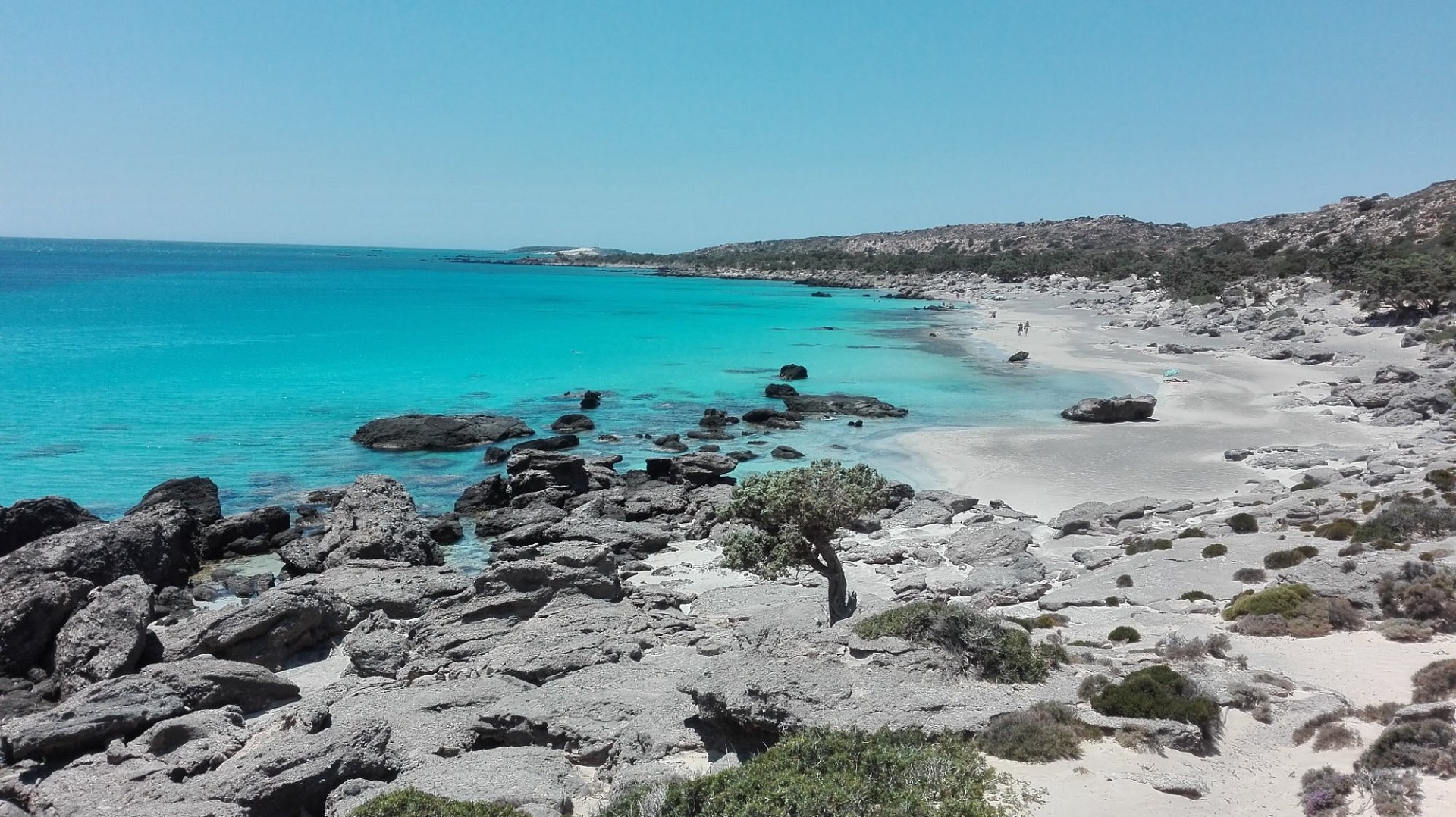
Kedrodasos Beach Chania is one of the most genuinely untouched beaches left in western Crete. It sits just one kilometre east of the famous Elafonisi lagoon, yet most of the people who go to Elafonisi never make it here. That is their loss, and quietly your gain.
The beach is named for the forest that makes it unlike anywhere else on the island. Located 76 kilometres southwest of Chania, the beach is full of juniper trees and sand dunes. The name means cedar forest in Greek, though the trees are actually junipers, not cedars. The species here are Juniperus oxycedrus subsp. macrocarpa and Juniperus phoenicea. They grow twisted and low, right down to the water’s edge, scenting the air and throwing shade across the sand. There is no other beach quite like it in Crete.
There are no facilities nearby, making this one of the last untouched places of its kind in Europe. No sunbeds. No taverna. No ice cream van. The area belongs to the NATURA 2000 network. You bring what you need, you take your rubbish away, and you leave the trees alone. That is the deal. Most visitors are fine with it.
| Distance from Chania | 76 km, about 90 to 100 minutes |
|---|---|
| Difficulty | Easy to moderate (short rocky walk from car park) |
| Time needed | Half day minimum, full day recommended |
| Best season | May, June, September, October |
| Parking | Free at the top of the cliffs |
| Entrance fee | None |
| Rental car needed? | Yes |
| Family friendly? | Yes, with older children |
What Makes Kedrodasos Beach Chania Worth the Drive
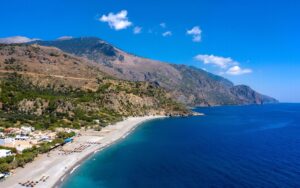
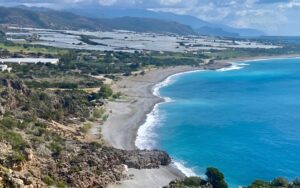
The water. That is the honest answer. The beach offers a long shore with white sand, sparsely situated black rocks, and crystal-clear water. The colour ranges from pale aquamarine near the shore to deep cobalt further out. On a calm day in June, it looks almost unreal.
Then there is the forest itself. The juniper grove covers an area of about 11 hectares. The trees grow dense and fragrant across the dunes behind the beach. In July and August, when the Libyan coast bakes and almost every beach in Crete is a furnace, Kedrodasos offers something most organised beaches cannot: natural, free shade. You do not need to pay for a sunbed to have somewhere cool to sit. You just find a tree.
The beach is protected to some degree from the winds that usually affect neighbouring Elafonisi. When the meltemi is blowing hard further up the coast, Kedrodasos often stays calmer. Not always, but often enough to matter.
The beach is approximately 340 metres long and 46 metres wide, which means it does fill up in August, but it never reaches the chaos of Elafonisi. There are no tour buses pulling up. The people here arrived under their own steam, which tends to filter out a certain type of tourist.
Local tip: Walk to the eastern end of the beach and keep going. There are two or three smaller coves beyond the main beach, accessible on foot via the E4 trail markers. Fewer people, same water. If you want real solitude in July, that is where you find it.
The Juniper Forest and Why You Need to Respect It
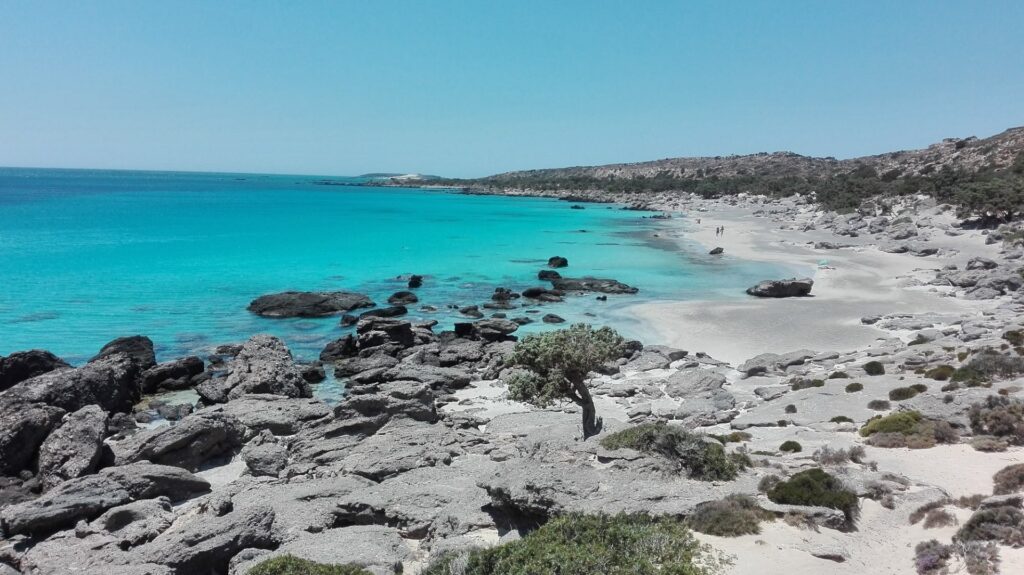
The forest is not just scenery. It is the reason the beach is protected. The trees are very fragile and need respect. Do not tie hammocks between them. Do not break branches for shade. Do not pitch a tent against the root system. People do all of these things and it damages trees that have taken decades to grow.
The species in the area are protected under Natura 2000, so if you plan to spend the night with your own tent, as many travellers do, avoid damaging the trees that grow on the sand.
Camping is a grey area here. People do it, regularly. Some people are camping for real, with tents set up and even solar panels. Whether it is officially permitted or not, the reality is that it happens, particularly in summer. If you do camp, the obligation is simple: leave the place exactly as you found it.
Warning: The junipers look sturdy but their root systems are shallow and easily compacted. Walking repeatedly on the same ground around the bases of the trees causes real damage. Stick to the sandy paths that are already established, not your own shortcut through the forest.
Kedrodasos vs Elafonisi: The Honest Comparison
Most visitors to this part of Crete come for Elafonisi. It deserves its reputation. The pink sand is real, the lagoon is beautiful, the water is extraordinary. But unlike Elafonisi, Kedrodasos remains largely untouched by mass tourism, offering a more authentic and quiet experience.
At Elafonisi in August, you will share the beach with hundreds of other people, tour buses from all over Crete, organised sunbed rows, and at least two or three boat trips arriving mid-morning. It is still worth it. But it is not a quiet day.
At Kedrodasos, you carry your own supplies in and you carry them out. Kedrodasos Beach is a natural beach with no organised facilities. You will find natural shade from the juniper trees and large rocks, but no sunbeds or umbrellas for rent. For some people that is a dealbreaker. For others it is exactly the point.
Many travellers visit Kedrodasos as part of a day trip that includes Elafonisi. Elafonisi attracts more tourists with its famous pink sand and shallow lagoon. Visiting both gives you a contrast between lively and secluded. That is the smart approach. Drive past the Kedrodasos turn-off first thing in the morning, spend a few hours there before the day heats up, then move on to Elafonisi in the afternoon when the organised tour buses have already started heading back north.
Local tip: The KTEL buses from Chania to Elafonisi depart around 4pm for the return journey. That is when Elafonisi empties out. If you can visit Elafonisi after 4pm in summer, you will see the beach in a completely different light, literally and figuratively.
Snorkelling and Swimming
The water clarity at Kedrodasos is excellent. The beach is divided into several smaller unnamed coves and bays. Some sections are sandy and shallow close to the shore, ideal for children or nervous swimmers. Others have flat rocks that drop more steeply into deeper water. The rocky sections are where the snorkelling is best.
Snorkelling lovers should not forget their gear. There is enough underwater life, rock formations, and water clarity here to make it genuinely worthwhile. No hire equipment available. Bring your own.
There is no lifeguard. This beach does not have lifeguards monitoring it. Swim with that in mind.
Warning: The wind can pick up in the afternoon, particularly from the west, which makes the sea choppier than it looks from the car park. If you are swimming with children, check conditions when you arrive at the beach, not just from the top of the cliff.
The Honest Notes
Kedrodasos is genuinely wonderful. It is also genuinely remote, genuinely without facilities, and not entirely without problems.
The juniper forest is sometimes occupied by long-stay campers. This means shade can be taken up, and the lack of waste management means litter can accumulate around the more used parts of the forest. The beach itself tends to be cleaner than the forest edge. Choose your spot accordingly.
Warning: There are no toilets anywhere near the beach. None at the car park, none on the path, none at the beach itself. Plan accordingly before you start the walk down. This is not a minor inconvenience over a long day.
The nudist culture here is informal and longstanding. While Kedrodasos is not officially designated as a nudist beach, some visitors choose to be nude. It tends to concentrate toward the eastern end of the beach, away from families. No one makes a fuss about it either way.
Before You Go
- Water: bring at least 2 litres per person. There is nothing to buy on the beach or on the path.
- Food: pack a full picnic. The nearest taverna is several kilometres away.
- Shoes: closed-toe shoes or trail sandals for the walk down. The path is rocky and loose in places.
- Sun: the juniper trees give partial shade but the beach itself is exposed. Hat and sunscreen essential.
- Toilets: none on the route or at the beach. Use facilities before you leave.
- Cash: no card facilities anywhere near the beach. If there is a small kiosk near the car park, it is cash only.
- Snorkelling gear: bring your own if you want it. Nothing to hire here.
Getting There
By Car
A rental car is essential. Kedrodasos Beach is approximately 75 kilometres southwest of Chania and the drive takes about 1.5 to 2 hours. Begin by taking the E65 highway westward towards Kissamos. Before reaching Kissamos, turn left following signs for Elos and Vathi. This route takes you through Topolia Gorge, then on to Elos Village, known for its chestnut trees and traditional Cretan tavernas. From there, continue south following signs for Elafonisi, passing Chryssoskalitissa Monastery on your left.
About 5 kilometres before Elafonisi, you pass Chryssoskalitissa Monastery. Approximately 1.5 kilometres before reaching Elafonisi, look for a small dirt road on the left leading towards Kedrodasos Beach.
The dirt road ends in a parking area from where a downhill path of sand and pebbles begins, about 600 metres long, ending at the beach. The parking is free. Arrive early because parking is limited and the beach fills up during peak hours.
Do not attempt to drive closer than the car park on your own vehicle. The terrain beyond is rough and not worth the tyre risk.

By Bus and Foot
The KTEL public bus runs daily from Chania to Elafonisi Beach during the tourist season, approximately April to October. The bus departs from Chania’s main public bus station and the trip takes slightly over 2 hours. Public buses run to Elafonisi but not directly to Kedrodasos. From Elafonisi, you can walk to Kedrodasos along a marked path. The walk takes around 20 minutes through the cedar forest.
This works, but you are then dependent on the bus schedule for your return. Check current KTEL timetables before you go.
By Boat
Private boats and boat tours from Chania, Kissamos, or Palaiochora offer a scenic way to reach Kedrodasos. Arriving by boat allows visitors to access hidden coves and snorkelling spots nearby, as well as combine with Elafonisi, Balos, and Falassarna. This option suits those doing a longer western Crete boat excursion.
Practical Information
| Location | Southwest Crete, 1 km east of Elafonisi lagoon |
|---|---|
| Distance from Chania | 76 km, 90 to 100 minutes by car |
| Entrance fee | Free |
| Parking | Free, limited spaces at clifftop car park |
| Walk to beach | 10 to 15 minutes on rocky path |
| Facilities | None (no toilets, no taverna, no sunbeds, no lifeguard) |
| Natura 2000 protected | Yes |
| Naturist use | Informal, mainly eastern end |
| Camping | Practised informally, not officially permitted |
| Best months | May, June, September, October |
| Snorkelling | Good, especially off the rocky sections |
Combine With
Elafonisi Beach is the obvious pairing. Many travellers visit Kedrodasos as part of a day trip that also includes Elafonisi, which is famous for its pink sand and shallow lagoon. They are less than 2 kilometres apart. Do both in one day.
Chrissoskalitissa Monastery sits roughly 5 kilometres north of Elafonisi on the same road. It is a historic monastery perched on a hill with panoramic views. Worth a 20-minute stop on the way in or out.
Topolia Gorge lies on the mountain road between the coast road and the inland village of Elos. The gorge passes by Agia Sofia Cave, a natural limestone cave with a small chapel inside. The road through the gorge is dramatic and slow. Allow time for it.
Paleochora is a small coastal town about 25 kilometres east of the Elafonisi road. It has cafes, shops, and a relaxed atmosphere. Good for a late lunch or an overnight stop if you want to avoid the long drive back to Chania on the same day.
Local tip: If you are driving back to Chania via the northern route through Topolia Gorge, do not rush it. The light on the cliff walls in the late afternoon, with the smell of wild thyme coming through the car window and almost no traffic on the road, is one of those accidental moments that ends up being the thing you remember most from the whole trip.