Knowing the best time to visit Chania is the most useful thing you can do before booking your trip. Get it right and you will have good weather, manageable crowds, and prices that do not make you wince. Get it wrong and you might find yourself in August heat that stops you leaving the shade by noon, or in February with half the restaurants shuttered and rain every other day. This guide tells you exactly what each part of the season is actually like, not the marketing version.
The honest answer is that Chania has no single best month for every traveller. It depends entirely on what kind of holiday you want. A beach-and-swim week is a very different calculation from a hiking and sightseeing trip.
| Best overall months | May, June, September, October |
|---|---|
| Peak season | July and August |
| Shoulder season | May, June, September, October |
| Low season | November to April |
| Summer sea temperature | Up to 26°C in August |
| Rainiest months | November, December, January |
| Driest months | July and August |
| Rental car recommended? | Yes, for most destinations |
The Best Time to Visit Chania: A Season-by-Season Breakdown
There is no single “best” answer, but there are clear patterns. Here is how each part of the year breaks down in honest, practical terms.
May and June: The Shoulder Season Sweet Spot
This is the period most local residents would recommend to a friend visiting for the first time.
May is quite warm for Chania, with tourists just beginning to arrive and accommodation prices relatively low. The average temperature in May sits around 20°C, ranging from about 15.7°C at night to 24.5°C during the day. That is comfortable for walking, sightseeing, and hiking without the crushing heat of midsummer. The Samaria Gorge opens on 1 May. You can walk it in May without worrying about heat exhaustion at the narrows.
June marks the official start of the summer season in Chania, with high temperatures and fine sea conditions. Average temperatures reach around 24.3°C. The mean sea temperature in June is around 22°C, meaning the water is warm enough for most swimmers.
Visiting from May to June is perfect for a more relaxed experience. These shoulder months offer warm weather for outdoor exploration without the peak summer heat, the sea is still good for swimming, and you can enjoy a peaceful visit to the old town and historical sites.
Local tip: In May, the wildflowers in the hills above Chania are at their peak. If you drive south toward the White Mountains, the roadsides are covered in poppies, anemones, and wild herbs. It does not last. By mid-June it is all dry again. Worth timing your trip around if that kind of thing matters to you.
The practical advantages of May and June are real. Hotel rooms are available without booking months in advance. Rental car prices are lower. The shoulder seasons of May-June offer the best balance of pleasant weather and manageable crowds. During these periods you will find shorter queues at popular restaurants and easier parking.
One honest limitation: some smaller beach tavernas and remote tourist facilities may not be fully open until mid-June. If your plan involves remote beaches on the far west coast, check what is operating before you drive two hours to find a shuttered kiosk.
July and August: Peak Season
August is peak season in Chania, with the largest number of tourists visiting during this month. July is nearly as busy. These are the facts.
In July, the average temperature in Chania is 27.2°C, with highs typically reaching 31.2°C and nights staying around 22.6°C. July also brings the most sunshine, averaging 12.5 hours of daily sun. The sea is warm. Everything is open. If you want a full-service beach holiday with all facilities running, this is your season.
Warning: August 15 is the Feast of the Assumption, one of the most important Greek public holidays. Domestic Greek tourism peaks around this date. Expect the busiest roads of the year, fully booked accommodation, and packed beaches. If you must travel in August, avoid the week of the 15th or book your accommodation and rental car at least three months in advance.
The Meltemi is the other thing no travel brochure tells you about. In the summer in Crete, especially in July and August, strong north-northwest winds known as the Meltemi blow on the island almost every day. The Meltemi can occur anytime between May and October but is most frequent in summer, June through September. Its maximum strength and duration is during July and August.
August also brings the Meltemi, a strong northerly wind. On windy days, many north-coast beaches become rough and wavy, which can make swimming difficult for young children.
Local tip: On Meltemi days, the sheltered bays around Akrotiri, particularly Marathi and Kalathas, stay calmer than the exposed north-coast beaches. If the wind is howling at Platanias or Agia Marina, drive 20 minutes east to Akrotiri. Most visitors do not know to do this. You will be glad you do.
On the crowds question, be honest with yourself. Chania experiences peak crowds from mid-July through August, with the harbour area becoming particularly congested between 6 and 9 PM when everyone gathers for sunset dining and photography. Cruise ship arrivals on Tuesdays and Thursdays typically add 3,000 to 5,000 additional visitors to the old town. These are not quiet evenings.
The main beaches are body to body, and resort towns are packed. If you travel during this time, you must book hotels and flights many months in advance, and be prepared for intense sun and big crowds everywhere you go.
July and August are, however, excellent for certain types of traveller. August is Crete at full volume. It is characterized by warm seas, packed beaches, busy roads, and late-night tavernas. If that sounds like your holiday, book early and enjoy it.
The sea reaches its warmest point in August, typically around 26°C. For swimming-focused holidays, this is genuinely the best it gets.
September and October: The Other Sweet Spot
September is, in many ways, the best month of all.
September through October sees a slight dip in temperature, averaging between 20°C and 27°C, making it excellent for those who enjoy cooler weather while hiking or exploring archaeological sites. The sea is still warm from the summer. The crowds thin noticeably from mid-September. Accommodation prices drop.
July and August are the busiest months, so for a more relaxed experience, the best time to visit is in early or late summer, meaning May to June and September to October. The weather is still warm, the sea is perfect for swimming, and you will enjoy quieter beaches and a more relaxed vibe.
October is still underrated by many visitors from Northern Europe. Early October in Chania is for the most part very comfortable weather, short sleeves during the day, and maybe a light jacket at night. One occasional heavy thunderstorm is possible, but otherwise conditions can be delightful.
The Samaria Gorge closes at the end of October. If gorge hiking is part of your plan, October is your last window.
The tourist season in Crete generally finishes at the end of October, so you should be fine for most of the month with restaurants and services open. By early November, however, many coastal tavernas and tourist businesses close for winter.
Warning: Late October can bring the first autumn storms. They arrive quickly and can make exposed western beaches, including Elafonisi and Balos, rough and unsafe. Always check the weather forecast the day before any western road trip in October.
November to April: Low Season
The low season gets unfairly dismissed. For certain travellers, it is exactly right.
The least ideal time to visit Chania is the rainy season, between November and February. That is accurate for a beach holiday. For anything else, the picture is more complicated.
Visitor numbers to Crete are very low in November and because of this many restaurants, bars, and hotels close on or around the 31st of October, with sunbeds on the beaches stored away. Flights to Crete are not as frequent in November. In winter there are no direct flights to Crete, so you will need to fly to Athens and get a connecting flight to Chania. This adds time and cost.
What you get in exchange is an entirely different place. The old town of Chania is lived-in and quiet. Some consider the low season the best time to visit Chania, as it is mostly locals going about their daily lives. The city is quieter but never dull, with a lively atmosphere thanks to its student population.
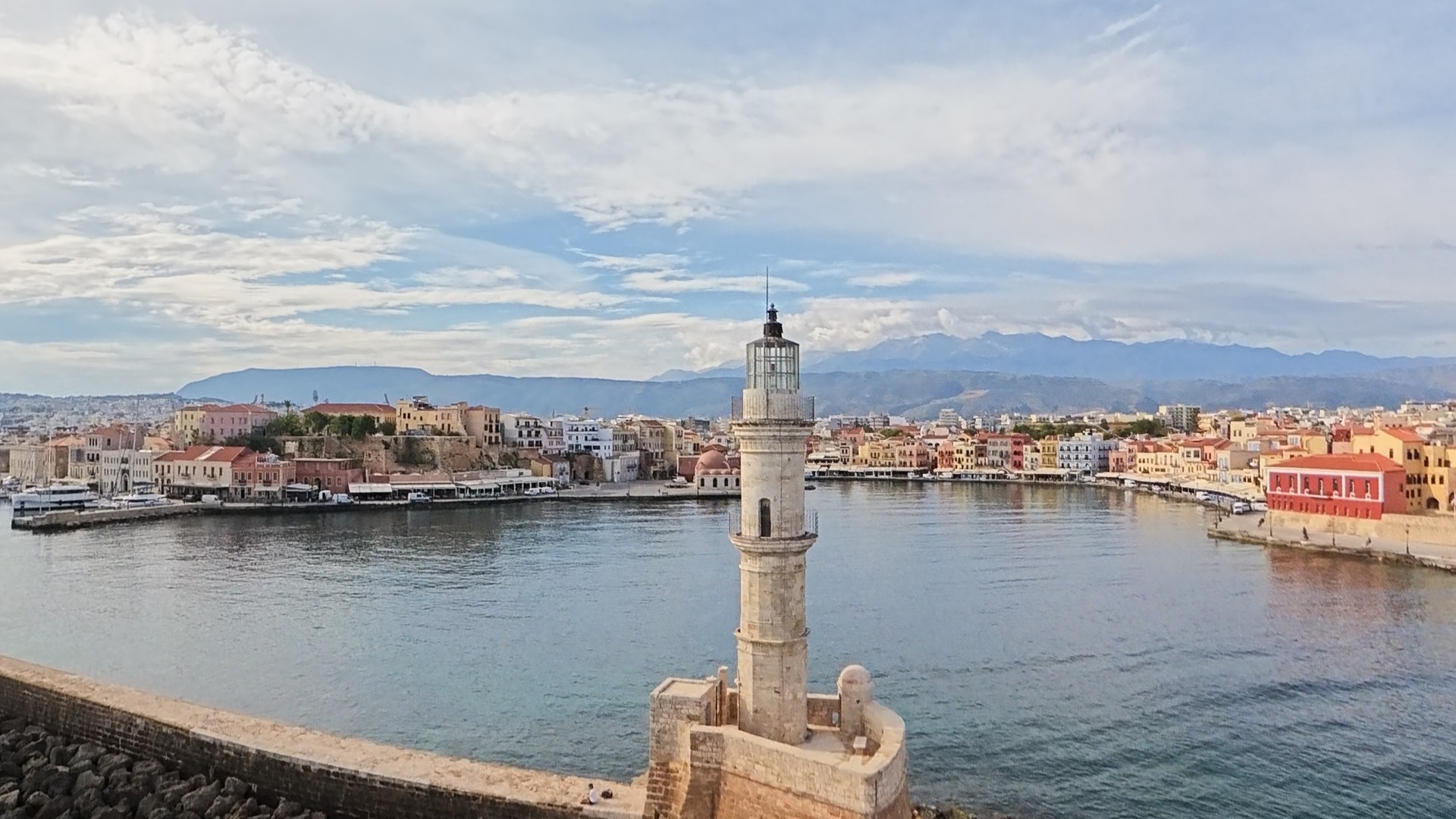
While the sea may be too cold for swimming, the snow-capped White Mountains and Chania’s charming old town, with its Venetian architecture, continue to captivate. The archaeological museum is rarely busy. You can stand in front of the Venetian lighthouse without someone’s selfie stick in your eyeline.
Warning: If you visit between November and March, check carefully which accommodation and restaurants are open before you book. Chania city itself remains active, but many establishments in outlying areas and resort villages will be fully shut. Do not arrive expecting a summer experience.
Winter does have one genuine attraction. From December onward, the White Mountains above Chania often have snow on their peaks. On a clear winter day from the harbour, you can see them sharp and white against a blue sky. That is not something you see in August.
Chania Month-by-Month at a Glance
| Month | Avg High | Sea Temp | Crowds | Notes |
|---|---|---|---|---|
| January | 13°C | 16°C | Very low | Rain likely. City only. |
| February | 14°C | 14°C | Very low | Coldest sea. Some almond blossom in hills. |
| March | 17°C | 16°C | Low | Weather improving. Good for walking. |
| April | 20°C | 16°C | Low | Pleasant. Sea still cold for most. |
| May | 24°C | 19°C | Low-Medium | Excellent. Gorge opens. Flowers. |
| June | 28°C | 22°C | Medium | Very good. Sea warming fast. |
| July | 31°C | 24°C | High | Hot. Windy. Busy. Good for beach. |
| August | 31°C | 26°C | Peak | Hottest, busiest, most expensive. |
| September | 28°C | 25°C | Medium | Often the best month overall. |
| October | 24°C | 23°C | Low-Medium | Still warm. Season winding down. |
| November | 19°C | 20°C | Very low | Many places closed. City life only. |
| December | 15°C | 17°C | Very low | Rain. Good for those who want Chania to themselves. |
Frequently Asked Questions
What is the absolute best month to visit Chania?
September, for most travellers. The best time to visit Chania is arguably between May and September. During these months, the city enjoys a balmy average temperature regime that reaches up to 28.5°C in July, with nights also pleasantly warm, hovering between 15°C and 22°C. September has the warm sea temperatures of summer, far fewer crowds than August, and prices that have already started to drop. If September is not possible, June is the next best option.
Is July and August too hot and crowded in Chania?
It depends on your tolerance. For heavy sightseeing, the heat can be oppressive. For a holiday centred on swimming and beaches, it is excellent. Most visitors find the midday hours, roughly noon to 4 PM, best spent in the shade or in the water. If you are sensitive to heat, crowds, or high prices, June or September will serve you better.
Can you swim in the sea in May or October?
In May, the sea is around 19°C. Cold for some, manageable for others. The sea might not be warm enough for swimming in May and October for many visitors. By late May it improves. In October the sea retains summer warmth, typically around 23°C, and most people find it perfectly swimmable for much of the month.
What is the Meltemi wind and will it affect my holiday?
In the summer months, especially from June to September, the main direction of the winds in Crete is north-west. The Meltemi usually starts in the morning after about 10 or 11 AM and gradually decreases in the afternoon hours after 6 PM. On exposed north-coast beaches it can make sunbathing uncomfortable on stronger days. Sheltered bays on the Akrotiri Peninsula, such as Marathi and Kalathas, stay much calmer. The Meltemi is also why August feels bearable at all.
Is Chania good to visit in winter?
For a beach holiday, no. For the old town, the food, the mountains, and avoiding all other tourists, yes. Winter is a great time for budget travellers or for those who want to see the authentic local life in the main city of Chania, which remains active year round. Just be prepared for limited restaurant choice and no direct flights from most of Northern Europe.
When should I book accommodation and car hire?
For July and August, as early as possible. If you wait until you arrive in August, you will likely face either no availability or significantly higher prices for rental cars. For May, June, September, and October, booking two to three months ahead is generally sufficient, though popular boutique hotels in the old town fill up quickly even in the shoulder season.
The Honest Notes
Every travel guide tells you when the weather is nice. Here is what they tend to leave out.
Warning: The Venetian Harbour at sunset in August is genuinely beautiful. It is also genuinely packed. The harbour area becomes particularly congested between 6 and 9 PM when everyone gathers for sunset dining and photography. If you want the harbour experience, go before 8 AM or after 10 PM in peak season. That is the only way to actually see it.
Warning: August is statistically the most expensive month of the year for hotels in Chania. Car hire prices also peak sharply. If your budget is limited, July and August will cost significantly more than the same trip in May or October. The difference can be substantial.
Warning: Elafonisi and Balos in peak season are not the empty paradise the photographs suggest. Both beaches are postcard-pretty, but they are no longer secrets. In the high season, it is best to go early in the morning or later in the afternoon to avoid the crowds. Arriving at Elafonisi at 11 AM in August is a different experience from arriving at 8 AM. Plan accordingly.
Getting There
Chania International Airport (IATA: CHQ) is located about 15 km east of the city centre near Souda Bay. In summer, direct flights operate from most major Northern and Western European airports. In winter, most direct routes stop, and you will typically connect through Athens.
From the airport, taxis are the most straightforward option into central Chania. There is also a local bus service (KTEL) that runs between the airport and the city bus station, though schedules are infrequent and the route involves a change at Souda. Check current KTEL schedules before relying on it.
There is no Uber or Bolt in Chania. Taxis only.
For exploring western Crete, a rental car is essential. No bus service reaches Elafonisi, Falassarna, or Balos direct.
Compare rental car prices in Chania

If you prefer guided day trips from Chania, organised tours cover the main destinations.
Book a guided tour from Chania
Practical Information
| Airport | Chania International (CHQ), 15km from city |
|---|---|
| Direct flights | May to October from most of Northern Europe |
| Winter flights | Connect through Athens |
| Best months overall | May, June, September, October |
| Peak season | July and August |
| Samaria Gorge open | 1 May to end of October |
| Meltemi winds | Peak July to August |
| Car hire recommended? | Yes, for most western Crete destinations |
| November to April | City life possible; many tourist facilities closed |
Combine With
Planning your timing also affects which experiences are possible. Here are the seasons when these key day trips from Chania work best.
Samaria Gorge (open 1 May to end October). The gorge is impossible outside those dates. May and October give you the best conditions: open trail, cool air, manageable crowds. August is possible but demanding.
Elafonisi (accessible year round by car, but remote). The beach is technically accessible in winter, but there are no facilities and the drive is long. May through October is the practical window. For emptier visits, go in May, June, or October.
Balos Lagoon (ferry from Kissamos runs May to October). The boat is the easiest way to reach it. Outside ferry season you can drive the rough dirt track, but conditions are challenging and many car hire contracts prohibit it.
Chania Old Town and Archaeological Museum (open year round). The old town is worth visiting in any season. The Archaeological Museum is genuinely excellent. In winter you will have it almost to yourself.
Local tip: If you can only visit once and you are not locked into school holiday dates, book for the last two weeks of September. The sea is still at summer temperature. The Samaria Gorge is still open. The old town has space to breathe. Restaurants are not rushed. The light in the late afternoon, when it hits the limestone hills above the city, is something else entirely. That is the Chania most visitors never see.