The Archaeological Museum Chania is one of the most important and most undervisited things to do in the city. Most tourists spend their time in the Old Town, walk the harbour, eat well, then leave. The museum does not get the traffic it deserves. That is a shame, because what they have put together in the new building in Chalepa is genuinely impressive. Not Heraklion impressive. But good. Very good, actually.
The museum shut down in 2020 and relocated to a brand new, purpose-built building. It opened in its current home on 16 April 2022. If you last visited during the old days on Chalidon Street, in that beautiful but cramped Venetian church, you are in for a surprise. The new space is a different experience entirely. More room, better light, modern display cases, digital media. The collection finally has space to breathe.
Give it two hours. More if you are the kind of person who actually reads the labels.
| Location | 15 Skra Street, Chalepa, Chania |
|---|---|
| Distance from Old Town | About 2.5km, 30-minute walk or 5-minute taxi |
| Time needed | 1.5 to 2.5 hours |
| Best season | Year-round. Good rainy-day option in summer |
| Parking | Free on-site parking available |
| Entrance fee | Check the official website for current prices |
| Rental car needed? | No. Walkable or easy taxi from Old Town |
| Family friendly? | Yes |
Why the Archaeological Museum Chania Matters
Chania sits on top of what was ancient Kydonia, a significant Minoan and later Greek city. Excavations in Chania’s Kastelli district have uncovered a continuous sequence of settlement from Neolithic through Late Minoan IIIC. The modern city has made excavation difficult. Roads, foundations, utility lines all cut through layers that go back thousands of years. But enough has been found, and carefully studied, to fill this museum with things that matter.
The museum explores the complete history of western Crete. Housed in a modern building in the Halepa district, the political and diplomatic heart of Chania in the late 19th and early 20th centuries, it presents more than 3,500 artefacts from excavations across the city and wider region.
The collection includes pieces from the ancient cities of Kydonia, Idramia, Aptera, Polyrinia, Kissamos, Elyros, Irtakina, Syia and Lissos, and also from Axos and Lappa in the Rethymno regional unit. This is not just a Chania museum. It is the museum of western Crete. Everything found in this corner of the island ends up here.
Local tip: The old museum location on Chalidon Street, inside the Venetian church of Saint Francis, is now empty. Some visitors still wander there expecting to find exhibits. It is worth noting the building itself, which has a remarkable history as a Venetian church, an Ottoman mosque, and a wartime storage depot. But the collection is in Chalepa now.
The History of the Collection
At the close of the 19th century, the collection of ancient artefacts that was to form the nucleus of the museum began to take shape. In 1899, on the establishment of the Cretan State, the Hegemonic Council passed a law providing for the establishment of two public Archaeological Museums, in Heraklion and Chania.
It has not been a smooth journey. As it was originally housed in government buildings, a number of items were destroyed in a 1934 fire, while others were lost during the Second World War. One-third of the museum’s antiquities and valuable objects were found to be missing after the war. What survived, and what has been excavated in the decades since, forms the collection you see today.
In 1963, the exhibits were moved to the impressive main church of the Monastery of Saint Francis, which dates back to the Venetian period. That building served the museum for almost sixty years. The move from its former cramped Venetian church home to a modern building has allowed more artefacts to be displayed.
What You Will Actually See: The Galleries
The permanent exhibition is set out in three galleries on the ground floor, presenting the archaeological riches of the regional unit of Chania from the first traces of human presence to the 4th century AD, and a gallery on the upper floor where part of the Konstantinos, Marika and Kyriakos Mitsotakis Collection is exhibited.
Gallery One: Prehistory and the Minoans
In the first gallery, the narrative opens with the earliest human presence in Chania, continuing with the presentation of prehistoric settlement life. Ancient objects and reconstructions associated with public and private life reveal the splendour of the Minoan past of West Crete, the coming of the Mycenaeans, and highlight the importance of the palatial centre of Kydonia.
Here, visitors can see artefacts from Gavdos, where hundreds of tools attest to human activity since the Paleolithic period. There are also Neolithic objects from the area of Chania, followed by Minoan findings from Kasteli Hill. These consist of remarkable Linear A and Linear B tablets, roundels, seals, and grave goods illustrating the importance of the palatial centre of ancient Kydonia.
The Linear tablets are worth pausing over. One case features clay Linear A tablets and sealings found in Chania, evidence of bureaucratic recording. Interestingly, Chania also yielded some Linear B tablets, showing Mycenaean Greek used in administration by around 1300 BC. Linear A has never been deciphered. Nobody in the world knows what those tablets say. That is what you are looking at.
Seal of the Ruler (Hegemon)
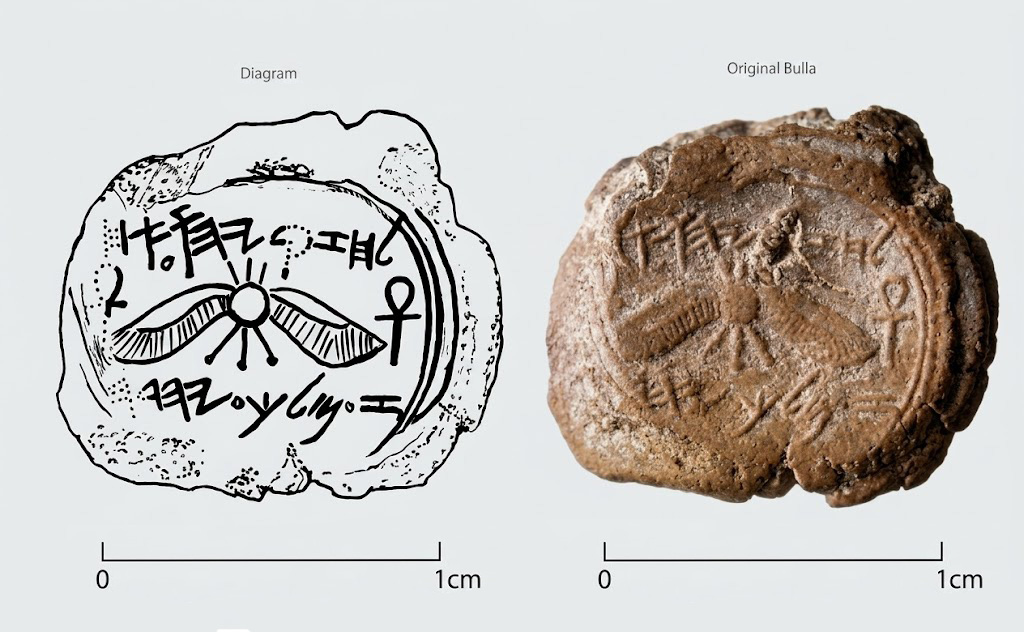
Kydonia was one of the most important Minoan centres in western Crete. The modern city of Chania sits directly on top of it. Most of it will never be excavated.
Gallery Two: The City-States
The second gallery focuses on the transition from prehistory to history and the city-states of Kydonia and Aptera. You continue your journey through history with the establishment of the city-states of western Crete, focusing on the region’s productive activities, alliances and currencies, and its trade with both East and West.
Both halls contain vessels, figurines, weapons and ornaments from the Geometric and Archaic periods, mostly found in ancient graves around Chania, as well as gold jewellery, sculptures and funerary monuments from graves from the historic period and a representation of a home destroyed in an earthquake in 365 BC. The reconstruction of that destroyed house is one of the more affecting things in the museum. An ordinary household, preserved in catastrophe.
Gallery Three: Roman Crete and Religious Life
Sanctuaries and religious customs, the Asklepieion of Lissos, funerary practices and representative examples of sculpture and funerary monuments complete the narrative of the life of the people of West Crete up to the 4th century AD. Special video presentations highlight the important Asklepieion of Lissos, with its unique group of marble statues, and the destruction of the “Miser’s” House.
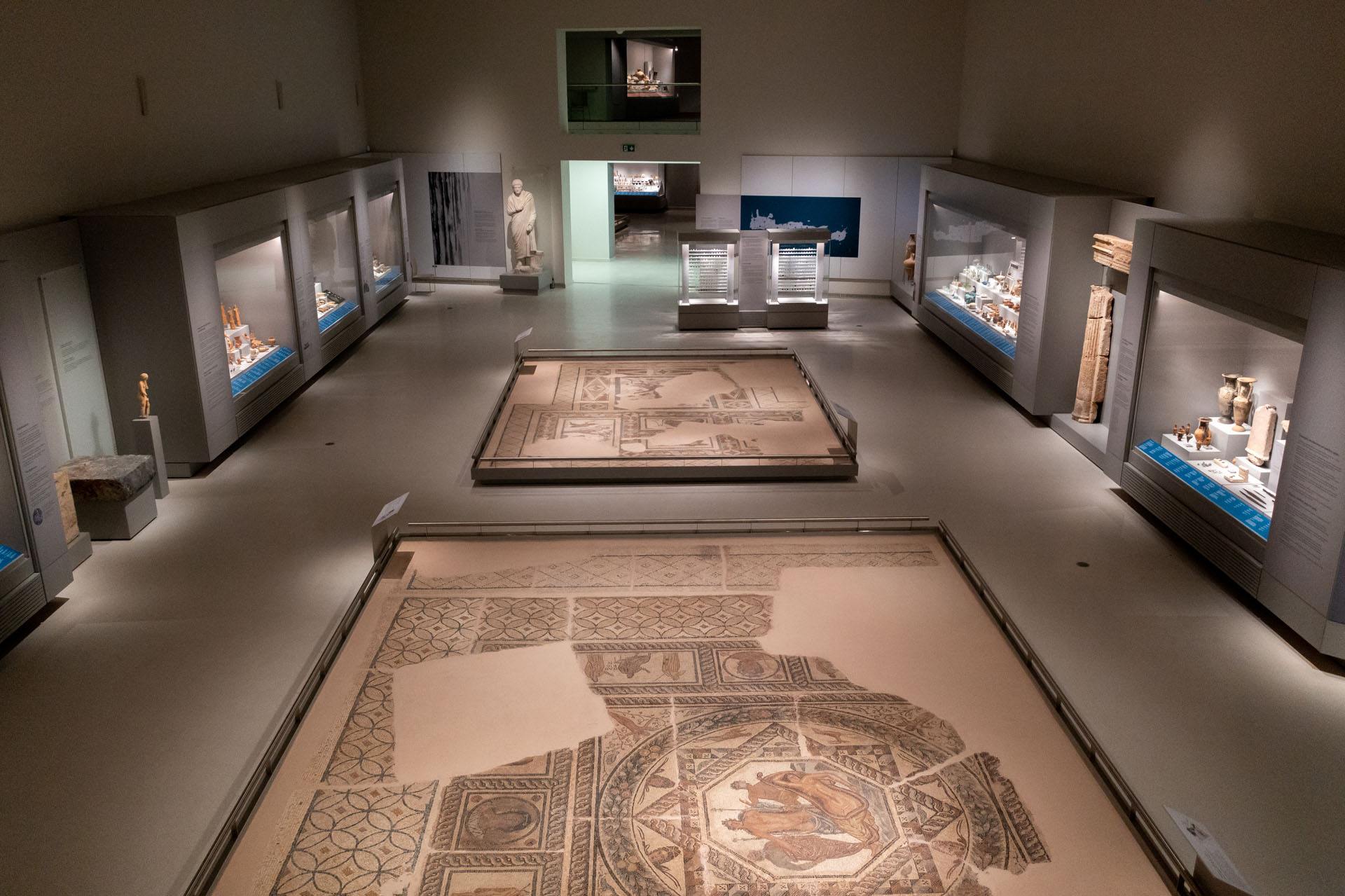
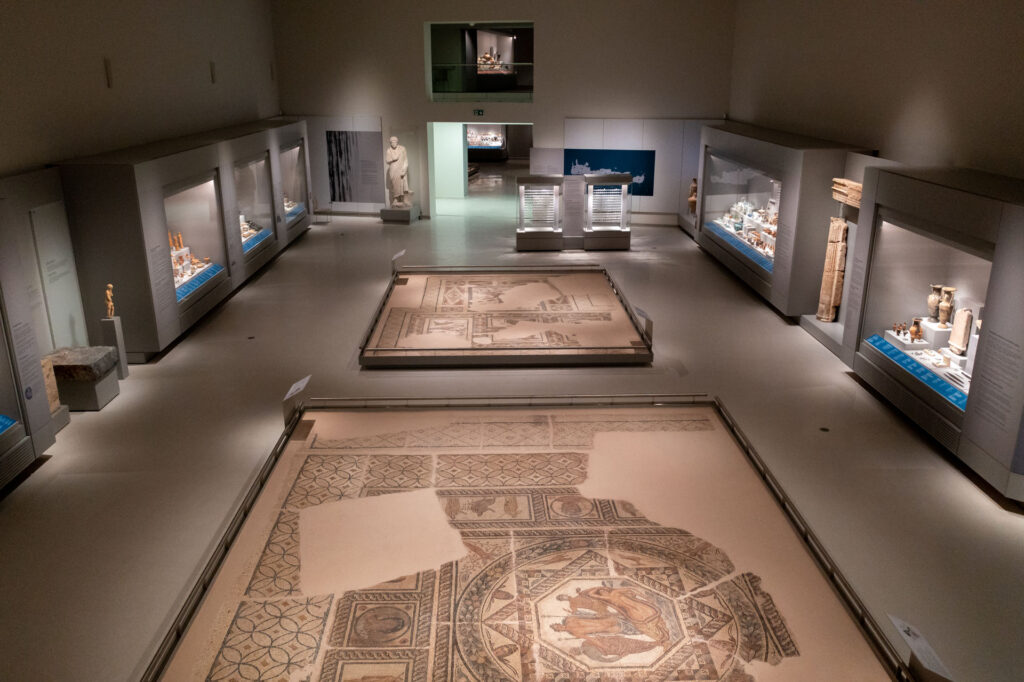
Among the Roman exhibits is a mosaic floor depicting Dionysus and Ariadne, and the statue of a philosopher from the ancient city of Elyros. The mosaic is one of the most reproduced images from the collection. See it in person. Photos do not do it justice.
The museum also has an ancient Cycladic style vessel from Episkopi, Kissamos, and a number of busts including one of Roman emperor Hadrian, found at the Dictynaion sanctuary in 1913, and a late Minoan sarcophagus from the necropolis of Armeni, dated to 1400 to 1200 BC.
The Upper Floor: The Mitsotakis Collection
On the first floor, you will find a remarkable number of objects from the Konstantinos and Marika Mitsotakis Collection, the private collection of Crete’s well-known political family. Among them are Minoan ceramics, stone carvings, jewellery and metalwork, as well as Minoan seal engravings with Minotaur depictions dating to around 1350 BC.
Among the numerous pieces that stand out is a sealstone depicting a Minotaur, a clay boat model containing a honeycomb, a bronze dagger with an elaborate gold hilt, and a gold diadem with a Medusa head. These are not background objects. They are the kind of things you remember.
Local tip: The museum provides audio guide devices on site, and there is also a third-party smartphone audio tour available through GetYourGuide if you prefer to book in advance. If you are serious about the collection, get the audio guide. The labels alone will not give you the full picture.
The Building Itself
The museum, designed by architect Theofanis Bobotis and partners, is composed of two distinct linear monolithic masses rising from the earth, described as a symbolic reference to the vestiges of civilisation beneath the surface. Whether or not you buy the architectural metaphor, the building works well. It sits on a plot of land covering over 11,500 square metres, with a total building area of approximately 6,000 square metres. Its location, averaging 98 metres above sea level, offers a magnificent view over much of the city, especially the seafront.
A standout feature is the rooftop cafe, which provides panoramic views of Chania. While described as upscale and pricey, it is a popular spot for visitors to relax after exploring the exhibits. Go up for the view regardless. It puts the city into a different kind of perspective.
The museum is air-conditioned, providing a comfortable environment even on hot summer days. It also offers free lockers for guests to store their belongings and is wheelchair accessible.
Warning: The museum is closed on Tuesdays. This catches people out regularly. Plan your Chania cultural day around a Wednesday to Monday visit.
Is It Worth It Compared to Heraklion?
A fair question. The Archaeological Museum in Heraklion is the most important Bronze Age collection in the world. If you are going to Heraklion, go there. Nothing in Chania competes with the Heraklion Minoan collection at that scale.
But the Chania museum is not trying to be Heraklion. It tells the story of this specific corner of Crete. The finds from Kydonia, Aptera, Falassarna, Lissos. These are local stories, told with local objects, in a purpose-built space that gives them room. If you are staying in Chania for several days, this museum adds real depth to your time here. You will understand what you are walking past in the Old Town differently once you have been.
Warning: Some people try to do the museum and Samaria Gorge on the same day. Do not. Both deserve your full attention, and you will be exhausted from Samaria in any case. Keep them on separate days.
Frequently Asked Questions
How long does the Archaeological Museum Chania take to visit?
Most visitors spend between 90 minutes and two and a half hours. If you read the panels carefully and use the audio guide, budget closer to two and a half hours. If you move at a general browsing pace, ninety minutes is enough for the main highlights.
Is the Archaeological Museum Chania suitable for children?
Yes, reasonably so. The collection uses ancient objects, reconstructions and digital media to highlight social organisation, religion, war, commerce and daily lives of people in ancient times. The reconstructed house, the warrior graves, and the more unusual objects hold children’s attention well. Under-fives will probably be bored, but school-age children tend to find enough to engage with.
Where exactly is the museum? Is it in the Old Town?
The museum is located in the suburb of Chalepa, the most important historic district of Chania after the Venetian urban core. It is not in the Old Town itself. It is about 2.5 kilometres east along the seafront, a pleasant thirty-minute walk or a short taxi ride. Many visitors walk there along the coastal promenade.
Does the Archaeological Museum Chania have an audio guide?
The museum presents the wealth of findings, from the beginnings of human existence in Chania to the 4th century AD. Representations, visual and digital media, tactile exhibits with Braille captions and an audio tour enrich the exhibition. Audio devices are available on site. A smartphone audio tour is also available separately through third-party tour providers.
Is the museum accessible for visitors with disabilities?
Access is ensured for people with disabilities in all visitable and public areas, including elevators, adapted toilets, dedicated parking spaces in the courtyard, tactile exhibits and captions in Braille for the visually impaired, and audio tour devices. Two non-motorised wheelchairs are also available.
When is the museum free?
Admission is free on 6 March (in memory of Melina Mercouri), 18 April (International Monuments Day), 18 May (International Museums Day), the last weekend of September (European Heritage Days), 28 October (National Holiday), and every first Sunday of each month from 1 November to 31 March.
The Honest Notes
The museum has been open in its current form since 2022. It is still building its reputation among visitors. That is actually an advantage right now. It is not yet crowded. Go in the morning, on a weekday, and you may have entire galleries to yourself.
Warning: Opening hours and entrance fees for Greek state museums can change between seasons and from year to year. Always check the official museum website at amch.gr before you go, rather than relying on third-party sources. The official site also has a ticket booking function for peak season.
The cafe on the roof terrace is real and the views are worth the detour. But expect cafe prices, not taverna prices. Get a coffee, look out over the city and the sea, then go back downstairs for the mosaic.
Getting There
By Foot
You can reach the museum by taking a pleasant thirty-minute walk from the Old Venetian Port of Chania, mainly along the seafront. This is the recommended route if the weather is good. Walk east along the coast road through the Koum Kapi neighbourhood, past the city beach, and continue into Chalepa. You will pass the old mansions of the diplomatic quarter on the way in.
By Bus
Take bus number 11 to the ΟΙΚΙΑ ΒΕΝΙΖΕΛΟΥ stop, or buses 11, 18, or 23 to the ΚΑΤΣΑΜΠΑ stop. Buses depart from the central bus station on Kydonias Street. Check current timetables at the KTEL urban bus website or ask at your hotel. The journey takes under ten minutes.
By Taxi
A taxi from the Old Town takes five minutes and costs very little. There is no Uber or Bolt operating in Chania. Taxis are metered. You can hail one on the street, find a rank near the market, or ask your accommodation to call one.
By Rental Car
If you are driving, there is free on-site parking available, and plenty of on-street parking nearby. For visitors already renting a car to explore the region, this is the easiest option. Parking is not a problem here the way it is in the Old Town.

Practical Information
| Address | 15 Skra Street, Chalepa, Chania 73133 |
|---|---|
| Opening hours (Apr to Oct) | Wednesday to Monday, 08:00 to 20:00 |
| Opening hours (Nov to Mar) | Wednesday to Monday, 08:30 to 15:30 |
| Closed | Tuesdays (all year) |
| Last admission | 20 minutes before closing |
| Entrance fee | Check official website: amch.gr |
| Parking | Free on-site |
| Facilities | Cafe, museum shop, toilets, lockers, wheelchair access, lift |
| Audio guide | Available on-site |
| Phone | +30 28210 23315 |
Combine With
The museum is in Chalepa, which is a worthwhile neighbourhood in its own right. Plan a half-day that takes in more than just the museum.
Eleftherios Venizelos Residence Museum is a ten-minute walk from the archaeological museum. Also in the Chalepa area is the Residence of Eleftherios Venizelos, another museum worth visiting if you are spending a couple of days in Chania. Combining the two places for a morning or afternoon visit is recommended. Venizelos is the most important Greek political figure of the 20th century and a native of Crete. The house is modest and interesting.
Ancient Kydonia (Kastelli Hill) is the open archaeological site in the Old Town, about twenty minutes walk back from the museum. Findings include ruins from the Minoan settlement and objects dating back to the Neolithic period. Murals, ceramics, mosaics and writing tablets in both Linear A and Linear B have been recovered, many of which are on display at the Archaeological Museum. See the objects in the museum first, then walk to the site where they were found.
The Maritime Museum of Crete is back in the Old Town, inside the Firkas fortress at the western end of the harbour. Its collection includes models of ships, nautical instruments, paintings, historical photographs and war relics, classified chronologically from the Bronze Age. A different story from a different angle.
The Byzantine and Post-Byzantine Collection of Chania is a small but worthwhile stop on Theotokopoulou Street in the Old Town. It covers the gap between the Roman period and the Venetian era that the archaeological museum leaves open. Together the two collections give you the whole sweep.
Local tip: The walk back from the museum into the Old Town along the seafront at early evening, with the light going gold over the water and the White Mountains still faintly visible to the south, is one of the better walks in Chania. Do not take the taxi back. Give yourself the thirty minutes. You have earned it.