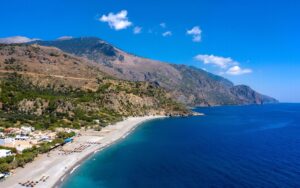
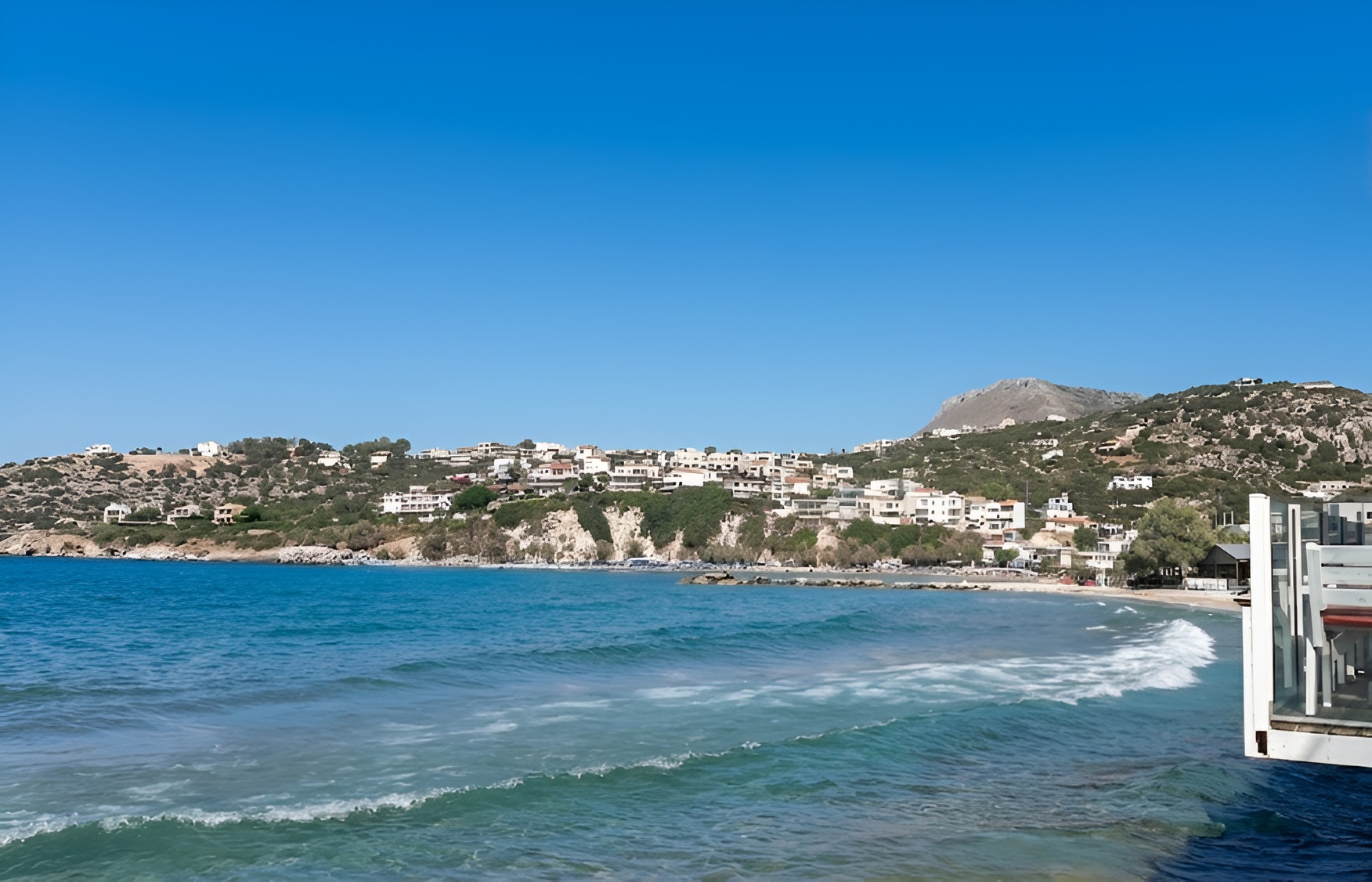
Almyrida Beach in Chania is the kind of place that regular visitors to Crete return to year after year, quietly, without telling too many people. It is the most well-known coastal resort in the Apokoronas peninsula, built inside a small cove at the mouth of Souda Bay, positioned at the very first coastal point on the southeastern side of the bay. The White Mountains sit behind it. The water in front is genuinely calm. And there is a row of waterfront tavernas that actually cook proper Cretan food.
This is not a dramatic beach. It does not have turquoise fjords or cliffs dropping into the sea. What it has is reliable, clean, shallow water, a manageable crowd, good food within walking distance, and enough to keep a family busy for several days. It is much quieter and less crowded than the Agia Marina and Platanias strip west of Chania, which is exactly why it tends to be preferred by families with children and couples looking for a proper rest. That difference matters in July and August.
Historically, Almyrida was known for its salt pans, which is where the name “Almyrida” relating to salt comes from. The village has grown steadily since the 1970s, but it has not sprawled into the kind of resort that feels indistinguishable from anywhere else in the Mediterranean. At least, not entirely. More on that below.
| Distance from Chania | 23km, about 30 to 35 minutes by car |
|---|---|
| Best season | May, June, September, October. Manageable in July and August |
| Parking | Street parking available near the beach, free |
| Entrance fee | None |
| Rental car needed? | Recommended, though bus is possible |
| Family friendly? | Yes, ideal for young children |
| Water sports | Yes, available on the beach |
| Blue Flag | Yes |
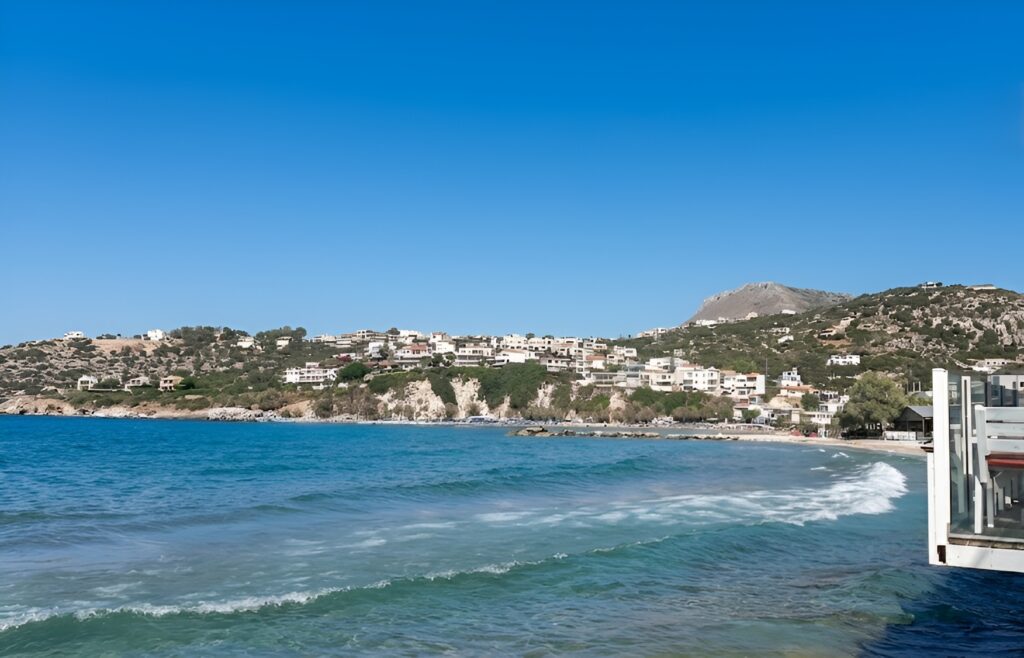
What Almyrida Chania Actually Looks Like
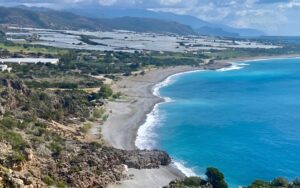
The beach is arranged over two main coves, giving you a choice between sandy and pebbly spots. The two main sandy bays are the ones most visitors come for. Both carry Blue Flag status and provide sunbeds, umbrellas, and a lifeguard. The pebbled beach to the west has no facilities. If you want to lay a towel down and be left alone, that western end is where you go.
Both sandy beaches are shallow and their sandy bottoms slope gradually, which makes them safe for families with children who are not strong swimmers. There are no sudden drop-offs, no rough surf, and very little wave action.
Almyrida sits well inside Souda Bay, which means it is protected from wind and waves unless there is a strong northerly blowing. On days when more exposed beaches on the north coast are choppy and unpleasant, Almyrida is often still calm. That is a practical advantage that visitors only discover once they have been caught out at other beaches.
The most distinctive feature of Almyrida is Karga, a rocky islet roughly 300 metres offshore that you can swim to. The island is said to have historically served as a pirate hideout and may have been part of an ancient naval engagement. Today it is uninhabited and a good target for a morning swim. On the island there are still signs of ancient walls and cavernous shelters built by the Germans during the Second World War. A stop worth making if you swim out.
The sunset at Almyrida is particularly good because the sun falls behind Souda Bay. For many visitors, this is one of the more memorable evenings of their trip. The tavernas face west. You do not need to go anywhere special to watch it.
Local tip: The western pebble beach at the far end of the resort sees far fewer people than the main sandy bays. In late afternoon, when the organised sections are packed and hot, walk ten minutes west and you will often find yourself almost alone.
The Beach, the Water and What to Do Here
At Almyrida you can swim, sunbathe, snorkel, paddleboard, and kayak. Swimming and snorkelling are particularly popular because of the clear, shallow water, which makes it easy to see marine life close to shore. Windsurfing equipment is also available for hire.
From the small fishing harbour at Almyrida, boat trips run to the sea caves in Souda Bay. There are also full-day pirate ship cruises for children and parents, as well as private boat tours on various itineraries. The boat trips from Kalyves harbour, just a few kilometres west, are particularly good and visit Marathi beach among other spots. Worth looking into if you are staying in the area for more than a couple of days.
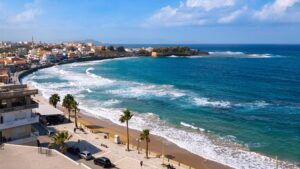
The central sandy beach in front of the village offers sunbeds and parasols, a lifeguard, opportunities for water sports, and plenty of mini markets, stores, cafés, and bars nearby.
Both main beaches at Almyrida hold Blue Flag certification, meaning they meet EU standards for water quality, safety, and environmental management.
The Village: Food, History and What Else Is Here
The resort has around eight or nine tavernas, a couple of snack bars and pizza places, four or five café-bars, a decent mini-market, a pharmacy, a bakery, a taxi office, and a couple of car hire places. That is essentially the entire village. It is small. Do not arrive expecting Chania old town.
The tavernas on the beach are well known for fresh fish and traditional Cretan cooking. A few of the restaurants sit directly on the waterfront between the two bays, with clear views out to Karga and across the bay. The food is generally honest, straightforward Cretan fare. Grilled fish, dakos, lamb. Not fancy. Reliable.
One consistent theme in visitor feedback is the food. People who stay here for two weeks report not having a single poor meal.
The historical layer is easy to miss if nobody tells you about it. At the entrance to the village, you will find the remains of a three-aisled early Christian basilica dating from the 6th century AD, with beautifully restored mosaic floors. Just above the basilica on Finikias Hill, there are ruins of a Greek-Roman city, and the islet of Karga also shows traces of ancient Greek-Roman settlements. Almyrida also played a role in Cretan history as the site of the last battle against the Turks in 1896. None of this is heavily signposted. Walk in and look around.
Almyrida is believed to have been a Phoenician colony, which is why the nearby location is called Finikia. Ancient ruins and tombs can be found there.
Local tip: The basilica mosaics are easy to walk past if you come in from the main road. They sit right at the entrance of the village to the west. The mosaics include peacocks, crosses, fish, and interlocking geometric patterns. Five minutes of your time and genuinely worth stopping for.
Almyrida as a Base for the Apokoronas Region
If you choose to stay in Almyrida, you are well placed to explore Apokoronas, a region that has countless historical monuments, traditional villages, and places that have remained largely unchanged over time.
With a hire car, there are many attractive, old, traditional villages in good scenery around the area. The ancient site of Aptera is close, as are drives into the hills and the White Mountains. Aptera in particular is excellent and takes about 25 minutes to reach. It is one of the better-preserved ancient sites on Crete, with views over Souda Bay and a good small museum.
Almyrida is also a practical hub for guided hikes in the Apokoronas hills, cycling tours through the nearby villages of Vamos and Gavalochori, and boat excursions along the sea caves of the Drapanos peninsula.
Just four kilometres east of Almyrida is Kokkino Chorio, the Red Village, known for the German fortifications built during the 1941 to 1945 occupation to protect the military port of Souda. It is also the filming location of the 1964 film Zorba the Greek. That alone makes it worth a short detour.
Warning: Almyrida is a seasonal resort. In winter it is almost deserted and 95% of shops are closed. A few cafes, one mini-market, a bakery, and the pharmacy stay open. Most permanent residents live in Chania. If you are travelling outside May to October, check ahead before assuming things will be open.
Before You Go
- Water: bring extra if you are planning to walk to the western beach or the basilica. The tavernas along the waterfront sell water, but there is nothing on the western pebble stretch.
- Sun: little shade on the beach itself. Hat, sunscreen, and a beach umbrella or sunbed hire all matter here in July and August.
- Facilities: showers, changing cabins, and toilets are available on the main organised beaches.
- Parking: street parking near the beach is generally free. It gets tight in August.
- Cash: bring some. Not every taverna or small shop reliably processes card payments. There are ATMs in the village.
- Swimming to Karga: the islet is about 300 metres from shore. Only attempt the swim if you are a confident swimmer. There is no boat rescue on that crossing.
The Honest Notes
Tourism has well and truly found Almyrida. It is popular, particularly with British families and younger visitors, and while comparatively quiet, it is not undiscovered.
Warning: The main sandy beach is narrow. In high season, sunbeds are crammed together and there is limited room to move them around to follow the shade. If you want more space, arrive early or use the pebble beach at the western end, which has no facilities but also no crowds.
Almyrida is also a little more expensive than some other places in the immediate area. This is consistent with what visitors report. The waterfront position and the captive audience of resort guests pushes prices up a notch. You are not paying Mykonos prices, but you are paying more than in a comparable village with less tourist infrastructure.
Warning: Almyrida is a lovely place if your aim is to relax, not party. Visitors looking for nightlife will need to take a taxi to Chania or Platanias. If you book expecting a lively resort and get here to find two or three quiet café-bars, you will be disappointed. Know what you are coming for.
On the positive side, the things that matter most work well here. The water quality is consistently good. The food along the waterfront is honest. The village is safe and easy to navigate. And the view, particularly in early evening when the light hits the White Mountains behind you and the sun drops over the bay, is the kind of thing you do not forget.
Getting There
By car: From Chania, take the E75 national road east toward Rethymno. After around 15 kilometres, take the turnoff toward Kalyves and follow the signs through Kalyves and into Almyrida. The drive from Chania takes about 30 to 35 minutes under normal conditions. Parking areas are available near the beach and are generally free. In high season, the parking spots closest to the beach fill up by mid-morning.

By bus: The KTEL service runs from Chania to Almyrida every two hours from 08:30, with a last bus at 21:00 in summer. Return buses from Almyrida to Chania start at 07:15 and run until around 21:45, starting slightly later at weekends. The bus drops you at Chania bus station, which is five to ten minutes’ walk from the old town. Check the current timetable at e-ktel.com before you travel, as schedules change seasonally.
By taxi: Almyrida has its own taxi stand in the village. A taxi from Chania city centre takes about 30 minutes. No Uber or Bolt operates on Crete.
Organised tours: A rental car is so practical for this area that organised day tours from Chania to Almyrida are unusual. Most people drive themselves or use the bus. However, if you are using Almyrida as a base, guided hikes, cycling tours, and boat excursions can be organised locally.
Practical Information
| Location | Apokoronas, Chania Prefecture, Crete |
|---|---|
| Distance from Chania | 23km, 30 to 35 minutes by car |
| Beach type | Sandy (main beaches), pebble (western end) |
| Blue Flag | Yes, both main sandy beaches |
| Facilities | Sunbeds, umbrellas, showers, changing rooms, lifeguard |
| Water sports | Kayak, SUP, windsurfing, snorkelling hire available |
| Parking | Street parking, free, limited in August |
| Entrance fee | None |
| Nearest hospital | Health Centre of Vamos, Apokoronas |
| Emergency | 112 (general), 100 (police), 171 (tourist police) |
| Season | May to October |
Combine With
Almyrida sits in a part of western Crete that rewards a few days of local exploration. These places pair well with a beach day here.
Aptera Archaeological Site: One of the best ancient sites in western Crete, about 20 minutes back toward Chania. Occupied from the Minoan period through Byzantine times, with well-preserved remains and views over Souda Bay. Entrance fee applies. Check the official site for current opening hours.
Kalyves: Just five kilometres west of Almyrida, Kalyves has a longer beach, a working harbour, and a slightly more lived-in feel than Almyrida. Good for an evening meal or a change of beach. Kalyves Cruises runs morning boat trips from the harbour to Marathi beach and other spots along the coast, with snorkelling stops. Consistently rated as a highlight by families visiting the area.
Vamos Village: In the hills above, Vamos offers a traditional retreat with stone houses and tavernas worth a day trip. About 15 minutes inland by car. It is one of the better-preserved villages in Apokoronas and much less visited than the coastal strip.
Kokkino Chorio (Red Village): Four kilometres east of Almyrida. A small village with German fortifications built during the occupation to protect the military port of Souda, and the location used for the filming of Zorba the Greek. Quick visit, easy detour.
Frequently Asked Questions
Is Almyrida beach good for families with young children?
Yes. Both sandy beaches are shallow and the bottom slopes gradually, making them safe for children who are not strong swimmers. There are lifeguards on duty during the day. The water is calm most days because the bay is sheltered. It is one of the better family beaches in western Crete for this reason.
How far is Almyrida from Chania?
Almyrida is about 24 kilometres east of Chania. By car it takes about 30 to 35 minutes. By bus, services run roughly every two hours from around 08:30. The journey on the bus takes around 40 to 45 minutes depending on stops.
Can you swim to the islet of Karga from Almyrida beach?
Karga sits about 300 metres offshore. It is swimmable for a confident adult swimmer in calm conditions. The channel between the beach and the island is not rough, but there is no organised rescue on that crossing. Do not attempt it with children or in poor conditions. On Karga you can see traces of ancient walls and wartime German shelters.
Is Almyrida better for a day trip or a longer stay?
Both are reasonable options. As a day trip from Chania it works well: the drive is short, the beach is good, and there are enough tavernas for a long lunch. But the real case for staying longer is the Apokoronas region itself. With a car, there are traditional villages, archaeological sites, coastal roads, and White Mountain drives to explore. Almyrida is a comfortable base for that.
What is the parking situation at Almyrida beach?
Parking is available near the beach and is generally free. The village is small and street parking on the main road fills up in August. Arriving before 09:30 in high season gives you the best chance of a spot close to the beach.
Is Almyrida beach crowded in summer?
Compared to Elafonisi, Balos, or the beaches west of Chania, Almyrida is quiet. But it does get busy in July and August. The main sandy beach is narrow, and sunbeds fill up quickly. It remains much less crowded than the resort strip of Agia Marina and Platanias and is generally preferred by families and couples looking for a calmer experience. If you want space, use the unorganised western pebble beach or arrive by 09:00.
The Honest Notes Summary
Almyrida is a genuinely good beach. The water quality holds up, the bay is calm, the food is reliable, and the historical layer running through the village adds something that a purely purpose-built resort lacks. It is not dramatic. It is not a secret. It is, however, considerably more pleasant than many beaches that get far more attention in western Crete.
The weak points are the same for any small resort that has become comfortable with a steady stream of repeat visitors. Prices are slightly higher than surrounding villages. The beach gets tight in August. And the resort itself offers nothing beyond the beach, the tavernas, and the handful of shops. If you need entertainment and nightlife, this is not the right place.
If what you need is clean water, calm conditions, a taverna with fresh fish and a decent house wine, and a sunset over the bay while the White Mountains catch the last light. That is exactly what Almyrida delivers.
Local tip: Most visitors to Almyrida end up spending at least one afternoon driving the back roads of Apokoronas without a particular plan. The road that climbs from Almyrida through Plaka and on toward Kefalas winds through olive groves and old stone walls with views back down over Souda Bay. It takes 20 minutes and costs nothing. It is one of the quieter pleasures of this part of Crete, and most package tourists never find it.