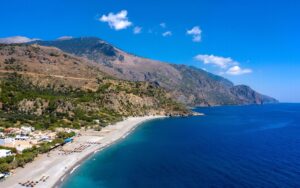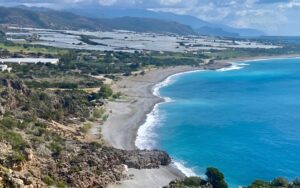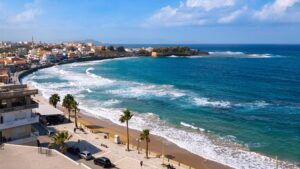
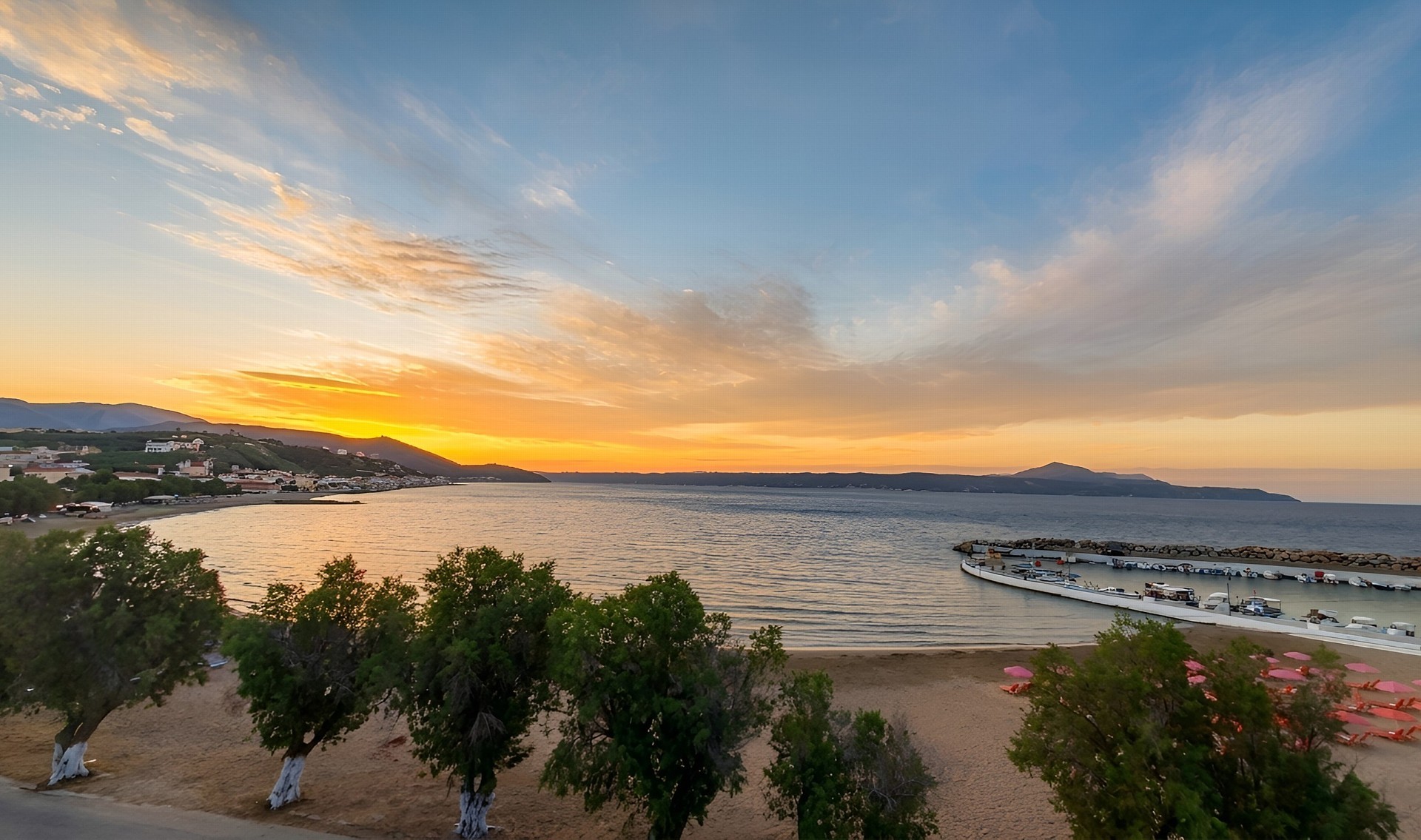
Kalyves Chania is a quiet, family-friendly seaside village in the Apokoronas region of northwest Crete, sitting on the southern shore of Souda Bay, about 21 kilometres east of Chania. Most visitors arrive expecting a beach stop and leave having found something better. A real village. One that actually functions year-round. Unlike places like Almyrida or the resorts west of Chania, Kalyves is a proper working village with a good local population, shops, cafés, and tavernas that function all year around.
The village is divided by the Kyliaris River, also called the Xydas River, with the old town on the west bank and the modern village on the east bank. That river matters more than you might expect. It splits the beach in two, keeps the water unusually fresh and clear, and gives the whole place a character you do not find at the purpose-built resort villages nearby. The Kyliaris is an important natural habitat for birds, trout, and turtles. In the mornings, ducks wander along the banks. It is a slightly odd thing to encounter at a beach resort. Locals do not notice them anymore.
This is not Elafonisi. It is not trying to be. Kalyves is for people who want a relaxed, fully serviced base with a good beach, honest food, and enough to do for a full week without needing to manufacture excitement.
| Distance from Chania | 21km, about 25 to 30 minutes |
|---|---|
| Beach type | Sandy, Blue Flag, gentle entry |
| Time needed | Full day or multi-day stay |
| Best season | May, June, September, October |
| Parking | Free, multiple spots near beach |
| Entrance fee | None |
| Rental car needed? | Recommended for exploring the area |
| Family friendly? | Yes, excellent for families |
The Beach at Kalyves Chania: What You Actually Get
There are two beaches at Kalyves. The one to the west of the village is a little over one kilometre in length. The beach to the east of the village is a little over 300 metres long. Most visitors gravitate toward the eastern stretch first, simply because it is closest to the village centre and the car parks. This is also where it gets busiest.
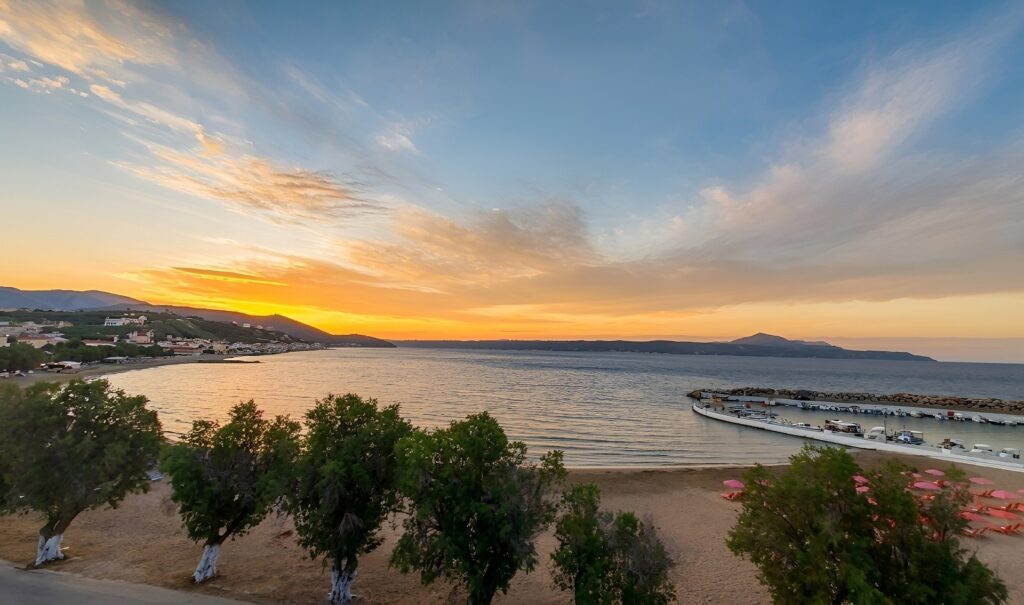
The beach sits in the Bay of Souda, so it is relatively well protected from winds and waves. That matters in summer, when other north-facing beaches on the Cretan coast can be choppy by midday. Here the water stays calm most days. The sand is soft, the water sparkling and clear, with no rocks or seaweed. A lifeguard is on duty, and conditions are mostly calm unless it has been very windy.
Golden sands sweep around the bay, backed by shady trees and beachside tavernas. The beach slopes gently into shallow clear waters, making it ideal for children. If you have young children, this is one of the better beaches in the Chania region for exactly that reason. No sudden drop-offs. No surf to knock them over. Easy to watch them from a sunbed.
Local tip: The western stretch of beach, known as Kiani Akti, is quieter and longer. If the eastern beach feels too busy, walk ten minutes past the river outlet and you will have considerably more space. The eastern beach, being smaller and closer to the village, can get busy. The longer western beach at Kiani Akti is long and wide and never feels crowded.
A note on sunbeds. Plenty of sunbeds and umbrellas are available, free in at least some cases provided you buy food or drinks from the associated taverna or bar. This is standard practice across Crete. Order a coffee or a beer and the sunbed is typically included. There is also plenty of parking, a taverna, a kiosk and an ATM almost on the beach. Practically everything you need is within a short walk.
Warning: Some visitors have noted that the eastern beach can feel overrun with sunbed loungers from the restaurants, leaving almost no room for a personal umbrella. If you want to bring your own setup, head to the quieter western stretch instead.
One thing worth knowing: the sea near the river mouth can be notably cold, due to the fresh river water mixing in. The same holds true for Kiani Akti beach to the west, where the Kyliaris River empties into the sea. You will feel it when you swim over the mixing zone. Some people love it on a hot August day. Others find it jarring. Worth knowing before you go in expecting bath-temperature water.
The Village Itself
Kalyves has layers to it. Most tourists see the seafront and the main road. That is fine. But the old quarter on the west bank of the river is worth exploring.
Kalyves carries the architectural imprints of three empires: Byzantine churches, Venetian fortifications, and Ottoman-era buildings still visible throughout the old quarter. The most prominent historical landmark is the Castello Apicorno, a hilltop fortress originally built in 1206 by the Genoese during their brief control of Crete. The castle was destroyed by the Ottoman pirate Hayreddin Barbarossa and finally razed by Greek revolutionaries in 1821, and only ruins remain, visible from the village on the hillside to the northeast.
An old Venetian mill, one of Crete’s most complex, is located along the Mesopotamos river, built from stone and kourasani, a mixture of mortar and ground tile, renowned for its durability. Most visitors walk right past it. Stop. Have a look.
Locals still gather at the kafeneia in the platia to discuss everything from olive harvests to football. This is not a staged version of Greek village life for tourist consumption. The square genuinely functions as a meeting place. Sit at one of the cafés there in the morning and you will see the difference between Kalyves and a resort village immediately.
Kalyves has been continuously inhabited since the Minoan era and is believed to occupy the site of the ancient city of Amphimatrion. Pottery shards and building foundations have been recovered in and around the modern village.
The fertile valley around the Kyliaris River supports olive cultivation, vineyards, and citrus groves, unusually green for an island as dry as Crete. This shows in the landscape around the village. You are not in a dusty scrub landscape here. The Apokoronas region is genuinely green, and Kalyves sits at the heart of it.
Eating and Drinking in Kalyves
The waterfront road has no shortage of options. Tavernas, cafés, and a few bars run along the seafront and main street.
Kalyves is a genuinely quiet, unhurried village. Think local families, a Blue Flag beach, and tavernas that close before midnight, not a party destination. This is not a complaint. It is useful to know before you book. If you want late-night bars and clubs, Chania old town is 25 minutes away. Kalyves is for those who want dinner by the water and an early night.
Regular visitors to Kalyves recommend Mythos, O Gyalos, and Akrogiali as their favourite restaurants, all serving traditional Greek food. The local rule applies here as it does everywhere in Crete: avoid the places with laminated photo menus and oversized English signage. Walk a bit further. Ask someone in the village where they eat.
The village serves traditional Greek cuisine such as fresh fish, rabbit, and salads. Rabbit cooked in wine with rosemary is one of the better things to eat in this part of Crete. If you see it on a menu, order it.
Local tip: The village square is the right place for morning coffee. Order a Greek coffee, not a Nescafé frappé. Watch the old men argue over their backgammon. Take your time. This is the actual pace of life here, and it costs nothing to join it for an hour.
What to Do Beyond the Beach
Kalyves works well as a base for the Apokoronas region. The beach is the main event, but a car gives you access to a surprising amount within 30 minutes.
Ancient Aptera, 9.9 kilometres from Kalyves, is one of Crete’s most extensive archaeological sites. Hellenistic city walls, a Roman theatre, Byzantine cisterns, and a small Venetian-era monastery sit on a headland overlooking Souda Bay. Plan 1.5 to 2 hours for a full visit. Overshadowed by more famous sites at Knossos or Malia, Aptera is not yet on the tourist route and can be investigated in relative peace. Check current entrance fees before you go.
The Souda Bay War Cemetery lies 8 kilometres west of Kalyves. Maintained by the Commonwealth War Graves Commission, it holds approximately 1,500 servicemen who fell during the 1941 Battle of Crete. It is one of the most moving and historically significant sites in western Crete, open year-round at no charge. If you have any interest in the Second World War or in the Battle of Crete, this is not a site to skip.
Several operators run day trips from Kalyves harbour, including snorkelling excursions along Souda Bay, island-hopping to Gramvousa and Balos lagoon, and sunset cruises along the Apokoronas coastline. Trips typically depart in the morning and return by early evening. Book a day in advance in peak season.
Stand-up paddleboards and kayaks can also be rented on the main beach. The sheltered bay makes paddleboarding manageable even for beginners.
Kera Beach is a secluded stretch of coastline 2.1 kilometres east of Kalyves. The beach offers a relaxed atmosphere with pebble shores and rugged cliffs framing turquoise water. There are no facilities, so bring water, snacks, and an umbrella. It is one of the quietest swimming spots on this stretch of coast. Good for a morning when you want to be left alone.
Frequently Asked Questions
Is Kalyves beach good for families with young children?
Yes. Kalyves is very family-friendly. The shallow waters at the main beach make it safe for children to play, and there are various facilities including restaurants and cafés catering to families. The gentle entry into the water and the calm bay conditions make it one of the most practical family beaches in the Chania area.
How far is Kalyves from Chania city?
Kalyves is 19 kilometres from Chania, about a 20-minute drive via the National Road, making it ideal for both day trips and extended stays. There is also a good bus service into Chania from Kalyves, taking around 30 minutes.
Is Kalyves beach good for snorkelling?
It is decent but not exceptional on the main beach. The snorkelling at Kalyves main beach is okay but not the best. However, the next town along at Almyrida is great for snorkelling, and on the far side of the small harbour the underwater scenery is reportedly excellent.
Does Kalyves have good nightlife?
No, and that is intentional for many visitors. Kalyves is quiet, not lively. It suits families, couples, and travellers seeking authentic Cretan atmosphere rather than a party scene. Bars and tavernas typically close by midnight and there are no clubs in the village. For a livelier evening, Chania old town is the answer.
When is the best time to visit Kalyves?
The best time to visit Kalyves is from late spring, May to June, to early autumn, September to October. During these months the weather is warm and the beaches are less crowded than in peak summer. July and August are busy with Greek families on holiday as well as international visitors.
Do I need a rental car in Kalyves?
Within Kalyves itself, everything in the village is walkable. The beach, tavernas, shops, and bars are all within 10 minutes on foot from the main square. However, a rental car is the most convenient option since public transport within the Apokoronas region is limited and many of the area’s best sites, including Aptera, Almyrida, Lake Kournas, and the Souda Bay War Cemetery, are spread across a wide area.
The Honest Notes
Kalyves is genuinely good. It deserves its reputation as one of the more pleasant base villages in the Chania area. But a few things are worth knowing before you arrive.
Warning: The sea is good quality with nice sand and mostly very clear and calm conditions, though if the wind really gets up, the sea can get quite rough. Souda Bay is more protected than the open north coast, but it is not immune to weather. In July and August, afternoon winds can pick up. Check conditions before heading out on a boat trip.
Warning: Parking spaces in the village itself can be limited, making parking easier for a smaller car. There is free parking near the beach and along the coastal road, but in August it fills up quickly. Arrive before 9am or park further back in the village and walk down.
Warning: Kalyves is a proper town with a good local feel. The beach is safe and sandy, but pretty average by the standards of western Crete’s more dramatic coastline. If you are chasing photogenic, jaw-dropping scenery, Balos and Elafonisi are an hour away. Kalyves is not that. It is a comfortable, lived-in place with a reliable beach. Different purpose.
The river split is worth noting for first-time visitors. Walking along the beach toward Kalyves you meet the river outlet that splits the beach in half. It is either wade through the fairly fast, knee-deep water, which is cold compared to the sea, or take the easy option and wander over the bridge to the other side. This is not a problem. Just use the bridge.
Before You Go
- Cash: some beach tavernas and sunbed operators prefer cash. Bring some. There is an ATM near the beach.
- Sun: the beach has some tamarisk tree shade but sunbeds are mostly exposed. Hat and sunscreen essential.
- Shoes: flat sandy beach, no footwear needed in the water. Bring sandals for the village streets.
- Facilities: showers and toilets are available on the main beach.
- Timing: arrive early in July and August for beach parking and sunbed availability.
- Boat trips: book any harbour excursions the day before in peak season. They fill quickly.
Getting to Kalyves Chania
By car: Kalyves is 19 kilometres from Chania, about a 20-minute drive via the National Road. Take the E75 east from Chania and exit at the Kalyves or Kalami sign. The village is well signposted from the main road. Parking near the beach is free.

By bus: KTEL Chania runs regular buses between Chania and Kalyves throughout the day in summer, about every one to two hours, with fewer services in winter. The journey takes around 25 to 30 minutes. Check the current timetable at the KTEL Chania station in town or on their website, as schedules change seasonally.
By taxi: Taxis from Chania city to Kalyves are available. There is no Uber or Bolt in Crete. Ask your accommodation to book one, or call a local taxi company directly. Agree on the fare before you get in.
Practical Information
| Location | Apokoronas region, 21km east of Chania |
|---|---|
| Beach type | Sandy, Blue Flag, two stretches |
| Parking | Free, near beach and coastal road |
| Facilities | Sunbeds, umbrellas, showers, toilets, lifeguard in summer |
| Bus from Chania | KTEL Chania, approx. every 1-2 hours in summer |
| ATM | Available near the beach |
| Nightlife | Quiet. Tavernas close around midnight |
| Best for | Families, couples, beach base holidays |
| Avoid | High season if you dislike busy tavernas and full car parks |
Combine Kalyves With
Almyrida Beach. Almyrida lies 4.8 kilometres west of Kalyves in the neighbouring resort. The beach has shallow, calm water suitable for families, and offers windsurfing, paddleboarding, and other water sports. Good for a change of scene and better snorkelling than Kalyves main beach.
Ancient Aptera. Nine kilometres from Kalyves, Aptera is one of Crete’s most extensive archaeological sites with Hellenistic city walls, a Roman theatre, Byzantine cisterns, and a small Venetian-era monastery sitting on a headland overlooking Souda Bay. Half a morning. Combine it with lunch back in Kalyves.
Souda Bay War Cemetery. Eight kilometres toward Chania. Maintained by the Commonwealth War Graves Commission, it holds approximately 1,500 servicemen who fell during the 1941 Battle of Crete, and is one of the most moving and historically significant sites in western Crete, open year-round at no charge. Thirty minutes is enough but most people stay longer.
Lake Kournas. About 25 kilometres east. A freshwater lake with pedaloes to hire and turtles to spot. There are good lakeside tavernas for lunch. Works as an afternoon excursion, particularly good with children.
Local tip: The drive back to Chania from Kalyves in the late afternoon, with the light falling across Souda Bay and the White Mountains turning pale gold, takes about 25 minutes and is one of those unremarkable drives that somehow stays with you. Pull over near the water on the way out of the village and take a proper look north across the bay before you leave. You will not regret the two minutes it takes.