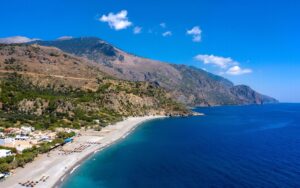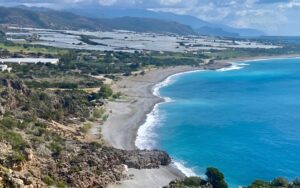
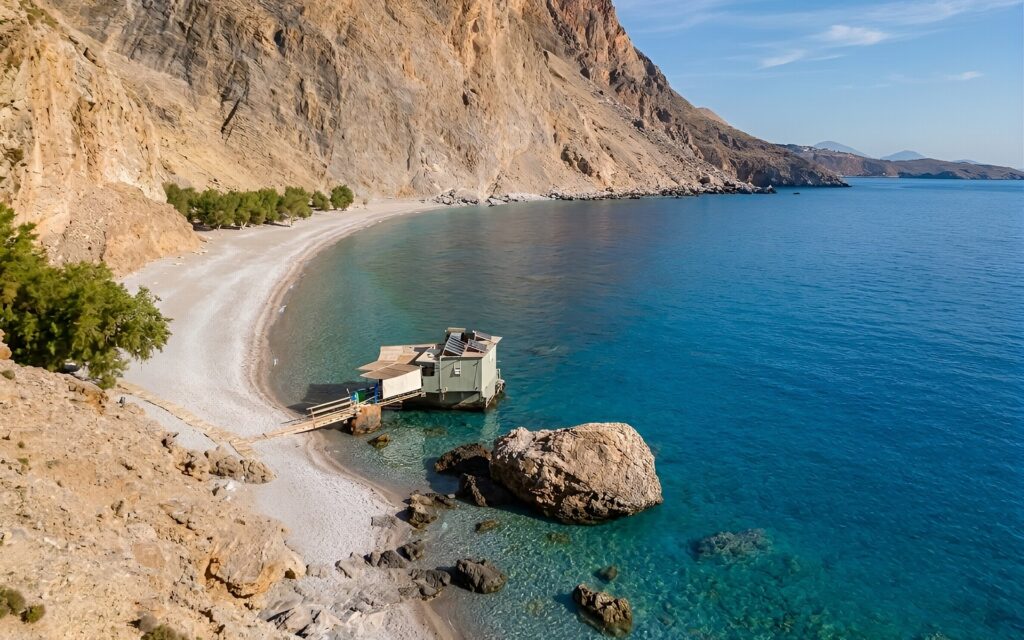
Sweetwater Beach Chania, known in Greek as Glyka Nera, is one of those places that earns the hype. There is no road to it. No car park beside it. No beach bar with speakers. It sits at the foot of a 600-metre cliff, and the fact that it cannot be accessed by road is precisely what keeps it out of reach of mass tourism. You earn it, either by boat or on foot. And that is the point.
The name Glyka Nera comes from the freshwater springs that flow beneath the beach, providing drinkable water even in summer. Push aside a few pebbles near the waterline and a hole fills with cold, clean water within seconds. People have been doing this for generations. It is one of those small, strange details that stays with you after everything else has blurred.
The beach was recognised internationally in 2003 when it was ranked among Europe’s top 20 beaches by The Times of London. That was over twenty years ago. It has not become worse since then.
Quick Summary
| Distance from Chania | 75km, about 2 hours by car to Chora Sfakion |
|---|---|
| Beach type | Pebble and smooth white stones |
| Best season | May, June, September, October |
| Parking | At Chora Sfakion (paid), then boat or hike |
| Entrance fee | Free |
| Rental car needed? | Yes, to reach Chora Sfakion |
| Family friendly? | Yes, with older children, note nudist section |
| Hike option | 30 to 45 min from Chora Sfakion trailhead / 1 hour from Loutro |
What is Sweetwater Beach Chania Actually Like?
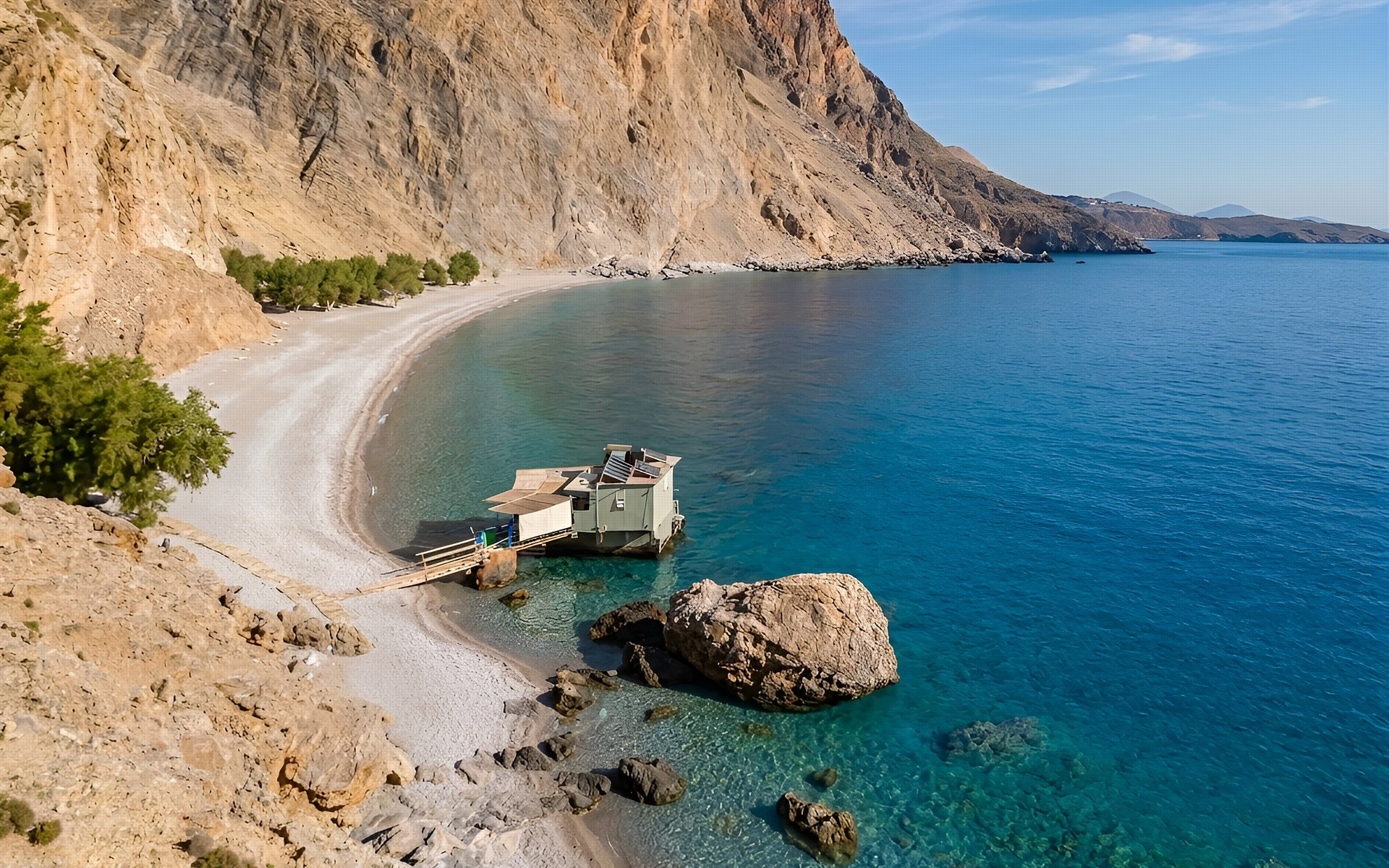
Glyka Nera is famous for its deep blue waters, white pebbles, and dramatic cliffs, some reaching heights of 500 metres. The beach is longer than most photos suggest. It extends 1.2 kilometres from the small harbour at the western end, and at its widest points measures up to 70 metres across.
The pebbles are small and smooth. They continue onto the seabed and are pleasant to walk on. At first the water is shallow, then it drops sharply into the depths and gets noticeably colder. That cold is part of it. The freshwater springs feeding the seabed keep the temperature lower than elsewhere on Crete. Because sweet water comes up out of the earth, it is the ideal destination on the hottest days of summer.
The deep blue sea is ideal for snorkelling, allowing visitors to explore underwater marine life around the rocky areas. Visibility is exceptional. The south coast of Crete, facing the Libyan Sea, simply has clearer water than the north. Come prepared with a mask.
The Mermaid Taverna
The unique Mermaid Taverna is located on a small islet at Glyka Nera Beach, offering food and drinks. It is the only structure on the beach. You can get fried sardines, a Greek salad, cold beers and local wine. Some visitors rave about it; others find the service variable. Note that you will be waiting in the glaring sun for the water taxi to arrive and the taverna staff will not always let you wait in the shade. Some visitors have found the staff unwelcoming. Come prepared. Bring your own drinks and food as backup. The taverna is a convenience, not a guarantee.
Amenities like the Mermaid Taverna and sunbed rentals are seasonal, typically operating from spring to autumn. If you are visiting outside peak season, assume nothing is open and pack accordingly.
Natural Shade and Sunbeds
The beach has only a canteen serving refreshments and umbrellas for hire. There are around 15 large tamarisk trees offering their shade. A large part of the beach close to the cliff face is fenced off, apparently due to the risk of falling rocks. This reduces the free space more than visitors expect. If you want shade without paying for a sunbed, arrive early and claim a spot under the tamarisks.
There is also a free shower on the beach, supplied by the freshwater springs under the sand. Small detail, but welcome after a swim.
The Nudist Section
Be aware before you arrive. There are three distinct areas on the beach. The area closest to the taverna is family-friendly where clothes are required. Next is a nudist and semi-nudist area, mostly couples. The far end, away from the taverna, is where long-stay nudists camp, some staying for weeks or months. It is all very laid-back. If you are with family and do not want topless or nude bathing, there is an area set aside for that.
If nudity makes you uncomfortable, stick to the western end near the taverna. If you hike in from the Chora Sfakion side, you arrive at the eastern, nudist end of the beach first. Keep walking toward the taverna.
Local tip: The freshwater springs are not just a novelty. Dig a small hole in the pebbles near the waterline, wait thirty seconds, and you have cold drinking water. Visitors have dug several of these over the years and you will see them marked with small stone borders. The water is tested and drinkable, but if you are cautious, use it to rinse your hands and face and bring your own drinking water from Chora Sfakion.
How to Get to Sweetwater Beach
By Boat (Recommended)
The easiest and most popular route is by boat from Hora Sfakion. Regular water taxis and small ferries operate during the summer months, with the journey taking about 10 to 15 minutes. You board at the port in Chora Sfakion. Several operators run the route. There are smaller ferry routes between Hora Sfakion, Sweetwater Beach and Loutro operating from April to late October. Check schedules at the port on the day. They change with the season and weather.
One important detail that most guides miss: at Glyka Nera Beach, you do not get off the boat at a pier. You disembark 1 to 2 metres from the beach in the water. This may not be suitable for people with mobility difficulties or the elderly. You will get your feet wet. Expect it.
By Foot
The trail is part of the European E4 footpath. To access it from the Chora Sfakion side, drive 4 kilometres toward Anopoli until the sign marking the beginning of the path. The hike is 1 kilometre with a descent of 95 metres, and typically takes 30 to 45 minutes.
The second trail from Loutro takes around an hour and follows a path along the cliff’s edge, offering thrilling views. Although the hike is short, it is quite challenging. Coastal hiking here is nothing like smooth coastal paths. It is rocky, uneven and sometimes exposed.
This coastal hike is not recommended for hikers who experience vertigo. Also: avoid hiking in July and August. The best season is spring (March to May) or autumn (October to November). Due to the heat and lack of shade along the route, avoid hiking this trail in summer.
By Car from Chania
Take the road from Chania that ascends to the Agia Irini pass, located 44 kilometres from Chania, then descends to sea level. The full 75-kilometre drive takes about 2 hours. The road through the Imbros Gorge area is scenic but winding. Leave time. Park in Chora Sfakion and take the boat from there.
Warning: The road from Chania to Chora Sfakion takes longer than Google Maps suggests, especially in summer with tourist traffic through the mountain villages. Allow at least 2 to 2.5 hours from Chania. If you want to catch the first morning boat from Chora Sfakion, leave Chania no later than 8am.
By Bus
Public bus service is available from Chania to Chora Sfakion once or twice daily, depending on the season. Check the KTEL Chania bus timetable before your trip. The bus will drop you in Chora Sfakion, from where you take the boat or hike. It is doable for independent travellers but requires careful planning around the return boat schedule. For most people, a rental car gives more flexibility.
The Freshwater Springs: What Actually Happens
This is worth explaining because it is genuinely unusual. There is a source of fresh water under the surface of the beach. There is no specific spring, but if you roll away a few pebbles, the hole fills up with fresh water in no time. The White Mountains behind this coastline hold enormous amounts of rainwater, which filters through the limestone and emerges at sea level here. The deep blue sea water is noticeably cold here because of the mountain water springs.
The water at Glyka Nera is measurably colder than at other beaches on the south coast, even in August. Bring a wetsuit or rash vest if you are cold-sensitive.
What to Watch Out For: The Cliff Risk
This is the honest note that most travel sites skip over. A woman lost her life from falling rocks from the cliff above Sweetwater Beach. Despite the dramatic backdrop of the cliffs, occasional falling rocks and landslides do occur. You are advised not to sit close to the cliff face. Goats also loosen rocks, so do not walk under a cliff if you can see or hear goats above you.
This is not a reason to skip the beach. Millions of people visit without incident. It is a reason to pay attention to where you set up your towel. The fencing you see on parts of the beach is there for this reason. Respect it.
Warning: Do not place your towel or sunbed directly against the cliff face, regardless of whether there is shade there. The cliffs above the beach are high and the rock is unstable in places. Stay on the open beach, away from the rock wall. This applies especially after rain.
Before You Go
- Water: bring at least 1.5 litres per person. The taverna may not always be open, and the spring water, while drinkable, is not guaranteed.
- Shoes: water shoes or sandals for the pebble beach entry. The stones get very hot by midday. Trail shoes for the hike.
- Sun: very little shade except under the tamarisks. Hat and sunscreen essential.
- Towel: bring a large one. No sunbeds left by mid-morning without paying.
- Return boat: check the boat schedule at the Chora Sfakion port before you leave. Do not assume a boat will come when you want one.
- Cash: the taverna may not accept cards. Bring euros.
- Signal: mobile signal is very weak at the beach.
Warning: If you plan to hike one way and return by boat, confirm the last boat of the day before you start walking. Missing the last boat means a 45-minute uphill hike in the afternoon heat, or sleeping on the beach. Neither is a disaster, but know your options before you commit.
Practical Information
| Location | Between Chora Sfakion and Loutro, south Chania |
|---|---|
| Distance from Chania | 75km, approx. 2 hours by car |
| Beach surface | Smooth white pebbles |
| Facilities | Mermaid Taverna (seasonal), sunbeds and umbrellas for hire, natural freshwater shower, basic toilets |
| Parking | In Chora Sfakion (paid). No parking at beach. |
| Entrance fee | Free |
| Boat access | Chora Sfakion or Loutro, seasonal service April to October |
| Nudist section | Yes, eastern half. Western half near taverna is clothed. |
| Camping | Tolerated under tamarisk trees, but check current conditions |
| Best months | May, June, September, October |
| Snorkelling | Excellent, especially to the left of the taverna |
Frequently Asked Questions
Is Sweetwater Beach worth it?
Yes. It is a genuinely exceptional beach, and the effort to get there is part of why it has not been overwhelmed. The water colour and clarity, the cliff setting, the cold springs in the pebbles: there is nothing quite like it on the north coast of Crete.
Is Sweetwater Beach a nudist beach?
Partly. If you are with family and do not want topless or nude bathing, there is an area set aside near the taverna. The nudist section occupies roughly the eastern half. The family-friendly section is to the west. Nudity is common but not obligatory anywhere.
How long does it take to reach Sweetwater Beach by boat?
The boat from Hora Sfakion takes about 10 to 15 minutes. From Loutro it is slightly shorter. The short crossing is comfortable and gives you a view of the cliffs from the sea.
Can children visit Sweetwater Beach?
Once at the beach, the clear and calm waters are generally safe for swimming, but the water can be quite deep in places, so close supervision is necessary. The pebble entry is harder for small children than a sandy beach. The boat disembarkation involves stepping into shallow water. Suitable for children who are comfortable in the sea and walking on uneven ground. Not ideal for toddlers.
How difficult is the hike to Sweetwater Beach from Chora Sfakion?
Moderate. The descent is around 1km with a drop of 95 metres, taking 30 to 45 minutes. Parts of the path are steep and exposed. The coastal hike is not recommended for hikers who experience vertigo. Good shoes are essential. Not suitable for sandals.
Is Sweetwater Beach better than Elafonisi or Balos?
It is a different experience. Elafonisi and Balos are famous for pink sand and turquoise lagoon water. Sweetwater is wilder, cooler, less accessible. If you want a beach where you feel genuinely away from tourist infrastructure, Sweetwater wins. If you want a family-friendly day in stunning shallow water, Elafonisi is harder to beat. Many people visiting the Sfakia area find Sweetwater the better beach, purely because of the water clarity and the setting.
The Honest Notes
Sweetwater Beach is real and it is very good. But a few things are worth knowing before you build your day around it.
The taverna is inconsistent. Some visitors report waiting in the glaring sun for the water taxi to arrive and being told by taverna staff they cannot wait in the shade. Reviews of the service are mixed. Bring your own food and drinks in a cool bag. You will then have no expectations and anything the taverna offers is a bonus.
A large part of the beach is now fenced off, apparently due to the risk of falling rocks. The sunbed operator has effectively taken control of much of the remaining shaded space, with a set of sunbeds and umbrella costing around 10 euros. The free space is more limited than older photos suggest.
Some visitors feel the beach is like a highway, with hikers constantly walking through, as the E4 coastal trail passes directly along the beach. This is unavoidable. In peak months it can feel busy despite the remoteness. May, June, and September are significantly quieter.
Warning: Do not assume the last boat of the day will wait for you. Visitors consistently report being stranded or nearly stranded. Check the return schedule when you arrive and set an alarm. The hike back up to the road in full sun after a long day at the beach is unpleasant. The boat is worth timing correctly.
Local tip: If you are staying in the Sfakia area for more than one day, consider combining Sweetwater with a morning walk through the Imbros Gorge the following day. The gorge starts near the village of Imbros, above Chora Sfakion, and is shorter and less crowded than Samaria. It is one of the better kept secrets on this stretch of coast.
Combine With
Chora Sfakion: The small port town where most people base themselves for the area. A working place, not a resort. A few good tavernas on the waterfront. Worth at least a coffee before or after the boat.
Loutro: A gem of a village along this coast. Accessible only by boat or on foot, it has no road connection. Small, quiet, a handful of hotels and restaurants. You can walk from Sweetwater to Loutro in around an hour on the E4 trail, or take the boat.
Imbros Gorge: 20 minutes north of Chora Sfakion by car. A short, manageable gorge walk (around 7km one way) with less tourist pressure than Samaria. Good to pair with a beach day, doing the gorge in the morning and the boat to Sweetwater in the afternoon.
Frangokastello: A 14th-century Venetian castle on the coast, around 15km east of Chora Sfakion. There is also a long sandy beach here, which is the nearest proper sand to Sweetwater. Worth a stop on the drive back.
Local tip: The best time to arrive at Sweetwater is mid-morning on a weekday in late May or early June. The tamarisks are still green, the taverna is open, the water is cold from the winter springs, and the E4 hikers have not yet started filtering through. By July the beach changes character entirely. Come before the season peaks, or come in September when it falls quiet again and the sea is warm from three months of sun.