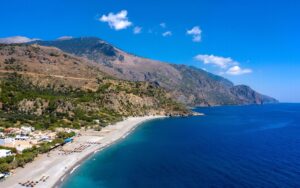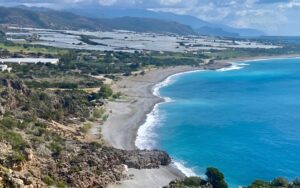
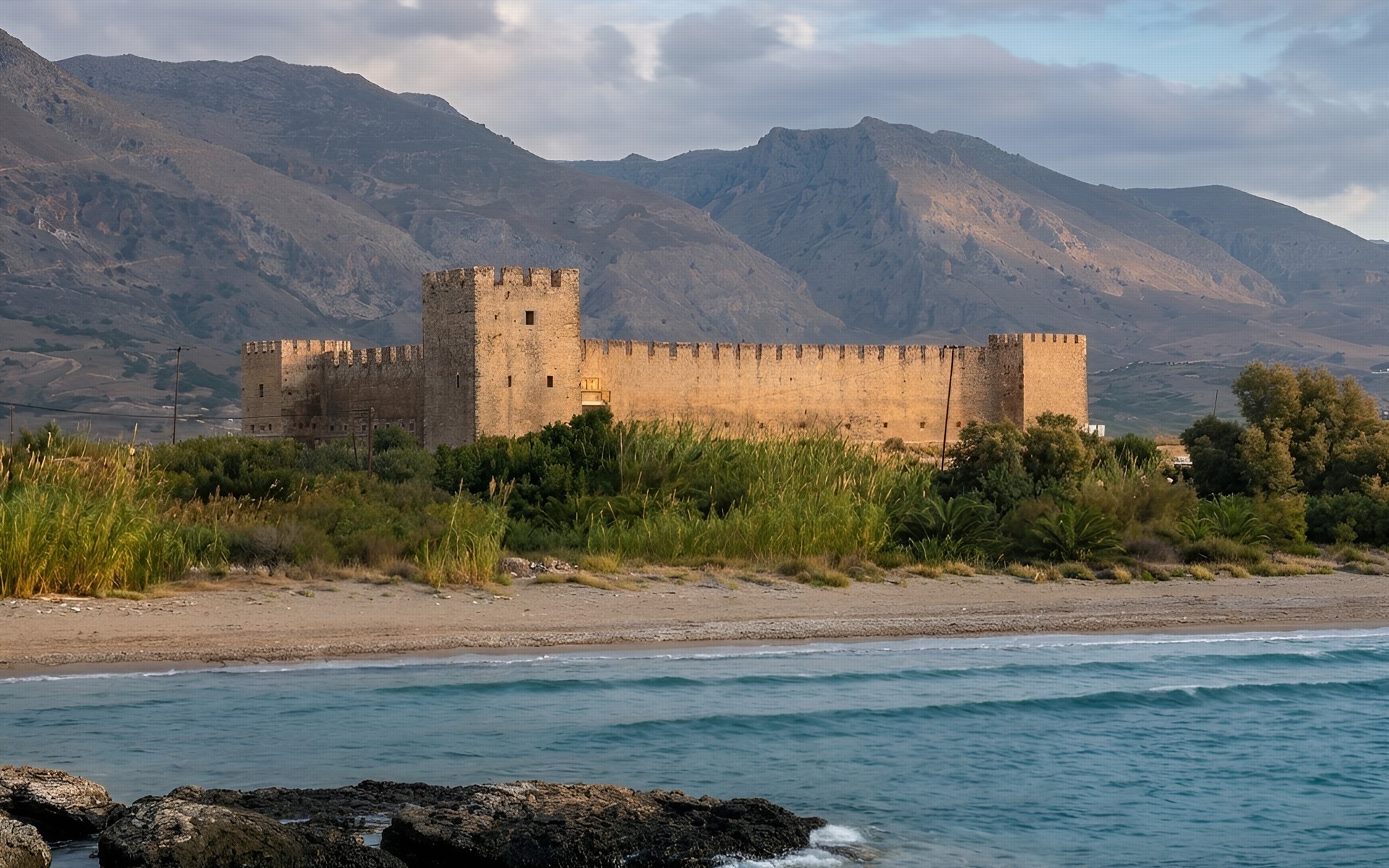
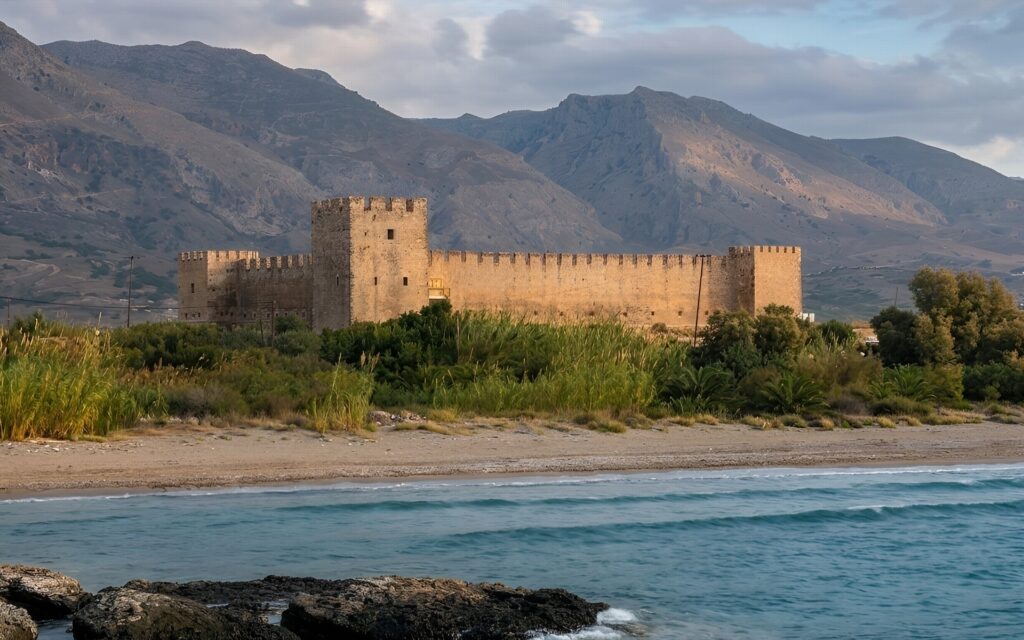
Frangokastello Chania is one of those places on Crete that you do not stumble across by accident. It is a deliberate destination. A Venetian fortress sitting directly on a flat coastal plain, the White Mountains rising hard behind it, the Libyan Sea stretching south. There is almost nothing else here. A handful of tavernas, a few dozen rental rooms, a long sandy beach, and one of the most blood-soaked histories of any place on this island. That combination is exactly why people make the drive.
The fortress sits on the southern coast of Crete, roughly 80 kilometres south of Chania city and 12 kilometres east of Sfakia. The road to get here is half the experience. You leave the north coast highway at Vrysses, climb through the Askifou plateau, and descend through Imbros Gorge to the coast. The landscape changes completely. The tourist infrastructure of the north coast disappears. By the time you reach Frangokastello, you feel like you have arrived somewhere genuinely different.
Frangokastello has an extensive, sheltered and gently shelving sandy beach, which has provided the basis for a low-key tourist industry in recent years. Tourist accommodation is scattered over the flat plain around the castle, but the area’s relative remoteness has discouraged major development. That remoteness is the point. If you are coming from Chania for a day, plan properly. If you are staying overnight, even better.
| Distance from Chania | 80km south, approximately 90 minutes by car |
|---|---|
| Time needed | Half day minimum, full day recommended |
| Best season | May, June, September, October |
| Parking | Free informal parking near beach and castle |
| Castle entrance | Currently closed for renovation. Check before visiting |
| Beach entrance | Free public beach |
| Rental car needed? | Yes, strongly recommended |
| Family friendly? | Yes, excellent for families with children |
The History of Frangokastello Chania
Built between 1371 and 1374 AD by the Venetians, who had conquered Crete at that time, this castle was set up to protect the area and the noblemen’s properties from pirate and enemy attacks. It was also used to suppress the frequent revolts of the people of Sfakia, who were still resisting the Venetian conquerors.
The name itself tells you everything about how the locals felt about it. At first, it was named the Castle of Saint Nikitas in honour of a nearby church. However, the locals would call it Frangokastello, which means Castle of the Franks, and the name was gradually adopted by the Venetians too. The word “Franks” was not a compliment. It was what Cretans called Catholic foreigners from the west. A piece of contempt that survived centuries and became the official name.
The local Sfakians, led by the six Patsos brothers, would destroy at night what was built during the day, making the construction impossible. The Venetians brought more soldiers and the Patsos brothers were arrested and hanged at the entrance of the fortress. A plaque in front of the castle commemorates them today. Worth reading if you visit.
The gigantic main gate stands on the southern side, and the Lion of Saint Mark, as well as the coats of arms of four illustrious Venetian families, can still be seen carved above the entrance. However, all the buildings and fortifications that we can see today inside the castle walls were renovated by the Turks during the 19th century.
In 1770, the Cretan rebel Ioannis Vlachos, otherwise known as Daskalogiannis, was captured at Frangokastello by Turkish forces. He was later tortured and executed at Heraklion. Then came the battle that defines this place.
Local tip: The small plaque honouring the Patsos brothers is easy to miss. It stands to the left of the main gate before you enter the castle grounds. Take a moment with it. Six men from a nearby village who chose to resist an empire. The Venetians won, obviously. But the name stuck.
The Battle of 1828 and the Massacre
On 17 May 1828, a celebrated battle was fought at Frangokastello. Hundreds of Sfakiots and Epirotes led by Hatzimichalis Dalianis, a Greek patriot from Epirus attempting to spread the Greek War of Independence from the mainland to Crete, occupied the castle, but were besieged by the Turks and massacred. However, many of the Turks were then themselves killed by rebel ambushes launched from the local gorges.
During this battle, 600 Greeks fought against an army of Turks which counted over 8,000 soldiers. The battle lasted for a week. In the end, the Turks lost 800 soldiers, and 335 Greek warriors lay dead along with their leader. Their bodies stayed unburied until the high wind from the neighbouring beach of Orthi Ammos brought sand and covered them.
That detail about the sand matters. It is the seed of the legend.
The Drosoulites: Ghosts at Dawn
This is where Frangokastello becomes something you do not find elsewhere in Greece.
The term Drosoulites refers to a long procession of visions seen by residents around Frangokastello castle in the Sfakia region of Crete. The phenomenon is rumoured to be visible every year, on the anniversary of the Battle of Frangokastello or even in early June near a small village in southern Crete. The visions, as described by witnesses, consist of a group of human-like shadows dressed in black, walking or riding, armed with weapons, moving from the monastery of Agios Charalambos and advancing towards the old fort.
On damp and windless mornings at the end of May and the beginning of June, shadows in human shape appear walking in single file for about 10 minutes after sunrise. They move slowly towards the castle and disappear into the sea.
The local people named them Drosoulites, “dew shadows,” due to the time of day that the phenomenon takes place. The phenomenon is observed when the sea is calm and the atmosphere is moist and before the sun rises too high in the sky. It usually lasts about 10 minutes. The shadows are visible from the valley at a distance of 1,000 metres. Many have tried to explain the phenomenon scientifically, and at one time it was explained as a mirage from the coast of North Africa, but still there is no accepted consensus.
More precisely, a Turkish Ottoman garrison stationed in Frangokastello experienced the phenomenon and rang the alarm in 1890. A similar experience was also recorded in 1942 when German soldiers apparently witnessed the Drosoulites and began firing at them, thinking they were being attacked.
Whether you believe in the supernatural or not is beside the point. The phenomenon has been reported consistently across centuries and by different groups who had no reason to coordinate their accounts. Science leans toward atmospheric mirage. Locals lean toward something else. You can make your own mind up.
Local tip: If you want any chance of seeing the Drosoulites, you need to be at Frangokastello in the last days of May or first days of June, at dawn, when the air is humid and the sea is calm. It is not a guarantee and it is not a performance. The phenomenon appears when conditions allow it and not on a schedule for tourists. Come early, stay quiet, and face east toward the church of Agios Charalambos.
The Castle Today: Open or Closed?
This is the information most travel sites do not give you clearly, so let us be direct.
As of March 2025, Frangokastello Castle is temporarily closed to visitors for restoration work. Ongoing renovations often limit interior access, which can be a point of disappointment for those hoping to explore more of the castle.
Local archaeological authorities have implemented a phased restoration approach that maintains the castle’s authentic character while addressing areas of deterioration. Specialised masons use traditional techniques and materials compatible with the original Venetian construction methods. This includes limestone restoration and mortar repointing using historically accurate mixtures.
The renovation status changes. Some visitors in recent seasons found the castle fully closed with scaffolding visible. Others found it partially open with access to the courtyard only. Even when accessible, entry is limited to the large central courtyard. Two of the towers have wooden staircases, but they are blocked off. There is not really much to see inside.
Warning: Do not come to Frangokastello specifically to go inside the castle. It has been intermittently closed for years due to ongoing renovation work, and the situation has not been resolved as of 2026. Check the latest reviews on TripAdvisor or Google before your visit to get the current access status. The good news is that the exterior is impressive from every angle and you do not need to enter to understand the place.
While the castle itself may occasionally be closed to visitors, its prominent location above the beach makes it an impressive sight even from a distance. This is true. The castle standing against the mountains with the sea in front is a genuinely powerful image. It photographs extremely well, particularly in the late afternoon when the light hits the stone walls from the west.
The Beach at Frangokastello
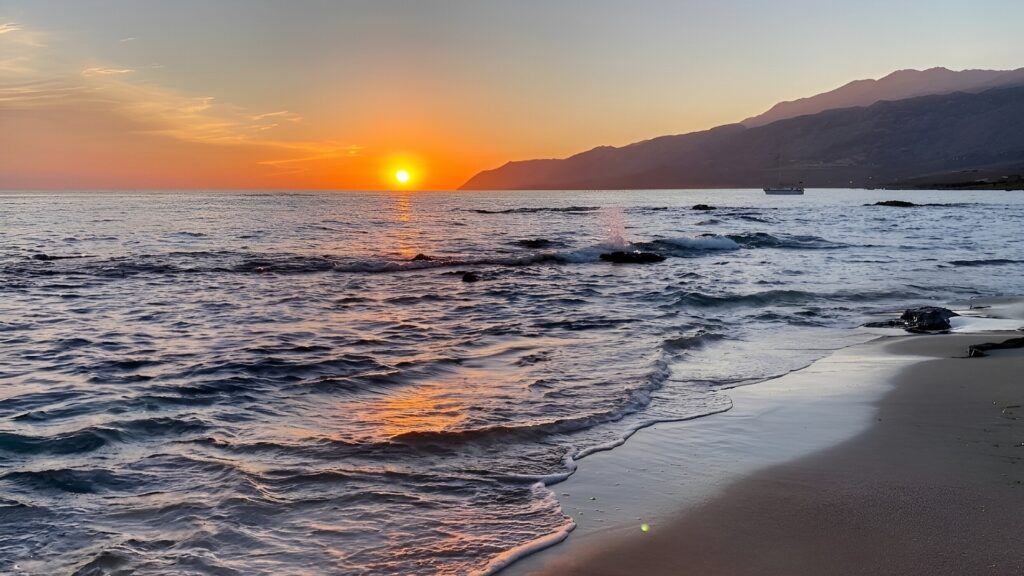
The beach is the other reason people come, and it is excellent.
The beach features soft golden sand and shallow, calm waters, making it ideal for children to play, build sandcastles, and wade in the sea under parental supervision. The gentle slope of the shoreline allows for a gradual depth increase, ensuring a secure area for young swimmers.
There are actually three distinct beach sections here. The western beach is around 600 metres long, made of coarser sand and more open to the west winds. A number of tamarisk trees provide natural shade. The best-known beach is located below the Venetian fortress and around 250 metres in length. The third beach to the east, called Orthi Ammos, is around 700 metres long.
The beach below the Venetian fortress can get a little busy. Orthi Ammos is generally very quiet.
Further to the west lies a pebbly beach with a rocky seafloor, often visited by snorkellers, while to the east the sand dunes of Orthi Ammos offer a truly unique beachside experience.
If the main beach below the castle is crowded, walk ten minutes east to Orthi Ammos. Most people do not bother. Their loss.
Warning: The wind is a real issue at Frangokastello. Visitors consistently mention a strong north wind that picks up sand and makes beach time uncomfortable. This is most common in the afternoon and in July and August. If you arrive and the wind is blowing, the western beach (with its tamarisk trees) gives more shelter, or walk east to Orthi Ammos which sits slightly more protected. The best months for calm conditions are May, June, September, and October.
The beach offers amenities such as sunbeds, umbrellas, and nearby tavernas, catering to the needs of families with children. Sunbeds are available for hire near the main beach section. Parking is free and informal. There is no admission fee to visit Frangokastello Beach, as it is a public beach.
Food, Drink, and Practicalities
At Frangokastello village you will find rooms and apartments to stay, along with several tavernas serving some delicious food and fresh fish. The traditional local speciality is tsigariasto (sautéed kid or lamb), boureki (courgette potato bake), and Sfakianes pites (sweet pies with local cheese).
Order the Sfakianes pites. They are different from what you get in the tourist tavernas of Chania old town, thicker and served simply with local honey. If you see Sfakian lamb on the menu, that is also worth ordering. This is a meat-eating corner of Crete.
There is a mini-market in Frangokastello, but if you need cash the nearest cashpoint is in Chora Sfakion, where the rural surgery also operates. Plan accordingly. Bring cash for tavernas and sunbeds.
It is advisable to bring cash, as some smaller establishments may not accept credit cards.
The Honest Notes
Warning: The castle interior has been closed on and off for years. Multiple recent visitor reviews describe arriving to find renovation work ongoing and no interior access. The castle grounds and exterior are still worth seeing, but if going inside is your primary reason for visiting, call ahead or check recent reviews before making the 90-minute drive from Chania specifically for that.
The remoteness is genuine. This is not a place with a medical centre, a pharmacy, or much emergency infrastructure nearby. The nearest proper hospital is back towards Chania. If you are travelling with young children or anyone with health concerns, keep that in mind.
The distance from the airports and the mass tourism of the north coast of the island is precisely what keeps Frangokastello relatively uncrowded. That same distance is what makes independent transport essential. There is almost no public transport, so you will need a car to get to Frangokastello.
Before You Go
- Water: bring at least 1.5 litres per person if you plan to walk or hike.
- Cash: the nearest ATM is in Chora Sfakion, 12km west. Do not rely on card payments at the beach or smaller tavernas.
- Shoes: for the beach area, sandals are fine. If you plan to walk to Orthi Ammos or the western beach, wear something more substantial.
- Sun: very little shade on the main beach below the castle. Hat and sunscreen are essential in summer.
- Wind: the afternoon north wind can be strong and sand-carrying. Morning visits are better for beach time in July and August.
- Castle access: check current renovation status before visiting if interior access matters to you.
Getting There
By Car
A rental car is the only practical option for a day trip from Chania. The route takes you east on the national highway to the Vrysses junction, then south through Askifou and down the Imbros road to the coast at Sfakia, then 12 kilometres east along the coast road to Frangokastello. Allow 90 minutes from Chania city. The road through Imbros is mountain road with tight bends, but it is paved and manageable in any normal car. Allow extra time on the way up in peak season as the road can slow behind camper vans and tour buses.
Parking is available near the beach and visitors can park along the side streets or open areas for free.

By Bus
Sometimes, in the peak summer months, there are buses to Frangokastello from Chania. There is a direct bus from Chania to Frangokastello in summer. Check www.e-ktel.com a few days beforehand for the current schedule. Frequency is very limited. Typically one departure per day in each direction, and the return timing may not suit a beach day. Verify the return time before you commit.
The bus connection via Chora Sfakion is a long route with connections required. By bus via Chania and Chora Sfakion the journey takes approximately 4 hours 45 minutes one way, which makes it impractical for most day visitors.
By Organised Tour
Several operators run day trips from Chania combining the Imbros Gorge walk with a beach stop at Frangokastello. This is a genuinely good combination. You walk 8 kilometres through the gorge in the morning, exit near the coast, and spend the afternoon at the beach. The drive back is handled. The 8km-long Imbros gorge can be easily walked through in just 2 to 2.5 hours, and at one point it becomes so narrow that you can touch the walls with outstretched arms.
Practical Information
| Location | South coast of Crete, Sfakia region, Chania prefecture |
|---|---|
| Distance from Chania | 80km, approx. 90 minutes by car |
| Castle status | Currently closed for restoration. Check before visiting |
| Beach | Free public beach, sunbeds available for hire |
| Parking | Free, informal, near beach and castle |
| ATM | Chora Sfakion, 12km west |
| Tavernas | Several at the village, open summer season |
| Medical | Nearest hospital in Chania. Rural surgery in Sfakia |
| Best months | May, June, September, October |
| Mobile signal | Patchy. Do not rely on data at the beach |
Combine With
Imbros Gorge. The most natural combination. Drive to the top of Imbros at Imbros village, walk the 8km gorge down to the coast, then drive 12km east to Frangokastello for the afternoon. A full and satisfying day. The gorge is easier than Samaria, open all year, and far less crowded.
Chora Sfakion. The small port town 12 kilometres west of Frangokastello. Worth a stop on the way back. There are a few good tavernas on the waterfront and ferry connections to Agia Roumeli and Loutro. The War Museum at Askifou on the plateau above is unexpectedly excellent if you have an interest in the Battle of Crete in 1941.
Loutro. A car-free village on the coast between Sfakia and Agia Roumeli. You can reach it by ferry from Sfakia. No vehicles, no roads in, a handful of tavernas and simple rooms directly on the sea. Very different from Frangokastello but the same spirit of the south coast.
Anopolis and Aradena Gorge. A short drive west from Sfakia and up into the mountains, Anopolis is the village above the coast. The Aradena Gorge drops from the plateau to the sea below and is considered one of the most dramatic gorges in Crete. For experienced hikers only.
Frequently Asked Questions
Is Frangokastello castle open to visitors?
As of March 2025, the castle is temporarily closed to visitors for preservation efforts. It is currently undergoing restoration work. The situation changes periodically. The exterior and grounds remain impressive regardless, and the castle is worth seeing even from outside. Check recent visitor reviews before you travel if interior access is important to you.
Is the beach at Frangokastello good for children?
Yes, one of the best on the south coast. The beach features soft golden sand and shallow, calm waters, making it ideal for children to play, build sandcastles, and wade in the sea. The gentle slope of the shoreline allows for a gradual depth increase, ensuring a secure area for young swimmers.
How long does a visit to Frangokastello take?
Allow at least half a day if coming from Chania. The drive alone is 90 minutes each way. A full day is better. If you combine Imbros Gorge with the beach at Frangokastello, that is a complete day from early morning to early evening.
What is the Drosoulites phenomenon?
The term Drosoulites means “dew men” or “dew shadows.” It refers to the ghostly figures of armed men who are said to appear at dawn during late May or early June, moving silently across the plain near Frangokastello Castle. While many attribute the phenomenon to natural explanations such as optical illusions or atmospheric conditions, others remain convinced that the Drosoulites are genuine spectral remnants of the tragic battle. No one has a definitive scientific explanation. The phenomenon has been reported by witnesses with no connection to each other across several centuries.
Is Frangokastello worth the drive from Chania?
Yes, if you have a day and a rental car. It is not a quick detour. The drive takes 90 minutes each way through mountain roads. But the combination of the castle, the beach, the history, and the overall character of the south coast makes it a genuinely different experience from anything on the north coast. The best way to do it is to combine the Imbros Gorge walk with an afternoon at Frangokastello.
Is there parking at Frangokastello?
Parking near Frangokastello Beach is convenient and generally free. There is a designated parking area close to the beach, providing sufficient space for visitors’ vehicles. It fills up in July and August during the middle of the day, but Frangokastello never reaches the parking chaos of Elafonisi or Balos.
Local tip: The drive back to Chania through Imbros and over the Askifou plateau in the early evening, with the light fading behind the White Mountains, is one of those south Crete moments that stays with you. Do not rush it. Pull over at the top of the pass above Askifou and look back south toward the sea. On a clear evening, you can see all the way to the Libyan coast. Then keep driving. The mountain roads require attention after dark.