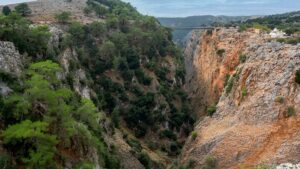
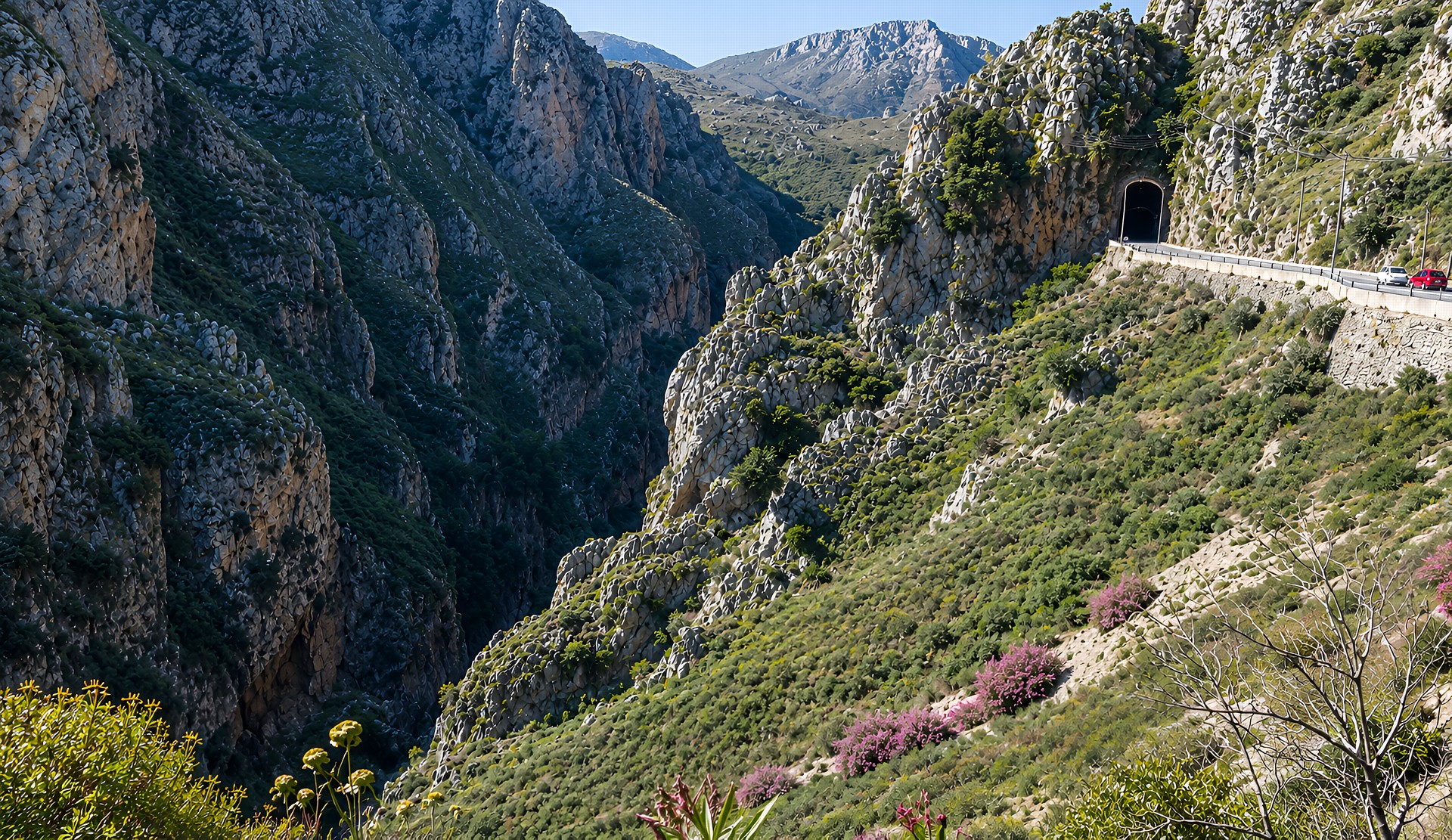
Topolia Gorge Chania is one of those places that most tourists drive straight through without stopping. That is a mistake. The gorge sits on the main road west toward Elafonisi, and the majority of visitors experience it only from inside a car, passing through the narrow hand-carved tunnel before moving on. Those who get out and walk it find something much better. Tall limestone walls, a dry riverbed to follow, the smell of thyme and wild herbs, goats picking their way across the upper rocks. No entrance fee. Very few people, even in high summer.
It is not Samaria. It is not meant to be. It is wonderful, not as overwhelming as Imbros or Samaria, but still worth a visit. The gorge is short, the terrain is manageable for most people, and you can easily combine it with other stops in western Crete. If you are already heading to Elafonisi or Falassarna, this is a natural addition to your day.
| Distance from Chania | 46km, about 50 to 55 minutes |
|---|---|
| Difficulty | Easy to Moderate |
| Time needed | 1.5 to 2 hours for the gorge walk |
| Best season | April, May, September, October |
| Parking | Free near Topolia village and at Katsomatados |
| Entrance fee | None |
| Rental car needed? | Yes |
| Family friendly? | With older children (uneven terrain, boulders) |
What Topolia Gorge Chania Actually Looks Like
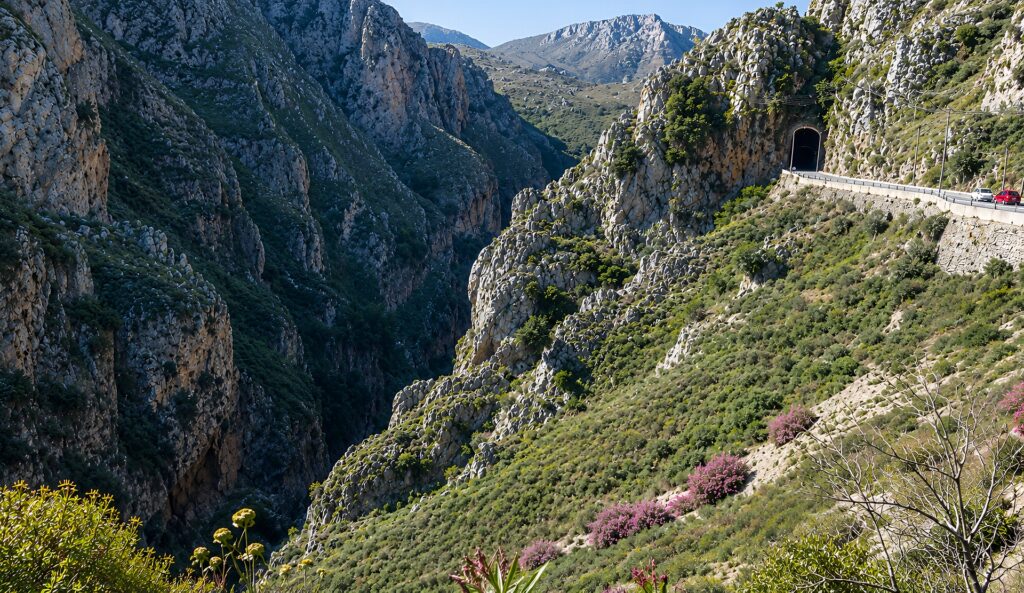
Topolia Gorge is a limestone gorge, a natural formation created over millions of years through the gradual erosion of rock by flowing water. It lies in western Crete, about 46 kilometres west of Chania. It extends for approximately 1.5 kilometres, with vertical rock walls that rise to 300 metres.
That 300-metre figure means something when you are standing at the bottom. The sky above you narrows to a strip. The walls close in. The riverbed is a tangle of rocks, boulders, and occasional fallen debris. The gorge is a botanical environment featuring plane trees, oleanders, wild olive trees, thyme, and various other plants. In spring there is still water running through the lower sections. By June it is dry. The shade from the walls keeps it cool even when the temperature outside the gorge is well into the thirties.
The canyon starts near the village of Strovles at an altitude of 450 metres and exits near the village of Topolia, at an altitude of 150 metres. The narrowest and most impressive hiking part of the gorge is located between Katsomatados and Topolia, where the side rocks are very high and steep.
Many visitors to western Crete remember the Topolia gorge not from hiking it but from driving along the winding road that cuts through it. Known to locals as the “Gorge of Caves” because of the many that are found along its route, this gorge is rich with vegetation. That tells you something. Most people never leave their car. The ones who do get it to themselves.
Local tip: The best approach is to start at Katsomatados village and walk north, uphill toward Topolia. The trail rises gradually through the gorge and you arrive at Topolia village, where there is a bakery. Park at Katsomatados, walk up, reward yourself with something from the bakery, then walk the road back. Starting from Topolia and walking down means a steep climb back up to your car at the end, which is considerably less enjoyable in the midday heat.
The Trail: What to Expect on Foot
Hiking in Topolia Gorge is moderately easy, suitable for visitors with basic fitness and stable footing. The hiking route covers approximately 1.5 kilometres, with an average walking time of 1 to 1.5 hours. The trail follows a natural riverbed lined with rocks, boulders, and patches of loose gravel.
That said, it is not a manicured path. The gorge still has large boulders that you have to climb. After heavy rain or winter storms, sections can be damaged and poorly marked. The main issue with the trail is the marking. The first part is fairly straightforward, but in the last section the trail markers become extremely sparse and confusing. Carry your phone with offline maps downloaded, or download the trail from AllTrails before you go. Do not rely solely on painted markers.
The route is considered child-friendly, but parents should monitor young children closely on the uneven ground. Anyone who has tried to carry a tired five-year-old over boulders in thirty-degree heat will understand why.
Warning: After periods of heavy rain, rockfall is a real risk inside the gorge. Hikers have noted fresh rockfall on the trail, particularly in autumn. If the walls above you look recently disturbed or there is debris on the path, turn back. The gorge has been damaged by severe storms in the past. Check conditions locally before you go.
The narrowest parts of the gorge reach only a few metres wide, requiring careful navigation. Risks include minor slips, ankle twists, or falls, especially after rainfall when sections of the trail become slick and muddy.
No guide is required. Hikers do not need a local guide to walk the gorge, but guided tours are available from operators in Kissamos and Chania for tourists seeking additional context or convenience.
The Topolia Tunnel
Before or after the hike, you will encounter the tunnel. The most challenging part of the drive is a single-lane unlit tunnel known as the Topolia Tunnel, built in 1920 during Prime Minister Eleftherios Venizelos. It is 110 metres long and 4 metres wide. The car flow is regulated by traffic lights on both ends of the tunnel.
It is said to be the only tunnel on the island of Crete that was dug by hand. That detail tends to land differently once you are inside it. Unlit. Narrow. Barely wider than a large car. You creep through in first gear.
A new Topolia bypass opened after eleven years of works and is now open to traffic. The old road through Topolia Gorge is still open, and some travellers continue to prefer it for its dramatic scenery. For many, part of the appeal of going to Elafonisi is driving through Topolia Gorge. However, for most visitors, especially those looking for a smoother drive, the new road is now the best option.
If you want to stop at the gorge and the Agia Sofia Cave, take the old road. If you are just passing through to reach Elafonisi, the bypass saves time and nerves.
GPS note: Many navigation apps still route you through the old tunnel road by default. If you want the bypass, follow signs for “Elafonisi New Road” rather than relying entirely on your device.
The Cave of Agia Sofia
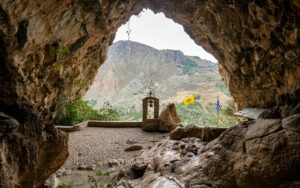
The cave of Agia Sofia is located 47km southwest of Chania, on the western walls of the gorge Topolia, near the main road to Elafonisi. On the left of the cave entrance, there is the small church dedicated to Hagia Sophia, the Wisdom of God.
To reach it, you climb. Be prepared for a steep climb of approximately 257 steps to reach the cave. The steps are uneven and there is no shade. Do this in the morning or late afternoon, not at noon in August.
There is no entrance fee required to visit Agia Sofia Cave. It is freely accessible to the public, allowing visitors to explore its historical chambers and natural formations without any cost or ticket purchase. A donation box is there for maintenance. Leave something.
The entrance of the cave has a width of 25 metres, while the height reaches 20 metres in many points. The cave has two rooms with different heights, the surface of which is full of stalagmites. The cave was a very important place of worship in the ancient times. Neolithic, Early Minoan, Late Minoan, Classical, Hellenistic and Roman pottery traces have been found here. People were using this cave for thousands of years before anyone thought to put a chapel inside it.
Agia Sofia Cave is the only known habitat of the spider species Pholcus creticus, which lives exclusively within this cave. Speleobiologists care about this. Most visitors will not notice the spiders. But it is a good fact to know.
The cave maintains a constant internal temperature of about 16 to 17 degrees Celsius and a humidity level of 75 percent year-round. After a hot morning in the gorge, that coolness is very welcome.
Local tip: The cave has no artificial lighting. Bring a torch or use your phone light once you move past the entrance. The deeper chamber is quite dark and the stalagmites on the floor are easy to trip over. Wear shoes with a proper sole, not sandals.
The Mythology of the Place
According to local traditions, Topolia Gorge hosted fairies and the Minoan goddess Vritomartis. The Minoans believed this was where the goddess Britomartys lived, while Talos, the bronze giant who protected Crete from enemy attacks, was associated with this place too. In myths, he often stopped here to rest, watching the heavenly dancing and singing of the nymphs.
There is also a story connected to the cave. A legend connects the site to the fall of Constantinople. It is said that after the city fell to the Turks, Cretan soldiers rescued the icon of Sophia, the Wisdom of God, and hid it inside the cave. Later, the icon was discovered lodged in the rock, precisely where the small chapel now stands.
Whether any of it is true is beside the point. These places accumulate stories. They are old, and people knew it. The gorge does not need embellishment to be worth the detour.
Warning: The cave is a religious site. Dress appropriately before going in. Cover shoulders and knees. This is not a rule that is often enforced, but it is the respectful thing to do. The chapel inside is still in use.
The Honest Notes
Most of the difficulty people report at Topolia Gorge comes down to two things: trail marking and rockfall. The marking is genuinely patchy in the upper section of the trail. Parts of the gorge trail were significantly damaged by rains and may not be fully repaired. It is easy to lose the path, so stay alert and stick to marked areas. The municipality’s maintenance efforts are limited, so careful navigation is key for a safe hike.
The gorge is also not entirely on its own quiet corner of the world. The road through Topolia, which is the main route for access to Elafonisi from the north, follows a winding path alongside the Topolia Gorge, in places deeply cut into the overhanging rock, before entering a narrow single-lane tunnel. The road runs parallel to much of the hike. You will hear cars. That is part of the deal. It does not diminish the gorge. But if you are expecting complete wilderness, know that the main road is never far away.
No formal restrooms or cafes are noted directly at the trailhead. Visitors should prepare accordingly, as amenities are limited. Nearby villages may offer facilities, but immediate access near the hiking start is minimal or absent. The exception is the taverna near the steps to Agia Sofia Cave, which does have basic facilities.
Warning: Do not walk back to your car along the main road. The tunnel section is unlit and the road is narrow. Hikers have done it and universally advise against it. If you are doing a one-way hike and need to return to your car, take a taxi from Katsomatados back to Topolia, or arrange in advance for someone to pick you up.
Before You Go
- Water: bring at least 1 litre per person. No water sources on the trail in summer.
- Shoes: closed hiking shoes or trail runners essential. No sandals on the boulder sections.
- Sun: the gorge provides shade, but the walk to and from the car does not. Hat and sunscreen.
- Toilets: none at the trailhead. Use facilities in Topolia village before you start.
- Navigation: download the trail offline before you go. Markers are unreliable in the upper section.
- Cave visit: bring a torch for the Agia Sofia Cave. The inner chamber is dark.
- Donations: bring a few euro coins for the Agia Sofia cave maintenance box.
Getting There
By Car
Driving from Chania to Topolia Gorge is the most practical option for independent travellers. The distance is approximately 46 kilometres, and the journey takes about 50 minutes via the Chania–Kissamos National Road and the Topolia road. From Chania, take the national road west toward Kissamos, then turn south following signs for Topolia and Elos. The gorge road begins as you pass through the village of Topolia.
Parking is available near the northern entrance of the gorge, close to Topolia village, though spaces can fill during peak tourist months. There is also free parking at Katsomatados village at the southern end of the gorge. You can park by the little bridge just off the main road near Katsomatados.

By Bus
KTEL buses operate routes between Chania and Kissamos, with stops at villages near Topolia. Travellers can take a Chania–Kissamos bus and arrange a taxi from Kissamos to the gorge. Some KTEL services may stop directly in Topolia village during the summer. This is a workable option but requires planning. Check the current KTEL schedule at the Chania bus station before you go. Return options are limited.
By Organised Tour
Several operators in Chania run day trips to western Crete that include a stop at Topolia Gorge, usually combined with Elafonisi. This is a good option if you do not have a rental car or prefer someone else to handle the driving on the narrow mountain roads.
Practical Information
| Distance from Chania | 46km, approx. 50 minutes by car |
|---|---|
| Gorge trail length | Approx. 1.5km one-way |
| Walking time | 1 to 1.5 hours one-way |
| Difficulty | Easy to Moderate (boulders, uneven terrain) |
| Entrance fee | None (gorge trail is free) |
| Agia Sofia Cave fee | Free (donations welcome) |
| Agia Sofia steps | Approx. 250 to 280 steps |
| Parking | Free at Topolia village and Katsomatados |
| Facilities | None at trailhead. Taverna near Agia Sofia steps. |
| Best season | April, May, September, October |
| Open | Year-round, no set hours |
Combine With
Topolia Gorge sits on the road that connects Chania to the far west of Crete. A day that starts with the gorge can easily expand.
Elafonisi Beach is the most obvious pairing. Balos Beach and Lagoon are just 27 kilometres away from Topolia Gorge. Elafonisi itself is roughly 30 kilometres south from the gorge once you clear the Elos area. Get to the gorge early, do the hike or cave visit in the cool of the morning, then push on to Elafonisi. Arrive before 10am to find parking and sunbeds.
Falassarna Beach to the north is a wide, long sand beach with a more relaxed atmosphere than Elafonisi and better facilities. From Topolia, it is about 25 minutes north. Good for families.
Kissamos Town is 15 kilometres north of Topolia and is an underrated stop. A real working town with a good archaeological museum, a seafront, and tavernas where you will be eating with locals rather than tourists. Good for a late lunch after the gorge.
The village of Elos sits just south of the gorge and is known for its chestnut trees. In October the chestnuts are harvested and the village holds a small festival. Quiet, genuine, worth a coffee stop.
Local tip: The drive back through Topolia Gorge at golden hour, with the afternoon light catching the upper cliff walls and the valley below going dark, is one of those unexpectedly good moments that the Elafonisi crowd never sees. Most people take the bypass on the return leg. Do not. Come back the old way. Drive slowly. Stop at the pull-offs above the gorge. The light at that hour is worth the extra twenty minutes.