Kissamos Chania is one of those places that quietly rewards the people who actually stop there. Most visitors speed through on their way to Balos or Falassarna, glance at the town square, and leave without a second thought. That is a mistake. On first sight, Kissamos does not look like a town full of fascinating things to do, but the truth is quite otherwise. This is a working Cretan town with deep roots, a genuinely good archaeological museum, excellent food, and a position that makes it the most practical base in all of western Crete.
Kissamos is located in the northwestern part of the Chania prefecture, and is also called Kastelli, a name derived from the period of Venetian rule, because of the fortress built here by the Venetians. The word Kastelli means “castle” or “fortress” in Greek. If you hear the name Kasteli or Kasteli Kissamou, both refer to the same town. That double naming causes endless confusion for tourists trying to find the KTEL bus listing. More on that below.
Unlike many other tourist destinations, Kissamos has not become overcrowded with visitors, and its economy is primarily focused on the production of wine, oil, raki and other agricultural products. Kissamos is ideal for people who want to explore West Crete while staying in a comfortable, organised place, with cheaper accommodation and food than other, more touristy parts of Chania Prefecture. If you stay here for a week, you will eat well, sleep affordably, and reach Balos, Falassarna, Elafonisi and Polyrrinia all in day trips. That is a hard combination to beat.
| Distance from Chania | 40 to 43km, about 45 to 60 minutes by car |
|---|---|
| Best season | April to June, September to October |
| Parking | Generally available in town; can be tight near the square in August |
| Rental car needed? | Recommended strongly for exploring the region |
| Family friendly? | Yes |
| Ferry connections | Kissamos port connects to the Peloponnese and Kythera |
| Museum | Archaeological Museum, closed Tuesdays |
What Kissamos Chania Actually Is
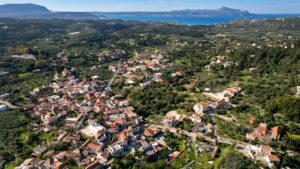
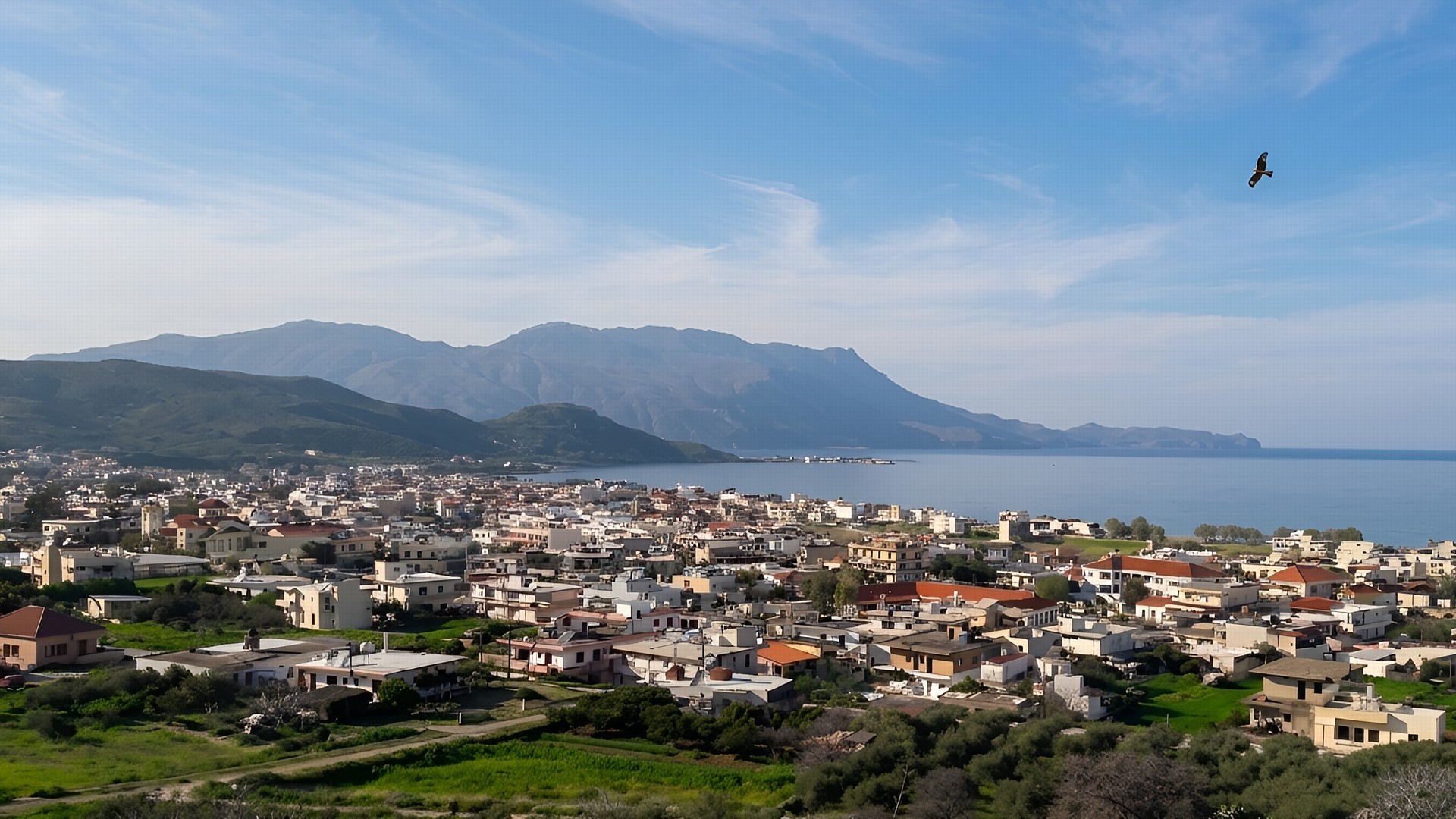
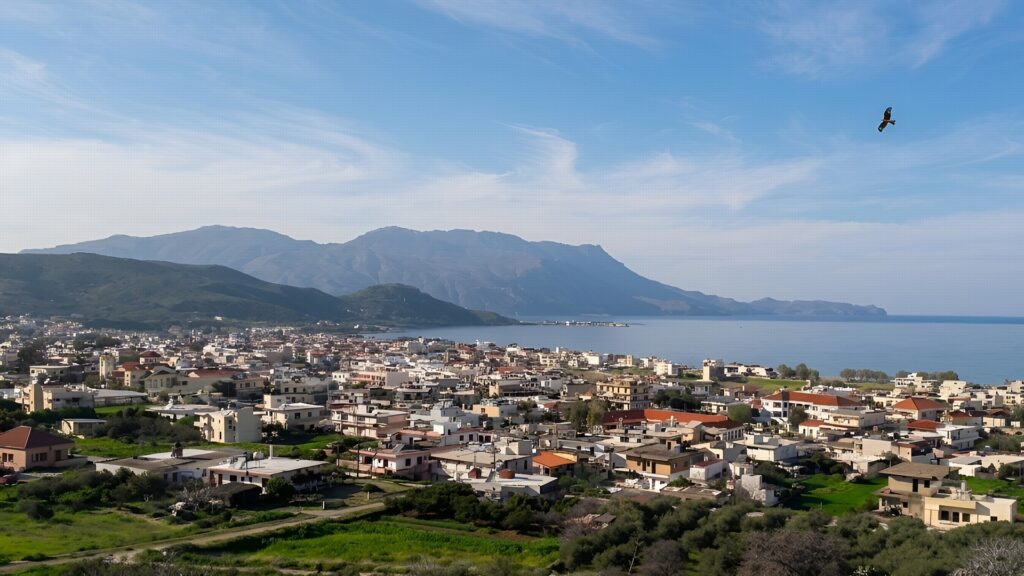
The capital of the region is the town of Kastelli, also called Kissamos, located in the wide bay formed by the peninsulas of Gramvousa and Rodopou. Look at it on a map and the geography makes sense immediately. The town sits at the centre of a large bay. To the northwest, the Gramvousa Peninsula curves away toward Balos. To the northeast, the Rodopou Peninsula stretches out toward Kolymbari. The sea is right in front. The hills run directly behind. The town occupies a flat strip of coast between those hills and the water, and it has been occupied in exactly this spot for an extraordinarily long time.
The town flourished during the Roman period and much evidence of this has been uncovered, with Roman baths, villas with mosaic floors, cemeteries, an aqueduct, and the remains of the fortress walls. The modern town is literally built on top of ancient Kissamos. When contractors dig foundations for new buildings, they find things. The town is scattered with archaeological finds, such as the famous mosaic floors in the courtyard of the Kissamos Health Center, while baths, a cemetery and an aqueduct from Roman times are preserved.
The Kissamos area is particularly fertile, rich in grapes, sultanas, wine and raki (tsikoudia). This is not tourist brochure language. It is simply true. The land around the town produces serious olive oil and wine. Agriculture here is not decorative. It is the main business.
The Archaeological Museum
The Archaeological Museum of Kissamos is housed in a Venetian-Turkish monument of Kissamos, and its exhibition covers the history of the wider region from the Prehistoric period to Late Antiquity with its main focus centered on the Roman city of Kissamos.
Before entering the museum, take a look at the facade. It is a Venetian-Turkish building with an arched entrance and two staircases over the portico. The building itself is worth a minute of your time before you go in. It has stood here through Venetian rule, Ottoman occupation, and two world wars. The monument was remodeled many times, the last time being its recent transformation into this museum in 2000.
Spread over two floors, the museum gives a good history of this area of Crete, detailing the early civilisations before the Romans came and then how the Kissamos area was utilised by the Romans. The ground floor covers material from Falassarna, Nopigia and Polyrrinia. The upper floor is where most visitors spend the most time. The biggest hall on the second floor features impressive mosaics. Two of them are particularly interesting and were part of important urban villas. The biggest of them depicts a magnificent allegory of Dionysus.
There are plenty of earthenware and stoneware dating back to 2000BC on the ground floor, but the upstairs section is more interesting with the well-presented Roman mosaic floors and the superb coin collection with coins from nearly every Roman Emperor post 54AD. One visitor noted that with a useful magnifying glass provided, you could spend 20 minutes on that coin exhibit alone, if the museum is quiet.
A notable item displayed at Kissamos is the Tylifos Stele, a peace treaty recorded between the cities of Falassarna and Polyrrhenia in 290 BCE. That single stone slab tells you something about how long-established and politically serious this part of Crete was.
The museum is closed on Tuesdays. Opening times are daily (except Tuesday) from 08:30 to 15:00. Check the official website for current entrance fee before you visit, as prices are reviewed periodically.
Local tip: Visit the Archaeological Museum before driving up to Polyrrinia. The museum has maps, descriptions and artifacts from the ancient city that make the hilltop ruins far more meaningful. In the opposite order, you will miss much of what you are looking at up there.
Polyrrinia: The Ancient City Above Town
The wonderful mountaintop ruins of the ancient city of Polyrrinia lie about 7km south of Kissamos, above the village of the same name. This is a half-day excursion that most visitors overlook, and that is genuinely a shame.
The city was founded by the Dorians in the 6th century and was constantly at war with the Kydonians of Chania. Later, under Roman occupation, Polyrrinia became the best fortified city of Crete and the administrative centre of western Crete through to the Byzantine period. When the Romans arrived, unlike their rivals the Kydonians, the Polyrrinians did not resist the Roman invasion and thus the city was spared destruction. A pragmatic decision that kept the city intact for centuries.
It is a 15-minute scramble up rocks and an overgrown path from the village to the church, and from there another 20-minute climb to the acropolis. The views from the top are extensive. You can see the whole bay, the two peninsulas and, on clear days, far out to sea. Many of the structures, including an aqueduct built by Hadrian, date from the Roman period. Near the aqueduct is a cave dedicated to the nymphs; it still contains the niches for nymph statuettes.
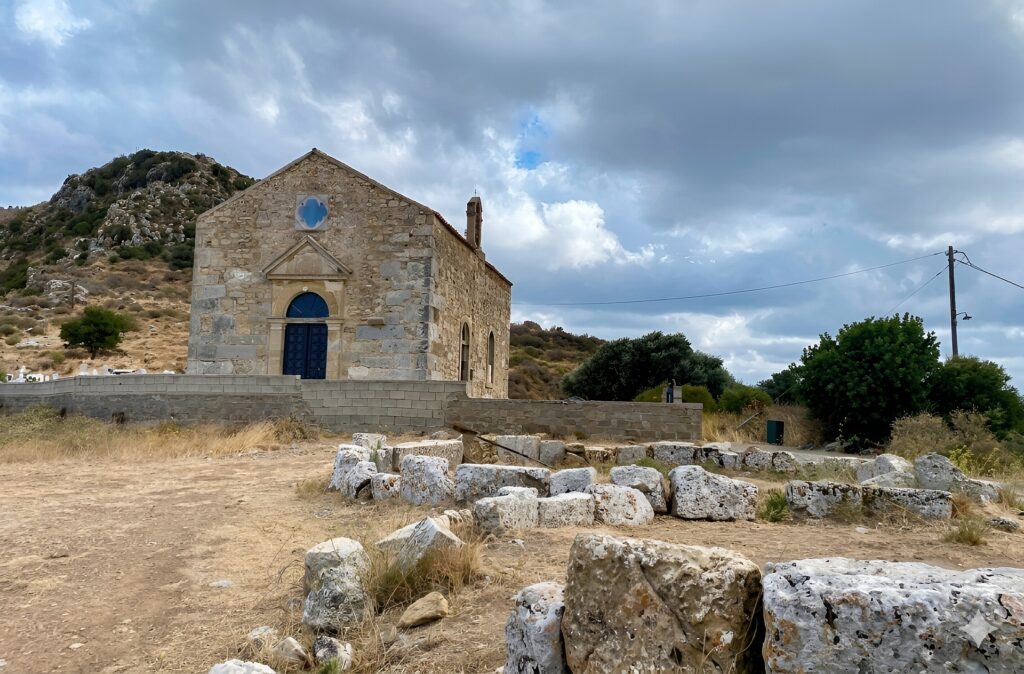
On the Acropolis of Polyrrinia stood the Temple of Artemis Dictynna, where the small church of Agioi Pateres (the Holy Fathers) stands today. It was built in 1894 using material from the ancient temple. You can see this for yourself if you visit the Acropolis, as ancient inscriptions are set into the church walls, and part of the ancient altar has been used in the Christian one. Layers of history, literally built on top of each other.
Warning: The climb to the Polyrrinia acropolis is in full sun with almost no shade. Go early in the morning or late afternoon in summer. Carry water. Visitors have reported it as genuinely challenging in July and August heat, not because it is technically difficult, but because there is nowhere to escape the sun.
The village runs a volunteer information centre which offers some drinks and a WC, but it closes at 3 in the afternoon. Plan accordingly. There is no public transport to the site. You need a car or taxi.
The Olive Tree of Vouves
About 13km east of Kissamos, in the village of Ano Vouves, stands what is considered to be the oldest olive tree in the world. The oldest olive tree in the world is located in the village of Ano Vouves of Kissamos in Chania, Crete, Greece. The ancient tree is 3,000 years old, as determined by the international scientific community.
This tree likely lived through the writing of the Iliad, the golden age of Athens, the rise of the Roman Empire, and the birth of Christ, and then lived for 2,000 years after that. It still produces olives. As a special honour, it was decided that the Olympic wreaths for the marathon champions of Athens 2004 and Beijing 2008 would be made of the branches of this legendary olive tree.
Next to the ancient tree you will find the Olive Tree Museum of Vouves, established in 2009, whose exhibits include tools and gear for olive cultivation, collection and processing. Small but worthwhile. Add this to a circuit that includes Kissamos town and Polyrrinia and you have a full, genuinely interesting day.
The Olive Tree of Vouves has a trunk circumference of 12.5 metres at its base. Its hollow interior can reportedly fit approximately ten people standing inside.
Where to Eat in Kissamos
In the evening, when people empty the beaches, the busiest place in Kissamos is the promenade, filled with tavernas, cafes and bars. The promenade along Mavros Molos beach is where you will find the seafront options. The town centre, around the main square on Skalidi Street, has the more local tavernas.
Castello Taverna on Skalidi Street is one to know about. Recent visitors describe food with real flavour, including yemista, chicken, rabbit stew, pork with celery, and Greek salad, in a charming space with the nicest owners. Importantly, the cost is much lower than other restaurants in the area. That is what you want in a town like this.
For seafood, the small fishing harbour to the west of town has a couple of fish tavernas. You will find them after passing the charming little fishing harbour of Kissamos where there are a couple of fish tavernas, in case you would like to have lunch or dinner there.
The Kaliviani area, just outside town, also has options well regarded by both locals and visitors. Generous portions of traditional dishes like moussaka, local chicken cooked with wine sauce, and fried calamari are highly recommended, and visitors praise the friendly staff and satisfying entrees at reasonable prices.
The Town Beach and the Port
The main beach of Kissamos is Mavros Molos, located to the western side of the town. This is the place where you will find most of the town’s beachfront hotels. It is a long sweep of mixed sand and shingle. Not the most dramatic beach in western Crete. But it is close, clean, accessible, and rarely packed to the point of unpleasantness.
On the other side of town, the long beach stretches for over 6km, up to the peninsula of Rodopos. Names like Telonio, Livadia, Korfalonas, Drapanias, Nopigia, Choni and Ravdoucha identify different sections of this beach, which is sandy or with pebbles in places. Most tourists do not explore this side at all. That means stretches of it are quiet even in August.
The harbour of Kissamos is outside the town, linking Crete to the Peloponnese, Kythera, Gythio and Kalamata. There are also daily boat trips to Gramvousa and Balos Beach. The ferry connection to the mainland is a practical option for travellers who want to combine Crete with the Peloponnese.
The E4 European Walking Path starts the Cretan section of its journey here. Its length in Crete is 320km and it crosses over mountains, plateaus and gorges, taking in spectacular scenery.
The Honest Notes
On first sight, Kissamos does not look like a town full of fascinating things to do. That impression does not fully go away. This is not a beautiful town. There is no old harbour with Venetian mansions. There is no winding medieval quarter. It is a functional, well-organised Cretan market town with a supermarket district, a pedestrianised square, and a seafront promenade. Visitors who arrive expecting something like Chania’s old town will be disappointed.
Warning: Kissamos is regularly used as a base for the Balos boat trip. The boat departs from the port about 2km west of town. In July and August the boats sell out. Book in advance, especially for weekend departures. Do not assume you can simply turn up and get a ticket on the day.
Warning: The town has two names used interchangeably by locals, signs, GPS systems, and bus timetables. When searching for the KTEL bus, look for “Kastelli Kissamou” or “Kastelli,” not just “Kissamos.” Visitors have missed buses because they were searching under the wrong name on the KTEL website.
Without a rental car, your options from Kissamos are seriously limited. Visiting the wider region requires you to hire a car or take taxis, unless you have the time to wait for the occasional public bus. The bus gets you to town and back to Chania, but for Polyrrinia, Falassarna, Vouves, the gorges, or the smaller coves, you need your own transport.
Local tip: Accommodation in Kissamos is notably cheaper than in Chania Old Town or the beach resorts around Platanias and Agia Marina. If your goal is to explore western Crete rather than to be based somewhere postcard-pretty, staying here will save you money every night and cut your driving times to the major sites considerably.
Frequently Asked Questions
Is Kissamos worth visiting or just a transit point?
Both, honestly. As a destination in itself, it rewards those who slow down. The Archaeological Museum is genuinely good and takes about an hour. Polyrrinia is a half-day. The promenade is pleasant in the evening. But its greatest value is as a base. Staying in Kissamos puts you 15 to 20 minutes from Falassarna, about an hour from Elafonisi, and within reach of a dozen gorges and villages that most tourists never see.
Is Kissamos better than staying in Chania?
Different, not better or worse. Chania Old Town is genuinely beautiful and worth a few nights. Kissamos is more practical for exploring the far west. If you have two weeks, spend a few nights in each. If you only have one base, decide whether sightseeing or atmosphere matters more to you.
How difficult is the Polyrrinia walk?
It is a 15-minute scramble up rocks and an overgrown path from the village to the church, and from there another 20-minute climb to the acropolis. No technical skill required. But the biggest difficulty is the heat, in full sun and no shade. Go early or late. Not suitable for anyone with serious mobility issues.
Can I get to Kissamos by bus from Chania?
Yes. KTEL Chanion-Rethymnou operates buses from Chania station to Kasteli of Kissamos station. The journey takes around an hour. Crucially, look for “Kastelli Kissamos” or “Kastelli” when searching the timetable, not just “Kissamos.” Always check the current timetable at e-ktel.com before travelling, as schedules vary by season.
Is there parking in Kissamos?
Generally yes, and mostly free. Parking around the main square can be tight in August. Outside July and August you will almost always find space without difficulty.
What is the Olive Tree of Vouves?
The oldest olive tree in the world is located in the village of Ano Vouves of Kissamos in Chania, Crete. The ancient tree is 3,000 years old, as determined by the international scientific community. It still produces olives. There is a small museum next to it. The village is about 13km east of Kissamos town and takes about 20 minutes to reach by car.
Getting There
By car: From Chania, take the E75 national road west. The drive is about 40 to 43km and takes 45 to 60 minutes depending on traffic. The road is fast, wide, and straightforward. Parking in and around Kissamos is generally free and available.

By bus: KTEL Chanion-Rethymnou S.A. operates buses from Chania station to Kasteli of Kissamos station. The journey takes approximately one hour. Check current schedules at e-ktel.com. Remember that the bus listing uses “Kastelli Kissamos” not “Kissamos.”
By taxi: Taxis from Chania to Kissamos are available but cover a significant distance, so the fare is not small. Reasonable for airport transfers with luggage, but for daily use, a rental car is far more practical.
By organised tour: There are daily boat trips from the Kissamos port to Gramvousa and Balos Beach. Various operators also offer day trips from Chania that pass through Kissamos on their way to Balos or western Crete.
Before You Go
- Museum: closed Tuesdays. Check current opening hours and entrance fee on the official Ministry of Culture website before visiting.
- Polyrrinia: no public transport. Car or taxi required. Carry water, wear sun protection. Go early in summer.
- Balos boat: departs from the port 2km west of town. Booking in advance strongly advised in July and August.
- Cash: useful to have in smaller tavernas and at the Polyrrinia information café.
- Parking: free and generally available in town. Tighter near the square on weekend evenings in high season.
- Photography in the museum: confirm the current policy before you visit, as rules have changed in recent years.
Practical Information
| Location | 40 to 43km west of Chania |
|---|---|
| Drive from Chania | 45 to 60 minutes |
| Archaeological Museum address | Stratigou Tzanakaki Square, Kissamos |
| Museum closed | Tuesdays and public holidays |
| Museum opening hours | 08:30 to 15:00 (confirm on official website) |
| Entrance fee | Small fee, check current price at Ministry of Culture website |
| Polyrrinia | 7km south of Kissamos, no public transport |
| Olive Tree of Vouves | About 13km east of Kissamos, village of Ano Vouves |
| Port | 2km west of town centre |
| Ferry connections | Peloponnese, Kythera, Kalamata, Gythio |
| KTEL bus listing name | “Kastelli Kissamos” |
Combine With
Falassarna. Falassarna Beach is just 10km from Kissamos, about 20 minutes by car. One of the best beaches in Crete, with ancient ruins at its northern end. Half a day is enough to combine a visit to the ruins and a swim.
Balos Lagoon. The beach of Balos is located just 14km from the town of Kissamos, about one hour by road. The boat from the port is the easiest approach. Alternatively, a 4×4 track takes you to the cliff-top viewpoint. This is Kissamos’s most famous neighbour. Book the boat in advance in summer.
Topolia Gorge and Sirikari. The gorge between Topolia and Sirikari is a well-marked walk through rock walls with Griffon vultures overhead. This is a lovely walk, well marked and less-travelled than many of the Cretan gorges. Start from Sirikari, walk down through the gorge to Polyrrinia, and back to Kissamos. About 17km, mostly straightforward.
Elafonisi. Elafonisi beach is located 45km from the town of Kissamos, about two hours by road. The pink sand beach in the far southwest of the island. A full day from Kissamos, but very achievable with a car.
Local tip: The drive back from Polyrrinia to Kissamos in the late afternoon, with the light spreading across the bay and the two peninsulas framing the water on each side, is one of the quieter rewards of this part of Crete. It takes five minutes. Do not rush it back to the main road.