Aradena Gorge Chania is one of the most serious and least-visited hiking destinations in all of western Crete. It sits deep in Sfakia country, roughly 85 kilometres south of Chania city, carved into the limestone of the White Mountains above the Libyan Sea. The gorge is dramatic, the history is dark, and the walk down to the coast is genuinely wild. This is not a place you drift into by accident.
Most tourists who come to Chania will have heard of Samaria Gorge. Far fewer have heard of Aradena. That gap makes no sense once you have been here. Only a few walkers come here, and you can get the trip almost to yourself, completely different from Samaria, which is crowded like a shopping centre on a Saturday. The gorge is harder, shorter, quieter, and more rewarding. And then there is the bridge.
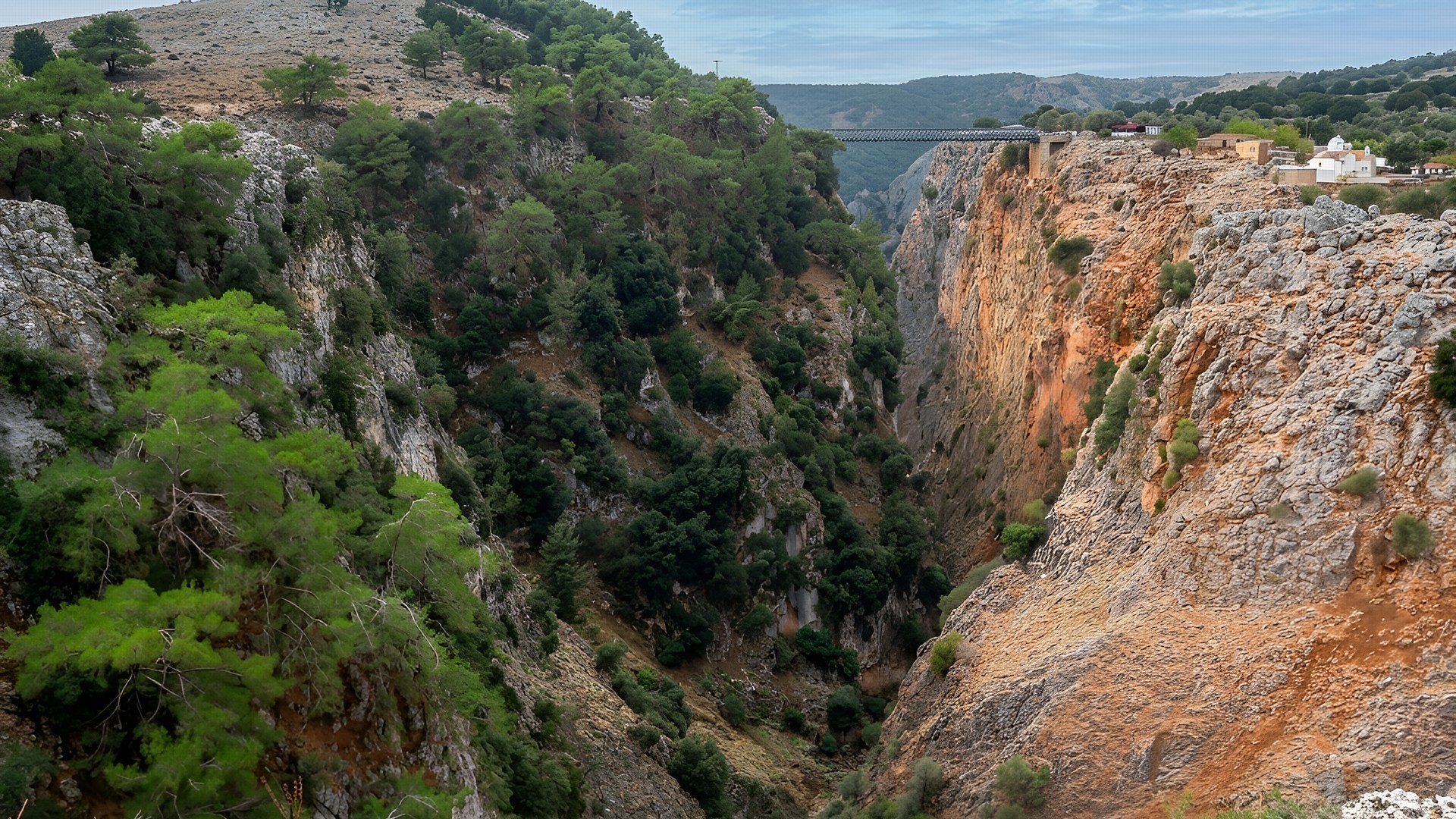
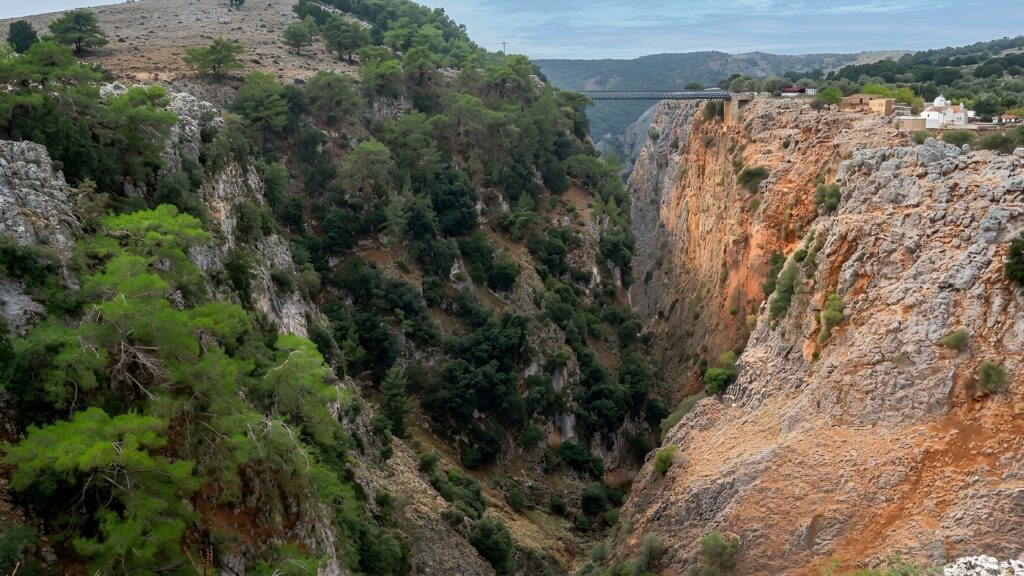
Aradena Bridge stands 138 metres above the gorge floor. It is the highest bridge for bungee jumping in Greece and the second highest in Europe. Before you even take a step on the trail, you have to cross it. Most people stop in the middle and look down. Some of them then decide they need to jump. That is a personal choice. Either way, the view from the bridge alone justifies the drive out here.
| Distance from Chania | 85km, approximately 100 minutes |
|---|---|
| Difficulty | Challenging |
| Time needed | 3 to 4 hours one way, or 5 to 6 hours as a loop |
| Best season | May, June, September, October |
| Parking | Free at the bridge |
| Entrance fee | None |
| Rental car needed? | Yes |
| Family friendly? | With older, fit teenagers only |
Aradena Gorge Chania: What You Are Actually Looking At
Located in the Chania prefecture of Crete, Aradena Gorge is the deepest gorge in the area, plunging to 138 metres deep. It stretches about 15 kilometres in total, but most visitors know only the easier 7 kilometre section starting near Aradena village.
Aradena is one of the most interesting and longest gorges in Crete. The old Sfakians called it Faragas, meaning Huge Gorge, due to its size, to distinguish it from the rest of the gorges of Sfakia. This characterisation was later falsely applied to the Samaria Gorge. Worth knowing. The locals always knew which gorge was bigger.
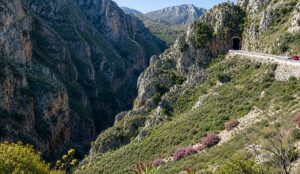
The gorge’s dramatic cliffs are made mostly of limestone, carved over thousands of years by wind, water, and natural wear, forming steep walls that soar up to 138 metres high. This deep natural sculpting creates a unique environment featuring an underground stream originating near Drakolaki Cave, shaping the valley floor. In summer the stream is dry. The gorge floor is loose rock and boulders. The walking is slow and requires concentration.
Hikers encounter steep paths, sturdy iron chains and ladders, and scenic views all the way to a tranquil beach with clear waters for swimming. The chains and ladders are the part people worry about. They are not a gimmick. There is one vertical section, roughly 9 metres deep, where you use an iron ladder installed specifically for the purpose. In the middle of the gorge, the route splits into two paths: an easy one and a harder one. The harder route requires climbing down two metal ladders and using a fixed rope to descend from large boulders.
The harder route is the one worth taking. The views are better and the experience is more complete. But if you have a fear of heights, take the easier path. Nobody will judge you.
Warning: There is no mobile signal inside the gorge. Tell someone your plan before you start. Bring a fully charged phone and consider downloading offline maps. If something goes wrong inside, you cannot call for help.
The Bridge and the Abandoned Village
Originally built in 1986, the bridge connects the abandoned village of Aradena to the opposite side of the gorge. Before the bridge existed, to reach Aradena you had to descend the path to the bottom of the gorge and climb to the opposite side. The village had no road connection at all until the 1980s.
The road connection was made only in 1987, after constructing an impressive metal bridge with a wooden deck. Its construction was a donation of the Vardinogiannis family to the village of Agios Ioannis, located a little further west of Aradena. The bridge is named after them. It is functional, not decorative. Cars still drive over it. Do not be frightened if a car drives over the bridge while you are below, as it sounds like a rock fall.
Now the village. Aradena is a village in the area of Sfakia, in southwestern Crete, located at an altitude of 520 metres above sea level on the southern slopes of the Lefka Ori. People from the area say that the village once had more than 700 permanent inhabitants. The settlement gradually declined, and by the 1950s it was completely abandoned.
The reason it was abandoned is one of those stories that only makes sense in Sfakia. A feud in the village in 1948 that led to six men’s deaths started when a child moved the bell from a sheep belonging to one flock over to a sheep from another flock. Three people died that same day, and the end result was depopulation of the village. In Aradena, separation became abandonment.
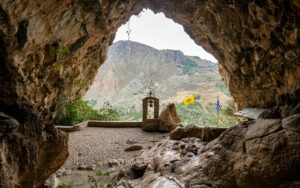
Walk through the ruins before you descend into the gorge. The village of Aradena gives us an idea of traditional Cretan architecture, which has managed to remain almost intact since the area was abandoned decades ago. Stone houses with collapsed roofs, empty doorways, a Byzantine church that still stands. It takes twenty minutes to walk around. It is worth every one of them.
Local tip: The church of Agios Ioannis inside the gorge is one of the oldest Byzantine churches in the Sfakia region. Easy to walk past without noticing. Stop and look inside if the door is open.
The Hike Down to Marmara Beach
The Aradena Gorge stretches from the abandoned village of Aradena, perched west of Loutro and east of Agia Roumeli, all the way down to Marmara Beach on the Libyan Sea. The standard descent is 7 kilometres. It drops roughly 520 metres in elevation. Count on 2.5 to 3.5 hours depending on pace and how much time you spend stopping.
There is parking right behind the bridge, and this is where the hike starts. The trail first goes through the deserted village of Aradena and down the steep slope into the gorge. The first section is loose and steep. Take your time. After 30 minutes the path levels out and you are properly inside the gorge walls.
At certain points the gorge narrows and becomes steep, with large boulders closing the way. This is normal. The route is marked, though not obsessively so. Pay attention.
Swimming is allowed at Marmara Beach after the hike. The beach offers a gravel shoreline, providing a refreshing opportunity for hikers to relax and cool off in the water following their descent through the gorge trail. The best part of the gorge is the endpoint at Marmara, an extremely beautiful beach with sea caves to explore. There is also a restaurant with good food.
Marmara in Greek means marbles, and the beach took its name from the soft, colourful rocks and sea caves that are its most striking feature. The water is clear and cold. After a few hours walking in summer heat, it is the right reward.
Warning: Marmara Beach has no road access. Once you are down there, your options for getting back are: walk back up through the gorge, take a taxi boat to Loutro or Chora Sfakion, or arrange a pick-up by boat in advance. Do not arrive at the beach without a plan for your return.
The Bungee Jump
If you want to jump, this is the place. In 1999, a group of friends already experienced in the extreme sports sector spotted the place and decided to set up a bungee jumping station. Soon Aradena gained notoriety among bungee jumping lovers all over the world.
The operator is Liquid Bungy, and they have been running this for decades. Bungee jumping at Aradena is a seasonal adventure. Typically, jumps take place from the first weekend of June until the last weekend of September. They offer jumps every weekend from the first of July until the end of August. For June and September, they operate only by prior booking.
Due to an optical illusion, from the jumping point the canyon seems to be very narrow, not more than a few metres. It is not. It is 138 metres down. Check the Liquid Bungy website directly for current dates, pricing, and booking. Do not assume they are operating on any given weekend without confirming.
Local tip: If you are planning to both hike and jump on the same day, do the jump first. Hiking 7 kilometres on shaky legs after a 138-metre bungee drop is one approach, but you will hike better before the adrenaline, not after. Also, the jump operators have their own schedule. Check it before you plan your day around it.
Getting Back From Marmara Beach
This deserves its own section because it catches people out. There are three realistic options.
The first is to walk back up through the gorge the way you came. It takes longer than the descent. The hike back is strenuous and has barely any shade on the ascent in the heat. In July or August this is a serious undertaking. Start the descent early, spend time at the beach, and begin the return no later than 3pm.
The second option is to take a taxi boat from Marmara to Loutro or directly to Chora Sfakion. From the beach of Marmara, small ferries run to Loutro daily. There are also smaller ferry routes between Hora Sfakion and Loutro and Marmara from April to late October. Check current schedules with the ferry operator ANENDYK before you go. Taxi boats can also be arranged privately from Chora Sfakion.
The third option is to hike from Marmara along the coastal path to Loutro. From the exit of the gorge up to the picturesque village of Loutro, you can walk for about an hour across the beaches of Likkos and Finikas. From Loutro, a ferry or taxi boat takes you to Chora Sfakion, where your car is parked. If you left your car at the bridge, you then need a taxi or lift back up. Plan this in advance.
The loop route via Livaniana village adds distance but solves the return problem: you end up back near where you started.
Before You Go
- Water: bring at least 2 litres per person. There are no water sources anywhere on the route.
- Shoes: proper hiking boots or trail shoes with ankle support. The gorge floor is loose boulders. No trainers, no sandals.
- Sun: almost no shade once you are below the gorge rim. Hat and sunscreen are not optional in summer.
- Swimwear: bring it. Marmara Beach at the end is one of the best swimming spots on the south coast.
- Toilets: none on the route. Use facilities at the start point.
- Return transport: sort this before you start. See the section above.
- Cash: the restaurant at Marmara and any taxi boats will likely prefer cash. Bring enough.
- Signal: none inside the gorge.
The Honest Notes
Aradena is genuinely harder than it looks on paper. The 7 kilometre figure understates the effort. The boulders, the ladders, the heat, and the return journey all add up. People who do Samaria Gorge expecting a similar experience are sometimes caught off guard here.
Warning: Do not attempt Aradena in July or August without starting very early. The gorge has almost no shade. By midday the temperature at the bottom can be brutal. Start at 7am if you can. You will have the gorge to yourself and be at the beach before the heat peaks.
While the Aradena Gorge is accessible year-round, the best time to visit is from May to October. May, June and September are the ideal months. The temperature is manageable, the gorge is not crowded, and the boats to Marmara are running.
Warning: This route is not appropriate for young children, anyone with a significant fear of heights, or people with knee problems. The ladder section and the steep boulder descent require real physical confidence. If you are uncertain, consider taking an organised guided hike instead, where an experienced local can assess the route with you in real time.
Getting There
By Rental Car
A rental car is the only practical way to get here independently. To reach the gorge, visitors can drive or take a taxi to the village of Aradena, located approximately 85 kilometres from Chania. The route takes you south through Chora Sfakion, then up into the mountains via Anopoli. The road from Anopoli to Aradena is narrow with tight hairpin bends in sections. It is paved throughout but requires a careful driver. A standard car handles it fine. Allow about 100 minutes from Chania city.

There is parking right behind the bridge and it is free. In peak summer weekends it fills up. Arrive before 9am to be safe.
By Bus and Taxi
There are daily buses from Chania to Chora Sfakion, particularly during the summer season. Once there, you can arrange a taxi or local transfer to reach Aradena. The bus journey to Sfakion takes around 2 hours. A taxi from Sfakion to Aradena bridge is a further 20 to 25 minutes up the mountain. This is expensive and leaves you with the return logistics problem. It works, but it requires planning.
By Organised Tour
Organised tours exist and are worth considering, particularly if you are doing this for the first time. They handle the transport, the return journey, and give you an experienced local who knows the route. Several Chania-based operators run full-day Aradena trips that include a boat transfer back from Marmara Beach.
Practical Information
| Location | Aradena village, Sfakia, Chania Prefecture |
|---|---|
| Distance from Chania | 85km, approx. 100 minutes by car |
| Trail length | 7km one way (bridge to Marmara beach) |
| Elevation drop | Approximately 520 metres |
| Entrance fee | None |
| Parking | Free, at the bridge |
| Facilities at start | None at trailhead |
| Facilities at Marmara Beach | Small taverna, sunbeds |
| Bungee jumping operator | Liquid Bungy (bungy.gr) |
| Bungee season | June to September, weekends and by prior booking |
| Best months to hike | May, June, September, October |
| Open year-round? | Yes, no official closure |
Combine With
Aradena sits in Sfakia, one of the most rewarding parts of western Crete. If you are making the long drive out here, build in extra time.
Chora Sfakion is the small port town at the bottom of the mountain road, 12 kilometres from Anopoli. Stop here on the way back. Get a table at one of the waterfront tavernas and order Sfakiani pita, the local cheese pastry. It is the right end to a long day in the mountains.
Loutro is a car-free village accessible only by foot or boat from Sfakion. Unless you come by private boat or yacht, you take the 20-minute ferry rides from Chora Sfakia, with about 4 ferries a day in the summer months. It is the most peaceful place on the south coast. If your legs allow it after the gorge, take the afternoon boat over and have dinner there.
Imbros Gorge is on the road between Chania and Chora Sfakion, about 40 minutes north of Sfakion. It is shorter and much easier than Aradena, with far less scrambling involved. It makes a logical companion if you want to do two gorges in a day, or if Aradena is too challenging for part of your group.
Frangokastello is a 14th-century Venetian castle on the south coast, about 15 kilometres east of Sfakion. It takes 20 minutes to walk around and is worth stopping at on your way back to Chania if you travel the coast road.
Frequently Asked Questions
How difficult is Aradena Gorge?
The Aradena Gorge is the deepest gorge in Chania. It runs from the southern slopes of the White Mountains to the small Marmara Beach. The hike is demanding and not recommended for people without any walking experience. It involves scrambling over boulders, iron ladders, and a fixed rope section. Rate it as a challenging day out, not a gentle walk.
Is Aradena Gorge better than Samaria?
They are very different. Samaria is longer, has better facilities, and is accessible to most reasonably fit people. Aradena is shorter, harder, much quieter, and more technically demanding. If you want solitude and a wilder experience, Aradena wins easily. If you want a classic Cretan gorge walk suitable for the whole family, choose Samaria or Imbros instead.
Can children do Aradena Gorge?
Not young children. Do not attempt the hike if you have mobility issues, lack hiking experience, or if you are afraid of heights. Confident, fit teenagers who are comfortable with heights and scrambling can manage it. Under 12s should not attempt the main route.
How long does Aradena Gorge take?
The one-way descent from bridge to Marmara Beach takes most people 2.5 to 3.5 hours. The full loop trail takes an average of 5 hours and 38 minutes to complete. Add time for the village walk, the beach swim, and the return journey.
Is there an entrance fee for Aradena Gorge?
No. Unlike Samaria, there is no entrance fee to hike Aradena Gorge. Parking at the bridge is also free.
What is the bungee jump at Aradena Bridge?
Aradena Bridge stands 138 metres high. It is the highest bridge for bungee jumping in Greece and the second highest in Europe. The operator is Liquid Bungy. They run jumps on summer weekends from June to September, and by prior booking outside of peak season. Check their website at bungy.gr for current schedules before making the drive.
Practical Note on the Return Journey
One thing this gorge teaches you quickly: the descent is only half the day. The return is a little more demanding. If you are walking back up, give yourself more time than you think you need. If you are taking a boat, confirm the schedule before you start walking down. The boats run seasonally and are subject to weather. Strong south winds can interrupt the service without warning. Have a backup plan.
Local tip: Most people who drive out to Aradena for the day go straight to the bridge, park, and hike. Very few bother to stop in Anopoli village on the way, 3.5 kilometres before Aradena. There is a small square with a kafeneion where you can get a coffee and a plate of something before the walk. The people there know the gorge like the back of their hand. If conditions are unusual that day, you will hear about it there before you find out the hard way.