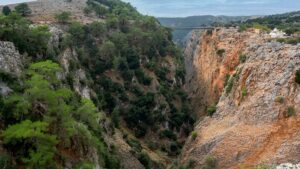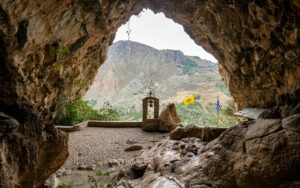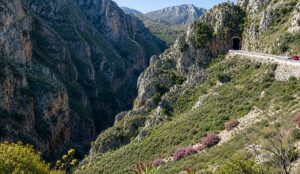
Imbros Gorge Chania is the most underrated walk in western Crete. Most tourists head straight for Samaria and never hear about Imbros. That is their loss. The gorge is shorter, easier to access, far less crowded, and in many ways more dramatic at its narrowest point than anything Samaria offers. If you have one morning for a gorge hike during your holiday, Imbros deserves serious consideration.
The gorge cuts through the White Mountains south of Chania, dropping from the village of Imbros down toward the coastal road near Komitades, above Sfakia. The walk is roughly 8 kilometres one way. It takes most people between two and three hours. The terrain is rocky but manageable. There are no steep technical sections. Families with older children handle it comfortably.
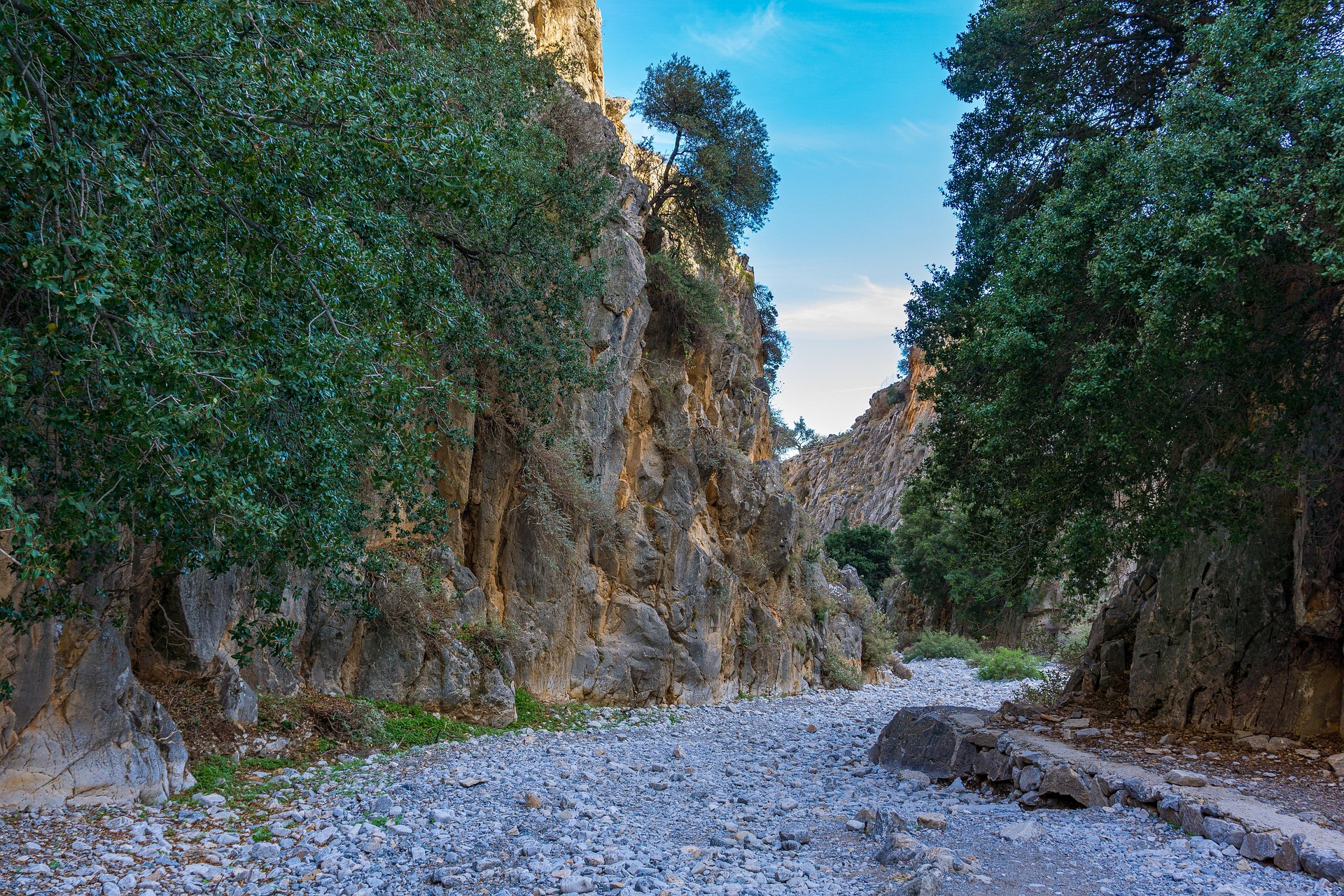
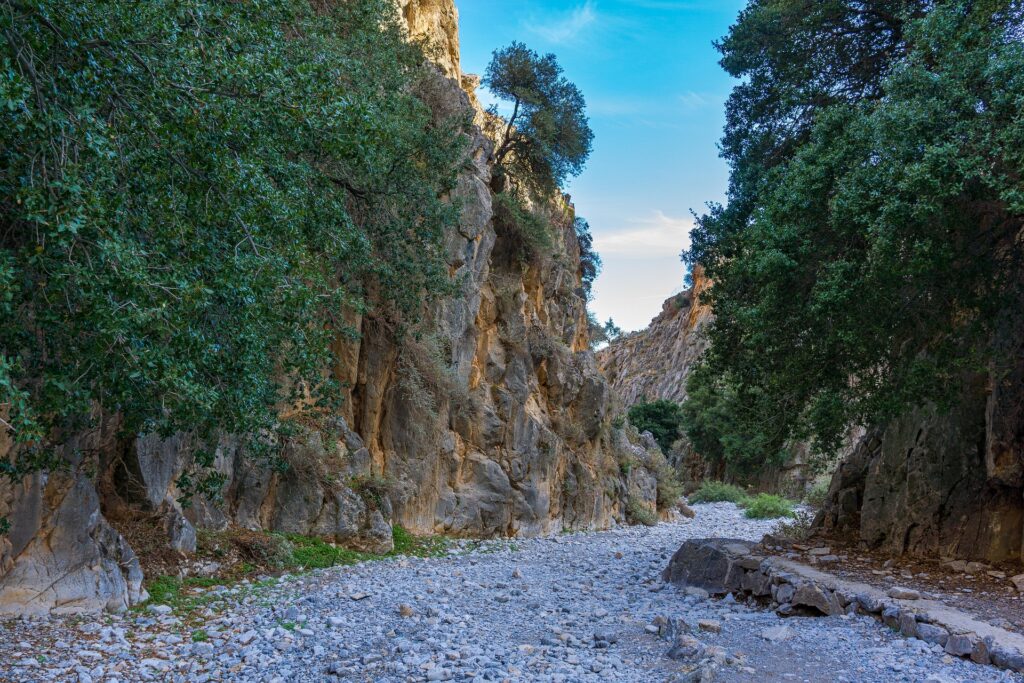
What makes Imbros special is the narrows. About halfway through, the gorge walls close in to less than two metres apart. The rock towers overhead, the light changes completely, and the temperature drops. It is the kind of thing you remember. The rest of the walk is good. That section is genuinely impressive.
| Distance from Chania | 73km, about 80 minutes |
|---|---|
| Difficulty | Easy to Moderate |
| Time needed | 2.5 to 3 hours walking, plus travel |
| Best season | April, May, June, September, October |
| Parking | Free in Imbros village |
| Entrance fee | Small fee at the trailhead |
| Rental car needed? | Yes, strongly recommended |
| Family friendly? | Yes, with older children (8 and up) |
What the Imbros Gorge Chania Hike Actually Looks Like
You start in the village of Imbros, at around 700 metres above sea level. The village is small and quiet. There is a car park, a small café that opens in the morning, and a trailhead with a ticket booth. The path drops immediately into the gorge.
The first section is open. Wide walls, olive trees, scrub vegetation. The path is well-marked and wide enough to walk comfortably. The rock underfoot is loose in places. Ankle support helps. Do not wear sandals.
After about forty minutes the gorge starts to tighten. The walls come closer and climb higher. The vegetation thins out. The path narrows. By the time you reach the famous narrows, roughly 4 kilometres in, the two cliff faces are almost touching above you. You can stretch your arms and touch both walls simultaneously. The passage is only about 20 metres long at its tightest point, but the effect on the senses is total. Worth every step to get there.
Local tip: Stop at the narrows and look straight up. The sky appears as a thin strip between walls that rise 150 metres above you. Most people keep walking because the group in front kept walking. Do not. Stand still for two minutes. The scale takes time to register.
After the narrows the gorge opens again. The second half of the walk is broader and easier going. The vegetation comes back. The path is wider. The light returns. You start to see the southern slopes of the White Mountains opening toward the Libyan Sea. The end point at Komitades arrives sooner than expected.
The Narrows in Numbers
The narrowest point of Imbros Gorge is approximately 1.5 metres wide. The walls at that point are over 150 metres high. The passage takes about 30 seconds to walk through and several minutes to properly absorb.
Trail Conditions and What to Expect Underfoot
The path through Imbros is rocky throughout. Not jagged technical scrambling, but uneven limestone and loose stones. Trail shoes are the minimum. Proper hiking boots are better, particularly if your ankles are not strong. The descent is gradual rather than steep, but your knees will know you have been walking downhill by the end.
There is some shade in the gorge, particularly in the first half. In July and August the open sections get hot. The narrows section stays cool even in midsummer. Start early. Before 9am if you can manage it.
Imbros Gorge vs Samaria: The Honest Comparison
This question comes up constantly. They are both gorge hikes in the White Mountains, and the comparison is natural. But they are quite different experiences.
Samaria is 16 kilometres long. It is a serious full-day commitment. The logistics are complex: you finish at the coast in Agia Roumeli and need a ferry back, which means planning around boat schedules and paying for the return trip. In July and August, thousands of people walk it on the same day. The path can feel like a queue.
Imbros is 8 kilometres. You are done in two to three hours. A car parked at the top means you can arrange your own return without depending on ferries or buses. The crowds are nothing like Samaria, even in peak summer. And the narrows at Imbros are arguably tighter and more dramatic than anything you walk through in Samaria.
The honest answer: if you are a serious hiker and want a full-day adventure, do Samaria. If you want a genuinely impressive gorge experience without the full-day commitment and logistics, Imbros is the better choice. Many people who live here prefer it.
Warning: Imbros Gorge is a one-way downhill route. You finish at Komitades, not where you started. If you drive to the top, you need a plan for getting back to your car. This is the single most common logistical mistake tourists make here.
The Return Journey: Sorting Your Logistics
Because the hike is one-way, the return trip needs thinking through before you start.
The most common approach with a rental car is to drive two vehicles: one left at Komitades at the bottom, one driven to Imbros at the top. If you are travelling as a group with two cars, this is simple and works perfectly.
If you have one car, you have two options. One: park at the top in Imbros, walk down, take a taxi from Komitades or Sfakia back to the village to collect your car. Taxis serve the south coast road, but the area is not busy, so arrange this in advance if possible. Two: park at the bottom in Komitades and walk the gorge uphill from south to north. This is harder and slower, but the route is open both ways and some people prefer it. The narrows are just as impressive in reverse.
There is also a bus connection. A local bus runs between Chania and Sfakia, stopping at Imbros village on request. Check the current KTEL schedule before planning around this, as times change seasonally. An organised tour from Chania will handle all transport logistics for you.
Local tip: After finishing the gorge, drive the 9 kilometres down to Sfakia for lunch. The tavernas along the harbour front serve fresh fish and local lamb. It is one of the most remote-feeling villages on the island, despite being reachable by road. A good way to round off the morning.
The Honest Notes
Imbros is genuinely a good hike. But a few things are worth knowing before you commit.
Warning: The gorge is open year-round, unlike Samaria which closes in winter. However, flash flooding is a real risk in the gorge after heavy rain. If there has been significant rainfall in the preceding 24 to 48 hours, check conditions before entering. The gorge walls channel water fast, and the narrows section in particular offers no escape if a flood comes through.
Warning: Mobile signal is unreliable inside the gorge. Do not depend on your phone for navigation or emergency contact once inside. Download an offline map beforehand. Tell someone your plan before you start, particularly if hiking alone.
The path is well-maintained and clearly marked throughout. You are not going to get lost. The ticket booth at the entrance is staffed during opening hours in season. Outside peak season, the booth may be unstaffed, but the gorge is still accessible.
Do not underestimate the heat in July and August. The open sections reflect heat off the rock walls. The narrow section is cool, but you spend less than twenty minutes there. Bring more water than you think you need.
Frequently Asked Questions
How difficult is Imbros Gorge?
The gorge is rated easy to moderate. The path is well-marked and the descent is gradual rather than steep. The surface is rocky throughout, which requires some care with footing. Most moderately fit adults can complete it without difficulty. Older children from around 8 upward generally manage well.
How long does the Imbros Gorge hike take?
Most walkers complete the 8-kilometre route in two to two and a half hours. Allow three hours if you are taking your time, stopping at the narrows, and travelling with children or older adults. Add travel time to and from Chania, which is roughly 80 minutes each way.
Is Imbros Gorge better than Samaria Gorge?
It depends what you want. Samaria is longer, more famous, and a bigger physical undertaking. Imbros is shorter, less crowded, and logistically simpler. The narrows at Imbros are genuinely spectacular. Many experienced hikers who have done both find Imbros the more enjoyable day out. Neither is objectively better. They suit different trips.
Is Imbros Gorge open all year?
Yes. Unlike Samaria, which closes from November to April, Imbros is accessible year-round. The best conditions are spring (April to June) and autumn (September to October). July and August are hot. Winter walking is possible but check for rain and flooding risk.
What shoes do I need for Imbros Gorge?
Trail running shoes at minimum. Hiking boots with ankle support are better. The path is rocky and uneven throughout. Do not wear sandals, flip-flops, or casual trainers. This is the advice ignored most often and the cause of most twisted ankles.
Can I do Imbros Gorge without a car?
It is possible but requires planning. A seasonal bus from Chania (KTEL) serves Imbros village with a stop near the trailhead. You can also join an organised day tour from Chania which handles all transport. Without a car or tour, logistics at the bottom end of the gorge require a taxi to connect back to public transport.
Getting There
By Car
From Chania, take the E75 coastal road east toward Rethymno, then turn south on the road toward Vrysses and Sfakia. From Vrysses, continue south through the White Mountains on the road toward Sfakia. Imbros village is signposted off this road, roughly 73 kilometres from Chania. The drive takes around 80 minutes. The mountain road from Vrysses south is well-surfaced but winding. Comfortable in a normal car. Free parking is available in Imbros village at the trailhead.

By Bus
KTEL Chania operates a bus service from Chania to Sfakia, which stops at or near Imbros village on request. Services are seasonal and infrequent. Check the current KTEL timetable at the Chania bus station on Kydonias Street or at the KTEL website before planning around this option.
By Taxi
Taxis from Chania to Imbros are available but expensive over this distance. More practical as a one-way option for the return from Komitades or Sfakia back to Imbros village if you have left a car there.
By Organised Tour
Several operators in Chania run guided day trips to Imbros Gorge, typically including transport from Chania, a guided walk through the gorge, and lunch in Sfakia. This is the easiest option if you do not have a rental car.
Before You Go
- Water: bring at least 1.5 litres per person. No water sources on the trail.
- Shoes: trail shoes or hiking boots. No sandals or flip-flops.
- Sun: open sections are fully exposed. Hat and sunscreen essential in summer.
- Toilets: basic facilities at the trailhead in Imbros village. None on the route.
- Transport: this is a one-way route finishing at Komitades. Arrange your return before you start.
- Signal: mobile signal is unreliable inside the gorge. Download offline maps.
- Cash: bring cash for the entrance fee and any refreshments at the start or finish.
Practical Information
| Trailhead location | Imbros village, Apokoronas |
|---|---|
| Start elevation | Approximately 700m |
| End point | Komitades village, near Sfakia |
| Trail length | 8km one way |
| Walking time | 2 to 3 hours |
| Entrance fee | Small fee at trailhead ticket booth |
| Parking | Free in Imbros village |
| Open | Year-round (weather permitting) |
| Best months | April, May, June, September, October |
| Difficulty | Easy to Moderate |
| Suitable for children | Yes, 8 and older |
| Dogs allowed | Yes, on lead |
Combine With
Imbros sits in the south of the Apokoronas region and is well-placed to combine with other destinations in western and southern Crete.
Sfakia (Chora Sfakion): Nine kilometres south of Komitades, Sfakia is the small harbour town at the bottom of the gorge run. There are several tavernas along the waterfront, a small beach, and ferry connections to Agia Roumeli and Loutro. Lunch here after the hike is a natural and very good ending to the morning.
Frangokastello: About 14 kilometres east of Sfakia along the south coast road, Frangokastello is a 14th-century Venetian fortress sitting on a flat coastal plain directly above a wide, shallow, calm beach. One of the most photogenic spots on the south coast. Easy to add as an afternoon stop.
Lake Kournas: On the return drive north, Lake Kournas sits roughly 15 kilometres from Vrysses. It is the only freshwater lake in Crete. Calm, green, and surprisingly peaceful compared to the coast. Good for a stop if you have energy left.
Georgioupolis: A further 6 kilometres from Lake Kournas, Georgioupolis is a relaxed seaside town with a long sandy beach and good restaurants. A sensible place to stop for dinner on the way back if you do not want to drive all the way to Chania first.
Local tip: If you drive back to Chania via the mountain road through Askyfou and Vrysses rather than rushing, pull over somewhere in the Askyfou plateau before the descent. The plateau sits at around 750 metres with the White Mountains on three sides. In the late afternoon light the scale of it is quietly astonishing. No viewpoint sign, no car park. Just the road and the mountains. That is the drive home.