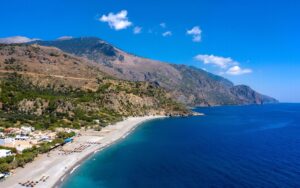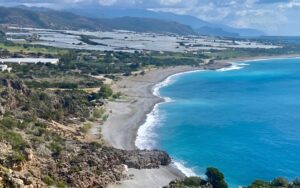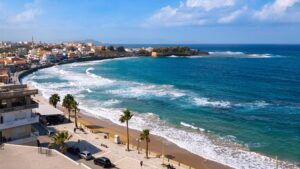
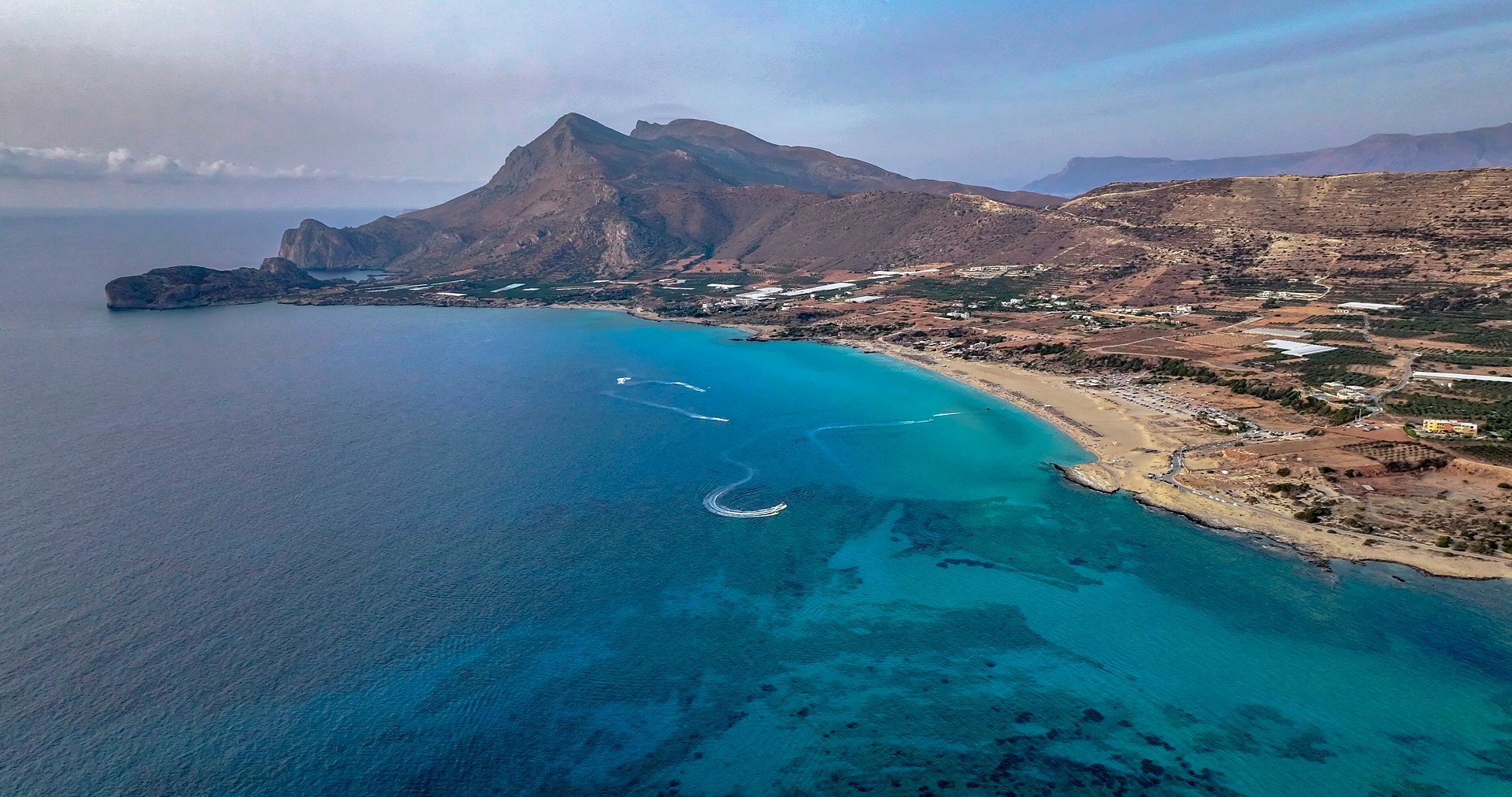
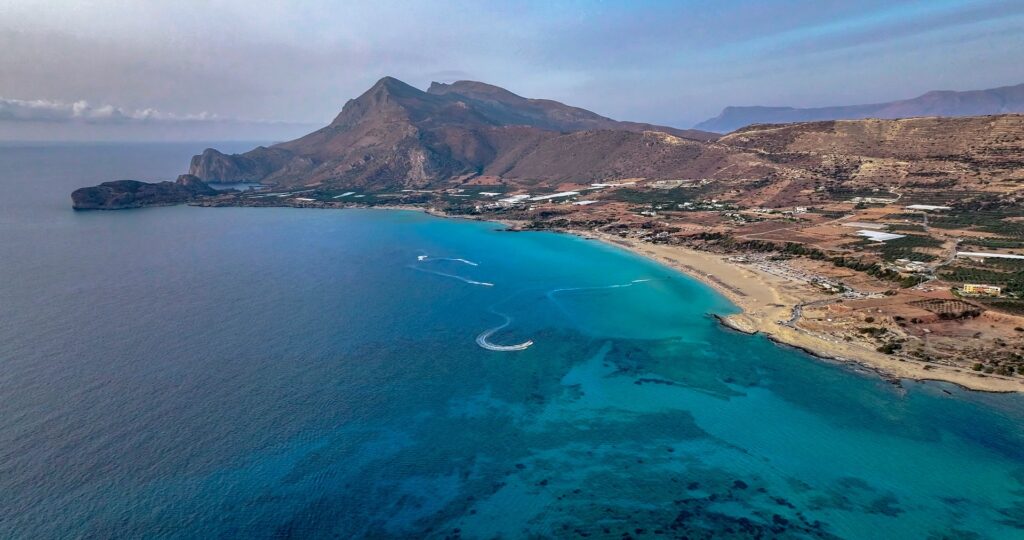
Falassarna Beach Chania is one of the genuinely great beaches of the Mediterranean. Not in the way that phrase gets used about every sandy strip on every Greek island, but in the way that people who have been to hundreds of beaches come back and say so. It lies 59 kilometres west of Chania town, and its coastline stretches for 3 kilometres of pale sand with a faint pink tint and water that sits at an extraordinary shade of blue-green. It faces due west into open water. The sun drops directly into the sea in front of you, and on clear evenings the colour it produces across the water is the reason this beach appears in so many European best-of lists.
Most beaches in Crete have a single selling point. Balos has the lagoon. Elafonisi has the pink sand. Falassarna has almost everything: space, water colour, facilities, a sunset that stops conversation, and enough different sections to satisfy a beach snob, a family, a windsurfer, and someone who just wants to sit in peace. It is not a secret. Do not come expecting to have it to yourself in August. But it handles crowds better than almost anywhere else on the island, and the reasons for that are worth understanding before you go.
| Distance from Chania | 59km, about 60 to 75 minutes |
|---|---|
| Difficulty | Easy |
| Time needed | Half day to full day |
| Best season | May, June, September, October |
| Parking | Available near the beach, fills early in peak season |
| Entrance fee | No entrance fee |
| Rental car needed? | Strongly recommended |
| Family friendly? | Yes, with some caveats by section |
Why Falassarna Beach Chania is Different
Space is what separates Falassarna from most of the beaches people compare it to. The main beach is broad as well as long, which means even on a busy August Saturday it absorbs people without feeling compressed. There is room to spread out, room between the sunbed rows and the waterline, room to walk.
The beach is not one beach. It is separated into five sections divided by rocks or dunes, and the different parts have been given various names by locals, such as Bourouni, Kalami and Agia Paraskevi. Understanding which section you are on, and why you might prefer one over another, is the most useful thing to know before you arrive.
The first beach, known as Pahia Ammos, is the most popular and largest section. It is very wide, around 1 kilometre long, and fully organised. There you can find restaurants, cafe-bars, umbrellas, watersports facilities, and a beach volleyball court. This is where most visitors end up, and where the sunbed operators and beach bars concentrate.
The second-largest section, Northern Pahia Ammos, is around 800 metres long. It is split into smaller strands divided by rocks and dunes, and is a quieter, more tranquil choice situated near the chapel of Agia Paraskevi.
At the northernmost edge of the coastline, close to the Ancient Falassarna archaeological site, lies a hidden inlet. This small pebbled beach has a rocky seabed and offers genuine peace and privacy. Worth the walk if you want to get away from the organised sections entirely.
Local tip: The section known as “Baby Beach” to the south of the main stretch has natural rock pools that form a sheltered, shallow area. It is the best part of Falassarna for young children. The rocks create a barrier that protects kids from currents, and there are usually a few sunbeds and umbrellas here too. Quieter than the main beach.
The Water, the Wind, and the Sunset
The water temperature at Falassarna runs cooler than beaches on the south coast or the sheltered northern bays. The beach is exposed to frequent northern and western winds. The consistent afternoon wind arrives from the northwest through the summer months, which makes it one of the more reliable spots in Crete for wind-dependent sports. Windsurfing, kitesurfing and surfing are all possible here, with rental and instruction available from operators on the beach. Paddleboarding works well in the calmer morning hours before the wind picks up.
This is useful information for two different types of visitor. If you are a windsurfer, the afternoon wind is a selling point. If you are coming for flat-water swimming with young children, aim for the morning. By early afternoon, particularly in July and August, the main beach can develop a proper chop that makes the water more exciting but less relaxing.
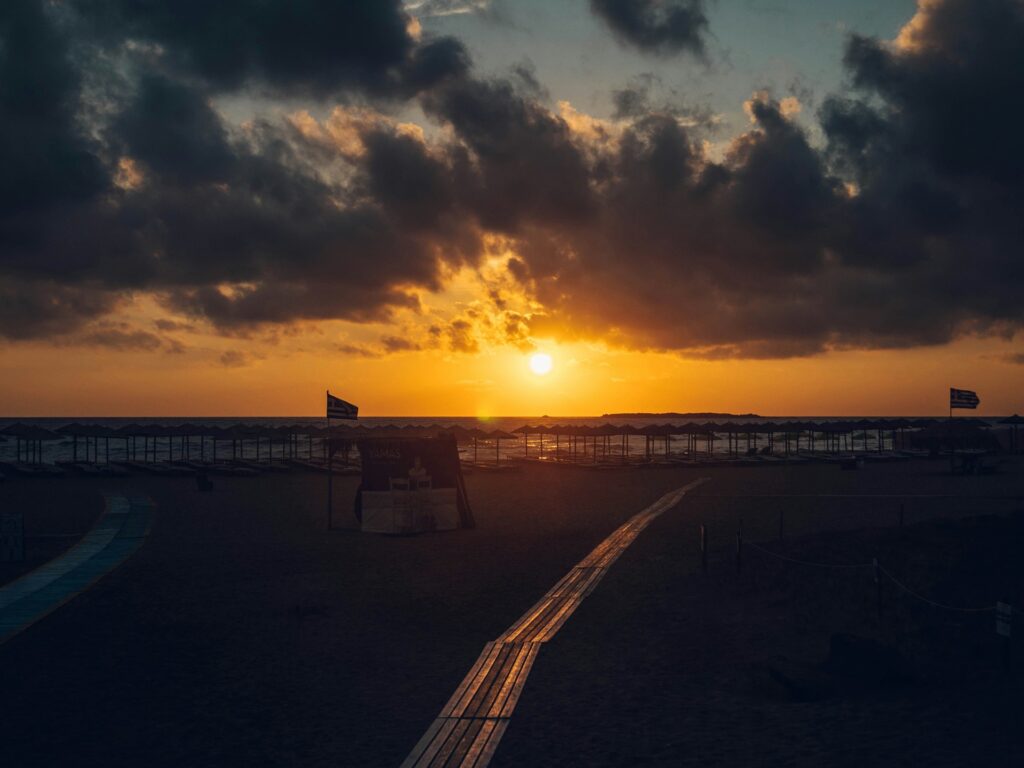
The beach is west-facing, offering magnificent sunset views. This is not marketing language. Falassarna is famous for its sunsets, considered the best in Crete because of its unobstructed view. There is nothing between the beach and the horizon. When the light is right, the water turns orange and then dark red, and the mountains behind you go purple. People stop talking and just watch. It happens every clear evening. Plan to be there for it.
Falassarna has been repeatedly recognised as one of the best beaches in Europe. The awards are deserved, but go before 9am in July and August if you want a sunbed at a reasonable price.
What’s There: Facilities, Food, and Honest Notes on Cost
Falassarna has good facilities including showers, changing areas, tavernas and a water sports centre. The beach offers both organised sections with sunbeds and umbrellas for rent, as well as free areas for those who prefer to bring their own. Prices for sunbeds vary depending on the location and type, with cabanas being the most expensive option.
Here is the honest version on cost: Falassarna is the priciest beach in western Crete when it comes to sunbed hire, and prices have increased considerably over recent years. Some travellers find the sunbed and parking prices steep. The further south you walk from the main organised sections, the cheaper or entirely free the beach becomes. You can always bring your own towel and umbrella and pay nothing.
Several tavernas are scattered along the beach. Only two restaurants sit directly on the sand of the main section, Playa Paraiso and Liokalyvo. Both have sections of sunbeds and cabanas along the water’s edge where you can order food and drinks.
The eating scene is practical and seasonal. During the main tourist months, several tavernas and beach bars operate near the main beach. The food tends toward straightforward Greek cooking: grilled fish, salads, mezedes, cold drinks. The closer you sit to the sand, the more you are paying for the location. That is standard economics for beach dining in Greece.
For a wider choice of restaurants and a less seasonal dining scene, Kissamos is the sensible answer. It is a proper town with a harbour, a small old quarter, and enough cafes and tavernas to eat well for several evenings. It is fourteen kilometres away, roughly twenty minutes by car.
Warning: The afternoon wind at Falassarna can arrive quickly and build to a level that puts fine sand into everything including your food and eyes. If the meltemi is forecast, the morning window is your best option. Check a local weather app before you leave Chania.
The Ancient Ruins: Worth the Short Walk
Most visitors come only for the beach. But one of the main attractions near Falassarna is the ancient city of Phalasarna, which includes ruins such as city walls, an acropolis, and a stone throne dedicated to Poseidon.
Falassarna is part of the Natura 2000 network, both due to its variety of flora and fauna and as an area of outstanding natural beauty. The archaeological site sits at the northern end of the beach. It is approximately 1 kilometre from the main beach. Visitors can easily explore both the beach and the ancient ruins during a single visit.
The archaeological site is a short walk from the main beach and is freely accessible. It takes fifteen to twenty minutes on foot from the main parking area. Not a major archaeological destination by Greek standards, but the setting is genuinely striking. The harbour here was once a working port. The land has risen several metres since antiquity due to tectonic activity, and what was once the harbour mouth is now dry ground some distance from the water. That fact alone is worth stopping for.
Local tip: The northern rocky section near the archaeological site is popular with snorkelers. The rocks create interesting underwater formations and the water is exceptionally clear here. Bring your own mask and fins because rental options thin out the further you walk from the main beach. This section also attracts nudists, so be aware if you are visiting with children.
When to Go: An Honest Assessment
The best months are May to October, with June and September offering ideal weather and sea conditions with fewer crowds.
July and August are when the beach is at full capacity. It is hot, mid-30s Celsius, in July and August, the peak season. This is by far the busiest time of year. All the restaurant and bar owners will tell you it is crowded, and accommodation is expensive but books out anyway.
Things start to quieten down in September, but it is still hot, often into the 30s. In October the temperature varies between 23 and 28 Celsius, dropping to around 19 or 20 overnight. The crowds are long gone. The cafes and bars are generally quiet. The weather is good, and you can often share a whole section of beach with just one other family or couple.
From November until late April, Falassarna shuts down. Most of the tavernas and beach businesses close entirely.
Warning: In July and August, the main parking area fills by 9 or 9:30am on busy days. Arriving after 10am means a longer walk from roadside parking or paying at one of the secondary lots. If you are coming in peak season, leave Chania no later than 8am.
Frequently Asked Questions
Is Falassarna beach worth visiting?
Yes. Falassarna has repeatedly been awarded as one of the best beaches in Europe. The combination of beach length, water quality, facilities, and sunset position makes it genuinely exceptional. Go in June or September to avoid the worst of the summer crowds.
How crowded does Falassarna get in August?
Space is what separates Falassarna from most comparable beaches. The main beach is broad as well as long, which means even on a busy August Saturday it absorbs people without feeling compressed. There is room to spread out, room between sunbed rows and the waterline. That said, the organised sections still fill up fast. Arrive early, or walk south to the quieter sections.
Is Falassarna suitable for families with children?
The soft sand, shallow entry waters, and facilities make it a good choice for families with children. The key is choosing the right section. The main Pahia Ammos beach works well for older children. The natural rock pools at the southern “Baby Beach” section form a sheltered spot for kids to paddle or swim, protected from any currents, with some sunbeds and umbrellas close by. Avoid the northern rocky section near the ruins with small children.
Can I get to Falassarna by bus from Chania?
The Chania-Falassarna bus runs during peak summer season, with services taking around 1 hour 40 minutes from Chania bus station, calling at Agia Marina, Kolymvari and Kissamos. Four services a day operate in the shoulder seasons. The bus works, but the timetable limits your flexibility and you lose most of a day in travel. A rental car is far more practical for a full beach day.
Is there free parking at Falassarna?
Parking is available near the main beach, with a large informal car park that fills early on summer weekends. Arriving before 10am or after 5pm makes the situation considerably easier. Some areas charge a small daily parking fee, others are free. Expect to walk a few minutes from your car to the beach regardless of where you park.
Is Falassarna better than Elafonisi?
That depends on what you want. Elafonisi has the famous pink sandbar and shallow lagoon, which is better for very young children. Falassarna has more space, better facilities, better water for actual swimming, and a far superior sunset. Most adults who have been to both tend to prefer Falassarna. It does not have the same postcard image as Elafonisi, but the experience of being there is generally better.
The Honest Notes
Falassarna’s reputation is fully earned, but there are things worth knowing before you go.
Warning: Sunbed prices at Falassarna, particularly at the main beach bar establishments, are the highest of any beach in western Crete. If you are on a budget, bring your own towel and umbrella, walk ten minutes south of the main section, and pay nothing. The beach does not care which part of it you sit on.
Warning: The water at Falassarna is colder than beaches on Crete’s south coast or sheltered northern coves, especially early in the season. In May and early June this is noticeable. By late June it is fine for most swimmers. In September it is genuinely warm and the best time to be here for sea temperature alone.
The road into Falassarna from the Kissamos direction involves a descent on a narrow, winding road with some sharp bends. It is 3 kilometres downhill along a fairly narrow, winding road, so be careful especially during the busy high season. Coming back up in traffic after a full beach day in July requires patience. That is the only frustrating part of the journey.
Before You Go
- Water: bring your own. Beach bar water is available but not cheap. At least 1.5 litres per person if you plan to walk the ruins or northern sections.
- Shade: most of the beach is fully exposed. Bring a beach umbrella if you are not hiring sunbeds. Mornings are shadeless.
- Shoes: flip-flops are fine for the main sandy sections. If you plan to explore the northern rocky areas or the ruins, bring sandals with a sole.
- Toilets: available at the main beach bar establishments. Showers too.
- Cash: some smaller operators on the quieter sections may prefer cash. The main beach bars accept cards.
- Wind: check the forecast. Afternoon wind is normal and can be strong. Morning visits are calmer for swimming.
Getting There
By car is the right way to do this. Falassarna is approximately 59 kilometres west of Chania city. Take the E75 highway west toward Kissamos, continue through Kastelli, then follow signs for Platanos and Falassarna. The final section of road toward the beach has some sharp curves and is single-lane in places, so the last few kilometres require a slower pace. Allow 60 to 75 minutes from central Chania depending on traffic.

By bus, KTEL operates services from Chania bus station. The Chania-Falassarna bus is a workable option during peak summer season, with several services a day taking around 1 hour 40 minutes from Chania bus station. Public buses have infrequent schedules, especially outside peak tourist season. Check the KTEL Chanion website for the current timetable before relying on this.
By taxi from Chania is possible but expensive for a day trip. A taxi will get you there in about an hour. The return fare adds up. This only makes sense if you are a group of four or five splitting the cost.
By organised tour, several companies in Chania run combined Balos and Falassarna day trips, or Falassarna-only excursions. These solve the transport problem but limit your time and flexibility.
Practical Information
| Location | Western Crete, Kissamos municipality |
|---|---|
| Distance from Chania | 59km |
| Drive time from Chania | 60 to 75 minutes |
| Distance from Kissamos | 17km, about 20 minutes |
| Beach length | Approximately 3km across all sections |
| Entrance fee | None |
| Parking | Available, fills early in summer. Check current charges on arrival. |
| Facilities | Sunbeds, umbrellas, beach bars, tavernas, showers, toilets |
| Water sports | Windsurfing, kitesurfing, surfing, paddleboarding, jet skiing |
| Open season | May to October |
| Best months | June, September |
Combine With
Kissamos (Kastelli). For a wider choice of restaurants and a less seasonal dining scene, Kissamos is the answer. It is a proper town with a harbour, a small old quarter, and enough cafes and tavernas to eat well for several evenings. Fourteen kilometres from Falassarna. Makes a good base if you want to spend more than one day in this part of Crete.
Balos Lagoon. The famous lagoon and Gramvousa island are around 30 kilometres north of Falassarna along the Gramvousa Peninsula. Most people do either Balos or Falassarna in a day. If you have a car and energy, the drive between them is manageable, but Balos requires either a boat from Kissamos or a rough dirt road. Do not try to rush both into one morning.
Elafonisi Beach. About 40 kilometres south of Falassarna along the west coast. The two beaches represent the best of western Crete and can theoretically be combined in a long summer day, but you will not do justice to either. Better to dedicate separate days.
Ancient Phalasarna Archaeological Site. Directly adjacent to the northern end of the beach. A short walk. The ancient city includes ruins such as city walls, an acropolis, and a stone throne dedicated to Poseidon. Free to access. Worth thirty minutes if history interests you at all.
Local tip: If you are staying in Chania for a week or more, go to Falassarna twice. Once in the morning on a June or September weekday when the main beach is half empty and the water is flat and cold and clear. Then again late on a clear evening, with nothing planned for dinner, and sit somewhere on the sand and wait for the sun to drop below the horizon. The second visit is a different experience entirely. Do not combine them into one rushed day trip.