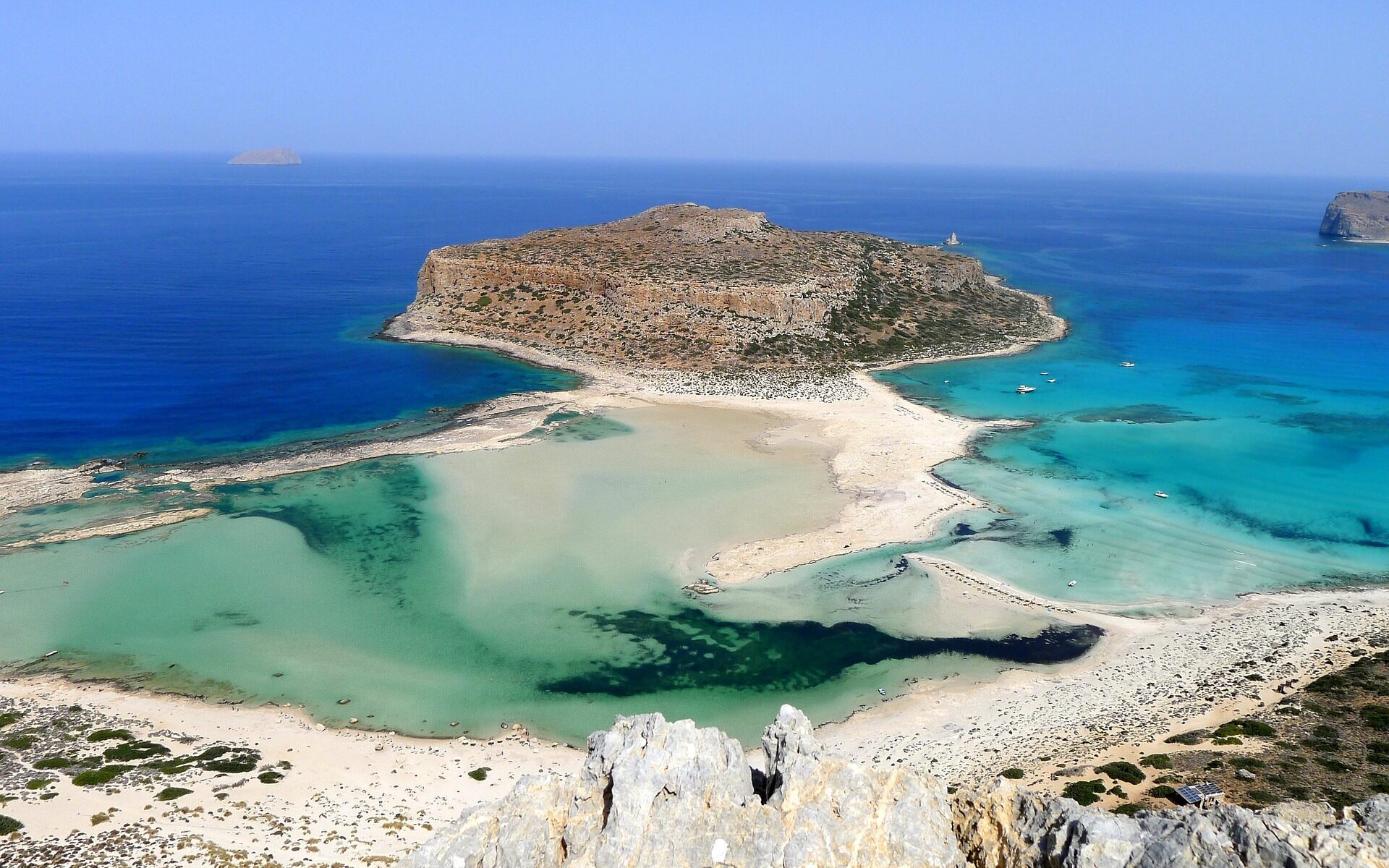
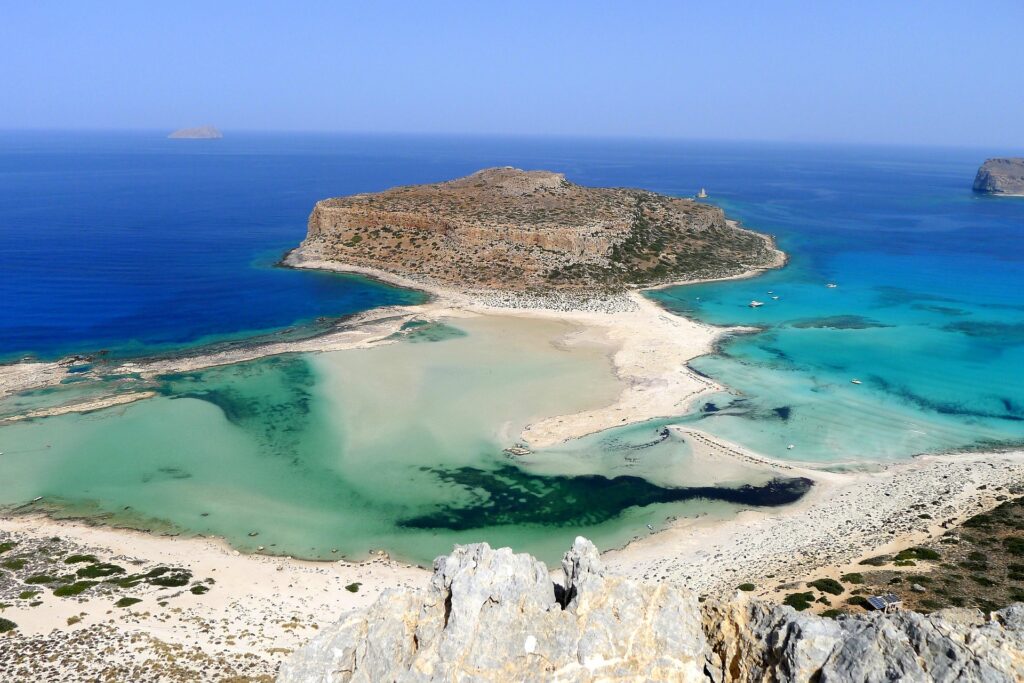
Balos Beach Chania is the image that sold half of northern Europe on booking a holiday in Crete. You have seen the photograph a hundred times before you ever arrive: a wide, shallow lagoon, water somewhere between turquoise and white, a pale sandbar connecting the mainland to a small rocky island, and cliffs dropping into the sea in every direction. The reality, when you finally stand at the viewpoint above it, is that the photograph has not lied. It is genuinely that colour. The lagoon actually does look like that. That does not happen often in travel.
What the photograph does not show is the road to get there, the crowd that arrives with the first ferry at midday in August, or the walk back up to the car park in 35-degree heat. Balos rewards preparation. Come without it and the day can unravel fast. Come with it and you have one of the best beach days in the Mediterranean.
The lagoon sits in the far northwest of Crete, almost at the end of the Gramvousa Peninsula. From Chania town, the drive is around 53 kilometres and takes roughly 75 minutes in normal traffic. Allow more in summer.
| Distance from Chania | 53km, about 75 minutes |
|---|---|
| Difficulty | Easy to moderate (road and short hike) |
| Time needed | Full day |
| Best season | May, June, September, October |
| Parking | Small fee at parking area above beach |
| Entrance fee | Small fee per person at the road barrier |
| Rental car needed? | Yes, or organised boat trip from Kissamos |
| Family friendly? | Yes, with young children (shallow lagoon) |
What Balos Beach Chania Actually Looks Like
Balos is a shallow lagoon with fine sand and broken shells over a bright seabed. That is why the water looks milky-turquoise from above. It is not a trick of light or of photography. The colour is real and it changes with the time of day and the angle of the sun. Early morning it is quieter, more blue. By midday, when the ferries arrive, the lagoon is full of people and the water is stirred to something almost white.
The famous pink sand appears in small patches of crushed shells. It is beautiful and natural, but not a pink carpet from end to end. Come with realistic expectations and enjoy the colours when they appear.
In front of the lagoon lies the 117-metre-high islet of Tigani, connected to the Gramvousa Peninsula by a flat sandbar. Depending on the season and weather conditions, the sandbar changes its shape and width and can occasionally be cut off from the sea.
Balos is considered one of the safest places to swim in Crete. The beach is very shallow and there are almost no strong currents. Buoys are placed in the water to prevent boats from coming too close to the swimming areas. The lagoon side is calm enough for small children to wade around in. The north side of the sandbar opens to a deeper bay, and that is where adults who actually want to swim tend to go.
Local tip: The best view of Balos is from the cliff viewpoint above the beach, about halfway down the path from the car park. Every visitor coming by car passes through it. If you arrive by boat, it is worth making the 15-minute climb up from the jetty just for this view. You will understand immediately why the photograph travels so well.
The Two Ways to Get to Balos
There is no single right way. Each has its advantages. The wrong way is arriving unprepared by either route.
By Car and on Foot
The road is paved and in good condition until Kaliviani. After Kaliviani, the road turns into a dirt track. This part of the drive is approximately 9 km long and can be bumpy.
The road is narrow, unpaved and close to drops in some places. Drive slowly and do not rush. Turning around is not always possible. Most rental cars can manage it. Small hatchbacks do this road every day. But you need to be comfortable driving slowly on rough terrain, and you need to leave the mirrors on the car.
Warning: Most standard rental car agreements do not cover damage caused on unpaved roads. With most rental companies, driving on unpaved roads is not covered by insurance, and in the event of damage or a breakdown, you will cover the costs yourself. Many rental companies now use GPS tracking to trace the vehicle in case of damage. Check your agreement before you go. If in doubt, book the boat instead.
From the car park, it is about a 20 to 30-minute downhill hike along a rocky path to the beach. The descent is straightforward and the views open up as you go. The hike back up usually takes 30 to 40 minutes, depending on your pace and fitness level. In July and August, doing that return climb at 2pm in full sun is unpleasant. Plan to leave the beach by early afternoon or wait until the heat drops.
If you want to enjoy the lagoon without crowds, visit before 9am during peak season and before 11am during the shoulder months. The best part about driving is that you can go early and stay late. There are lots of people on the beach when the tour boats arrive. Going before them, or staying after they leave, is a genuinely different experience.
By Boat from Kissamos
Another option is to take a ferry from Kissamos Port. Boats depart between 10:00am and 12:00pm, with capacities from 300 to 1,200 passengers across different companies. The journey to Balos itself takes roughly 1 hour and 20 minutes.
Visitors can enjoy 2.5 hours at Balos. The itinerary also includes a 2-hour stop at the island of Imeri Gramvousa before returning to Kissamos Port. The entire excursion lasts 8 hours, with the return boats scheduled to arrive back at Kissamos between 17:00 and 19:00.
Check the official website for current ticket prices and book ahead. During the high season, it is common for these ferries to be fully booked in advance.
The boat option makes logistical sense if you are staying in Kissamos or nearby, or if you do not want to deal with the road. The downside is the fixed timetable. You get 2.5 hours at Balos, which sounds like enough until you are actually standing in that lagoon and want to stay longer.
Local tip: Private boat trips from Kissamos, Chania Old Port, or Kolymbari are a genuine alternative to the big ferries. You get flexible timing, fewer people, and the chance to stop at smaller coves along the peninsula that the ferry never visits. Worth considering if there are four or more of you travelling together.
Gramvousa Island
If you go by boat, you will stop at Gramvousa Island before Balos. Most people treat it as a nice bonus. It deserves more attention than that.
On this rocky island, located about two kilometres from Balos, lie the ruins of the 16th-century Venetian fortress of Kastro Gramvousas. In the early 19th century, the castle served as a pirate hideout, and at times up to 3,000 people are said to have lived here. This is why the area is also known as the Pirate Bay of Balos. Even today, the fortress walls are still fully preserved in places.
The climb to the fortress from the beach takes around 20 minutes and it is steep. But the view from the top, looking down at the turquoise water and back toward the peninsula, is one of those views in western Crete that you will still remember on the flight home. Go early when the boat docks, before the crowd fills the path.
Gramvousa is only accessible by ferry or private boat. There is no road connection to the island.
Crowds, Timing and What Nobody Tells You
Balos is the most photographed beach in Crete. It is extremely popular in July and August. Even late October can feel busy.
The crowd pattern by car is different from the crowd pattern by boat. If you arrive by car before 9am, you will have the lagoon mostly to yourself for an hour or two. There are lots of people on the beach when the tour boats arrive. That changes the atmosphere completely. The water goes from clear to cloudy in an hour once a thousand people are wading through it.
Conservation measures introduced in recent seasons include reduced ferry services and a cap on visitor numbers. Plans for shuttle buses in Kaliviani are in place to limit car traffic on the dirt road. If this system is operational when you visit, you may need to park at Kaliviani and transfer by minibus. Check local information before you go, as the situation is still evolving.
There are a few organised sunbeds and beach umbrellas but they tend to be booked out by 10 to 10:30am or even earlier. If a sunbed matters to you, arrive early or bring your own mat.
Warning: There is almost no shade at Balos. The beach faces south and the cliffs behind offer nothing. By late morning in summer, the heat is intense. Bring more water than you think you need, and a good hat. The small snack bar on the beach sells cold drinks but the prices reflect the location.
Facilities at Balos
Keep your expectations realistic. The snack bars on the beach and at the car park only sell packaged snacks and drinks, and they are not particularly good. Bring your own food if you want a proper lunch. Sunbeds and umbrellas are available for hire on the beach. There are toilets at the car park. There are no toilets on the path down.
The beach has no lifeguard. The lagoon is safe, but the deeper bay on the north side can have stronger currents on windy days.
Frequently Asked Questions
Is Balos Beach worth visiting?
Yes, without much hesitation. The lagoon is as remarkable as the photographs suggest. The colour of the water, the sandbar, the views from the cliff above, the island of Gramvousa nearby: these are genuinely special things. The effort required to get there is real but manageable with preparation.
How crowded does Balos get?
Very crowded in July and August, particularly from late morning when the ferries arrive. To avoid the worst of the crowds, visit early in the morning or late in the afternoon. For a more peaceful experience, visit during the quieter months of May, June, September, or October.
Can children visit Balos?
Yes. The shallow waters make Balos ideal for swimming and wading, especially for families with children. The hike down from the car park is around 20 minutes on a rocky path. Children who are comfortable walking on uneven ground will manage it without difficulty. The lagoon itself is calm and very shallow.
How long does a day at Balos take?
Allow a full day. If you are driving from Chania, that is roughly 75 minutes each way plus the dirt road section. Add the hike down and back up, plus time on the beach. A full day out from Chania is a realistic commitment. If you go by ferry, the entire excursion lasts 8 hours, with the return boats arriving at Kissamos between 17:00 and 19:00.
Is the road to Balos really that bad?
It depends on your driving experience. The road is narrow, unpaved and close to drops in some places. Drive slowly and do not rush. Turning around is not always possible. Small cars do it regularly. But check your rental agreement first, and do not attempt it in the dark.
Is Balos better than Elafonisi?
They are different. Elafonisi is easier to reach, has more facilities, and also has pink sand. Balos has more dramatic scenery, a more enclosed lagoon, and the added bonus of Gramvousa island nearby. Both are worth a day of your holiday if you are spending a week or more in western Crete.
The Honest Notes
Both routes to Balos have a catch. The road is rough and most rental agreements do not cover you. The ferry gives you limited time at the beach on a fixed schedule with hundreds of other people.
Warning: Boat trips may be shortened or cancelled due to wind or waves. Keep alternative plans if visiting by sea. The northwest coast of Crete can pick up swell quickly in spring and autumn. If the sea is rough, ferries do not run. Check before you leave Chania.
Balos is a protected area. Visitors are strongly urged to collect all garbage, avoid plastic, and refrain from taking sand or shells, to ensure the lagoon remains healthy for future visitors. The pink sand comes from crushed shells. Taking a bag of it home is damaging, and it is also illegal.
Warning: August is the peak of peak season. The car park fills before 9am and the beach is wall-to-wall people by 11am. If your holiday falls in August and Balos is on your list, either be there at first light or go by private boat at an early departure time. Arriving at noon hoping for a quiet lagoon will disappoint.
Before You Go
- Water: bring at least 2 litres per person. The snack bar on the beach is expensive and may have queues.
- Shoes: trail shoes or sturdy trainers for the rocky path down and back up. Not flip-flops.
- Sun: no shade on the beach or the path. Hat, sunscreen and a cover-up are essential in summer.
- Food: bring lunch. The snack bar has limited options. There is no taverna at Balos.
- Cash: the entrance barrier and parking typically require cash. Bring small bills.
- Toilets: available at the car park. None on the path down.
- Car insurance: check your rental agreement before driving the dirt road.
- Sunbeds: arrive before 10am if you want one. They go fast.
Getting There
By Car
From Chania, take the E65 coastal highway west toward Kissamos. Continue through Kissamos town and follow signs for Kaliviani and Gramvousa Peninsula. The road is paved and straightforward until Kaliviani village, where it becomes a dirt track for the final stretch. This stretch spans 7.4km of dirt road and typically takes around 30 minutes to reach the parking area. During the high season at peak times, the journey may take up to 1.5 hours due to increased traffic and difficulty finding parking.
Leave Chania by 7:30am in summer if you want to arrive early. The difference between arriving at 8:30am and 11am in August is significant.

By Bus and Ferry
Chania city centre hosts the central bus station, which is the starting point for public transport to Kissamos. From April to September, the Kissamos bus route extends to Kissamos Port to connect with the Balos ferry service. This option works but requires careful planning around ferry departure times. Check the current KTEL timetable before travelling, as schedules change between seasons.
By Organised Tour
This is the most stress-free option for visitors who do not want to drive the road or navigate bus connections. Organised tours depart from hotels across western Chania, include a coach transfer to Kissamos Port, and handle the boat tickets.
Practical Information
| Location | Gramvousa Peninsula, northwest Crete |
|---|---|
| Distance from Chania | 53km, approximately 75 minutes |
| Distance from Kissamos | 15km to the start of the dirt road |
| Entrance fee | Small fee per person at the road barrier (check current rates) |
| Parking fee | Small fee at car park above beach |
| Facilities | Snack bar, toilets at car park, sunbeds and umbrellas for hire |
| Ferry from Kissamos | Departs 10:00am to 12:00pm, check current schedules |
| Season | Accessible roughly May to October |
| Best months | May, June, September, October |
| Nearest town | Kissamos (Kasteli), about 15km |
Combine With
Balos sits in the far northwest of the island, which means you are already out near Kissamos. Make the most of the drive.
Falassarna Beach is 30 minutes south of Kissamos. A long sandy beach facing west, with a proper sunset if you time it right. Completely different feel from Balos: more open, more accessible, and with better tavernas nearby. Easy to combine on the same day if you go to Balos early and finish at Falassarna in the afternoon.
Kissamos Town itself is often overlooked as a lunch stop. It has a small Venetian and Roman history museum, a seafront promenade, and a handful of honest tavernas that tourists from Chania rarely find. Worth an hour before or after the Balos boat.
Polyrrenia is a ruined ancient city about 7km south of Kissamos, sitting on a hill above a small village. The drive takes 15 minutes from Kissamos. The site is largely unexcavated and there is no entrance fee. The views over the bay are very good and you will have it almost to yourself.
Chrissoskalitissa Monastery is about 45 minutes south of Kissamos on the road toward Elafonisi. A white monastery on a rocky headland above the sea, with 90 steps cut into the cliff. Not a tourist spectacle. Worth a stop if you are making the longer drive down toward Elafonisi on a separate day.
Local tip: If you drive to Balos, do not rush back to Chania the moment you reach the car park. The light on the Gramvousa Peninsula in the late afternoon, with the sun dropping toward the sea to the west and the cliffs turning amber, is genuinely worth sitting still for a few minutes. Falassarna is 30 minutes south for sunset. That is the drive to make.