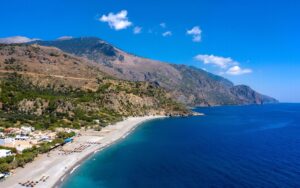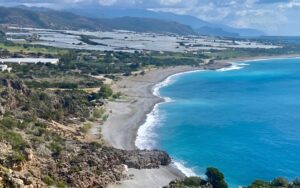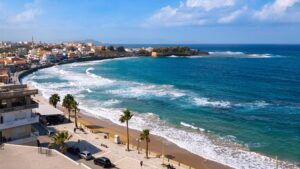
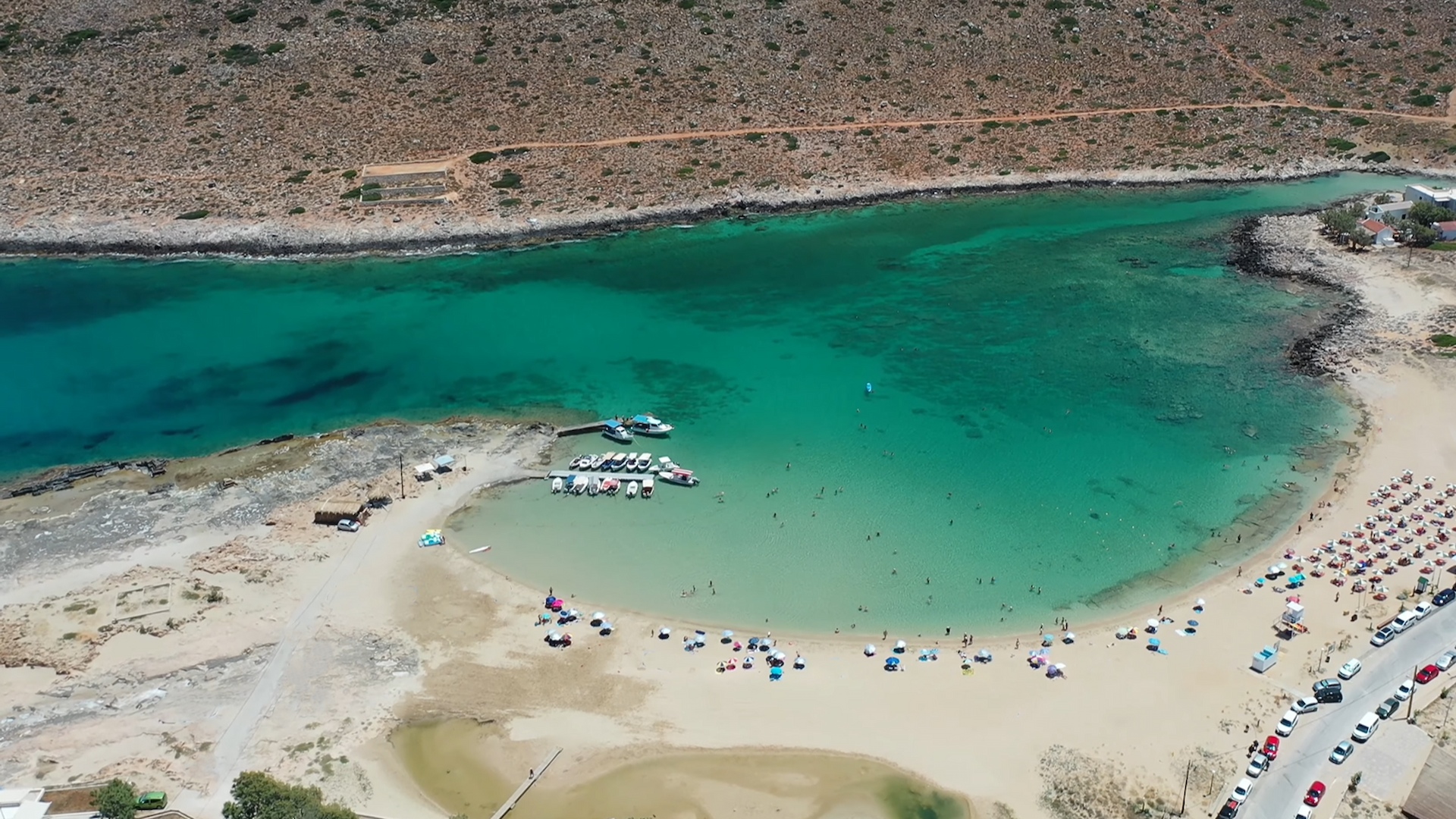
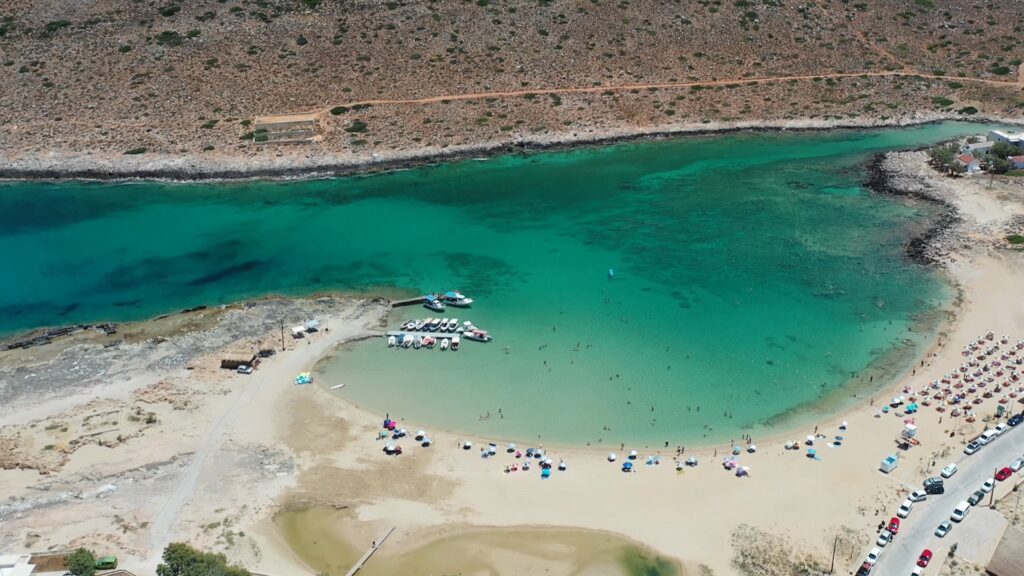
Stavros Beach Chania is, without question, one of the most relaxed and genuinely family-friendly beaches on the entire Akrotiri Peninsula. A near-perfect circular lagoon, protected on three sides by a dramatic limestone headland. The water is shallow, clear and almost always calm. Most tourists who come here arrive for the Zorba the Greek connection and end up staying far longer than they planned.
That is the thing about Stavros. It does not try very hard. There are a few tavernas, a stretch of hired sunbeds, and a mountain sitting right behind you. The film crew left sixty years ago, but the bay looks more or less the same. That mountain is still there. The water is still that colour.
What it is not is secret. In July and August, Stavros fills up quickly. It gets busy in summer, so get there early if you want a good spot. Arrive after 10am on a weekend in peak season and you will be looking for somewhere to put your towel. But get there early, or come in May, June, September or October, and you will understand why people keep coming back.
| Distance from Chania | 17km, about 25 to 30 minutes |
|---|---|
| Difficulty | Easy |
| Time needed | Half day to full day |
| Best season | May, June, September, October |
| Parking | Free, roadside near the beach |
| Entrance fee | None |
| Rental car needed? | Recommended, but bus is possible |
| Family friendly? | Yes, excellent for young children |
What Makes Stavros Beach Chania Different
Stavros sits at the northern tip of the Akrotiri peninsula, a 17 kilometre drive from Chania. The beach is a circular bay almost entirely enclosed by a dramatic limestone headland, which creates a natural bowl of perfectly calm, clear turquoise water. That enclosed shape is everything. While other beaches on the north coast of Crete can be choppy or windy, the enclosed shape of the bay provides natural protection from most wind directions.
The main beach is sandy, with golden tones and occasional pink hues. The water is clear and shallow across most of the bay, creating very safe swimming conditions for families. There are no sudden drop-offs, no rocks underfoot in the central section, and no significant current. If you are travelling with small children, this matters more than almost anything else.
The edges of the bay become rocky, which makes them suitable for snorkelling. There is not much in the way of large marine life, but the water clarity is good and younger snorkellers will enjoy the rocky edges between the two beaches.
There are two beaches at Stavros, not one. The main beach is on the east of the village. It is a small semicircular lagoon, completely protected from the winds of the area. The bay has white sand and turquoise shallow waters. The second beach is located northwest of the village, only 200 metres from the main beach. It is quieter than the main beach and if the weather allows it, it’s a great option.
Local tip: The second beach to the northwest gets less sun in the morning and is more exposed to north wind. If the main beach feels too organised or too busy, walk over. It often has empty patches of sand even when the main bay is packed.
The Zorba the Greek Connection
You cannot write about Stavros without talking about the film. The bay became internationally famous as the filming location for Michael Cacoyannis’s 1964 film Zorba the Greek, based on Nikos Kazantzakis’s novel. The iconic final sirtaki dance scene, performed by Anthony Quinn and Alan Bates on the beach, was shot against the distinctive limestone rock that rises at the western edge of the bay.
The village started becoming more famous around 1964, when the beach scenes from the famous movie Zorba were filmed. Anthony Quinn is dancing the well-known Greek syrtaki dance, composed by Mikis Theodorakis, against the backdrop of the Stavros Mountain.
The movie received three Academy Awards and four nominations. That rock formation behind the bay, which looks vaguely like a camel from the right angle, is the one from the final scene. It is immediately recognisable if you have seen the film. Even if you have not, it is a genuinely dramatic piece of landscape.
A small taverna near the beach now carries a poster of the scene, and the rock itself is immediately recognisable. Some of the beachside restaurants play the Theodorakis soundtrack. It can feel slightly theatrical in high season. Come in the shoulder months and the whole thing is considerably more atmospheric.
The cave in the film’s famous mine scene was Lera Cave, cut into the Vardies mountain directly above the beach. You can hike up to it.
Lera Cave and the Vardies Mountain
The cave Lera is formed at the west slopes of the steep mount Vardies, at an altitude of 70 metres, above the lagoon of Stavros. The cave took its name after the chieftain of Cape Akrotiri, Stephanos Leras, who was hiding around the area between 1821 and 1833.
Excavations certified its use from the Neolithic to the Byzantine period, with important findings being inscriptions of the Classical period mentioning the worship of the god Pan and the Nymphs. Then in 1964, the film crew arrived. The choice of Stavros for the shooting of the legendary film by Cacoyannis with Alan Bates and Anthony Quinn brought Hollywood taste to the picturesque harbour. The cave Lera played the role of the lignite mine in the film.
The Lera Cave Trail is considered a moderate route with an elevation gain of 462 feet, taking approximately 30 to 60 minutes to complete. The path starts from the beach and goes more or less straight up. The path to the cave is easy to spot, and more or less a straight shot, from sea level directly up to the cave. It is steep. Do not attempt it in sandals or without water, and do not attempt it in the heat of a July afternoon.
The view from the cave entrance is the payoff. The entire lagoon spreads out below you. You can see the exact angle the film crew used in the final scene. Little Stavros lay beneath us, framed by the outline of the cave, with the sun setting over the sea. The view stretches far down the coast, toward Chania.
Warning: The Lera Cave trail is steep and partially unmarked. The rocky path can be slippery in dry conditions. Wear proper shoes, bring water, and go in the cooler morning hours. Not suitable for young children or anyone with mobility issues.
Facilities at Stavros Beach
Stavros’s distinctive features include its powdery sands, clear waters, and a natural lagoon protected by a limestone mountain. Visitors can enjoy sun loungers, umbrellas, and nearby tavernas serving Cretan cuisine.
The beach is organised but not aggressively so. There are sunbeds available for hire in the central section, but there is still free sand on either side. There is still plenty of free space to spread out on the beach. You do not have to pay to be here. That is worth knowing.
There is a lifeguard on duty during the main summer season. That matters if you are travelling with children.
For food and drink, Mama’s Place offers a variety of food options including breakfast and coffee in a casual setting, and Koulieris Restaurant provides a family-friendly dining experience with traditional Greek cuisine. Almyriki Restaurant is a top choice, offering Greek, fish and seafood options with a high rating and excellent reviews.
Parking is free and easy, at least early in the day. Free parking is available near the beach. You can park along the road near the beach, and there’s generally ample space if you arrive early. However, during peak season it’s advisable to arrive early as it can get busy.
Warning: In July and August, parking at Stavros fills up fast. Arrive before 9am if you want a space near the beach. After 10am on a weekend, you may end up parking further away in the village and walking down.
The Venetian Quarry Peninsula
Between the two beaches sits a small rocky peninsula worth ten minutes of your time. Before you leave, take a walk on the small peninsula that separates the two beaches, as it houses the ruins of the Venetian quarry from which the limestone was excavated for the construction of the walls of the city of Chania.
The quarry itself is not dramatic to look at. A few carved rock faces, some rough cut marks. But knowing that the stone for the harbour walls of Chania was cut here by hand and shipped up the coast puts a different frame around the landscape. The peninsula also gives you the best view back across the main lagoon.
Local tip: Walk to the far end of the peninsula in the early morning before the beach fills up. The light on the water at that hour is excellent, the main bay is often glass-flat, and you will have the view entirely to yourself.
Before You Go
- Water: bring at least a litre per person. The tavernas are close but fill up fast in summer.
- Sun: the bay faces north and gets full sun from late morning. Hat and sunscreen essential.
- Shoes: regular shoes or sandals are fine for the beach. For the Lera Cave hike, wear proper trainers or trail shoes.
- Toilets: available at the beach. Use them before heading to the cave or the peninsula.
- Cash: the smaller beach bars and some parking areas may be cash only. Bring some.
- Sunbeds: only in the central organised section. Free sand is available at both ends of the bay.
Frequently Asked Questions
Is Stavros Beach safe for young children?
Yes. The beach features a shallow, sheltered bay with calm waters, making it ideal for children to play safely. The sandy bottom is gradual, there are no sudden drops, and a lifeguard is on duty during peak season. This is one of the best beaches near Chania for families with toddlers or early swimmers.
How crowded does Stavros Beach get?
Stavros is popular but not overwhelming compared to beaches like Elafonisi or Balos. The area can become busy on weekends from June onwards, and July and August peak season brings significant crowds by mid-morning. Arrive before 9am for the best experience. May, June and September are noticeably calmer and more pleasant.
Is Stavros Beach worth visiting if I have not seen Zorba the Greek?
Yes. The film connection is interesting context, but the beach is worth visiting entirely on its own merits. The sheltered lagoon, the mountain backdrop, the shallow clear water. These work independently of any cinema history. That said, watching the film the evening before your visit adds something to the experience.
How difficult is the Lera Cave hike?
The Lera Cave trail is considered a moderate route with an elevation gain of 462 feet, taking approximately 30 to 60 minutes to complete. The trail is short but steep and rocky in places. It is manageable for reasonably fit adults. Not suitable for small children, and not something you want to attempt in flip-flops or during the hottest part of a summer day.
Can I visit Stavros Beach without a car?
KTEL operates a bus from Chania to Stavros roughly every four hours. Check the current timetable at e-ktel.com before you travel. Bus services are limited on weekends, so the car or a taxi is considerably more practical if you want flexibility. The drive from central Chania is straightforward and well-signposted.
What is the best time of year to visit Stavros Beach?
April to May or October bring fewer crowds, cooler weather, and are perfect for photography and peaceful walks. For swimming, the water is comfortably warm from June through to October. July and August are the busiest months. If swimming is the priority and crowds are not, September is the best single month.
The Honest Notes
Stavros is as good as it looks in photos. But there are things other travel sites do not tell you.
Warning: The sunbed prices at Stavros are notably higher than at comparable beaches on the Akrotiri Peninsula. The Zorba connection gives the beach operators a pricing argument they are not shy about using. The free sections of beach are perfectly good. Use them.
The village of Stavros itself is pleasant but small. There is no nightlife here and only a handful of restaurants. If you are based in Chania and doing a day trip, that is fine. If you are staying in Stavros for a week, you need to be someone who genuinely wants very little to happen. Some people do. It suits them perfectly.
Warning: The bay faces north, which means the sun arrives late morning. If you want all-day sun from 8am, you need to know this. In June, the sun clears the mountain properly around 10am. In early May it can be later still.
The second beach to the northwest is genuinely worth knowing about. On days when the main bay is packed, that beach is often half empty. It is more exposed to wind, but on a calm day it is a quieter and more pleasant option. Most tourists never make the 200-metre walk around the peninsula.
Getting There
By car: Stavros sits at the northern tip of the Akrotiri peninsula, a 17 kilometre drive from Chania. From central Chania, follow the signs toward Akrotiri and then Stavros. The road passes through pine forest and past the Chania airport before climbing north through the peninsula. It is well-paved and clearly signed throughout. Allow 25 to 30 minutes from the old town.

If you are arriving at Chania Airport, Stavros is actually closer to the airport than to the city centre. If you pick up your hire car from Chania Airport, it is a short drive under 10 km with very little traffic, directly north from the airport without having to go into Chania town.
By bus: KTEL operates a bus from Chania to Stavros roughly every four hours. The journey takes around 40 minutes. Check the current timetable at e-ktel.com as schedules change seasonally. This is a workable option if you are not renting a car, but the infrequent service means you need to plan your return carefully.
By taxi: Taxis from central Chania to Stavros are available. There is no Uber or Bolt in Chania. Agree the fare before you get in, or make sure the meter is running.
Organised tour: Several day trip operators in Chania run tours to the Akrotiri Peninsula that include Stavros combined with the monasteries of Agia Triada and Gouverneto. This is a good option if you want context and logistics handled for you.
Practical Information
| Location | Stavros village, Akrotiri Peninsula, Chania |
|---|---|
| Distance from Chania | 17km, 25 to 30 minutes by car |
| Distance from Chania Airport | Approximately 10km, 15 minutes |
| Parking | Free, roadside. Can be busy in peak season |
| Entrance fee | None |
| Sunbeds | Available for hire, central section only |
| Lifeguard | Yes, in peak season |
| Toilets | Yes, at the beach |
| Tavernas | Several, within 2 to 5 minutes walk |
| Bus | KTEL from Chania, roughly every 4 hours |
| Best months | May, June, September, October |
| Not recommended for | Those wanting nightlife or busy resort atmosphere |
Combine With
Stavros sits at the northern end of the Akrotiri Peninsula, and the peninsula rewards a full day of exploration. These nearby destinations combine well.
Agia Triada Monastery. You can visit the nearby Holy Trinity Monastery and Gouverneto Monastery on a tour of the Akrotiri area. Agia Triada is 10 minutes south of Stavros and one of the most photogenic monasteries in Crete. Note that most monasteries on Akrotiri are closed on Wednesdays and Fridays.
Gouverneto Monastery and Avlaki Gorge. Further north on the peninsula from Agia Triada. Just a bit further inland lies the Gouverneto Monastery, one of the oldest in Crete, where visitors can walk through centuries-old religious architecture and even hike down the nearby Avlaki Gorge to the ruins of the ancient Katholiko Monastery.
Marathi Beach. A small beach on the eastern side of the Akrotiri Peninsula, about 10 minutes by car from Stavros. Less visited than Stavros, with a small harbour and one or two fish tavernas. Good for a quieter lunch stop.
Kalathas Beach. Stavros is on the Akrotiri peninsula, which has other beaches like Kalathas, located about 8 kilometres south of Stavros. A wider, sandier beach with more facilities. Good option if Stavros is packed.
Local tip: If you are doing the Lera Cave hike, go at the end of the afternoon, not midday. The trail faces west and the sun is brutal on the way up in summer. Go around 5pm in July or August. By the time you reach the cave entrance, the light on the water below is doing something interesting, and the view back across the lagoon toward Chania in the late afternoon is the best version of it there is.