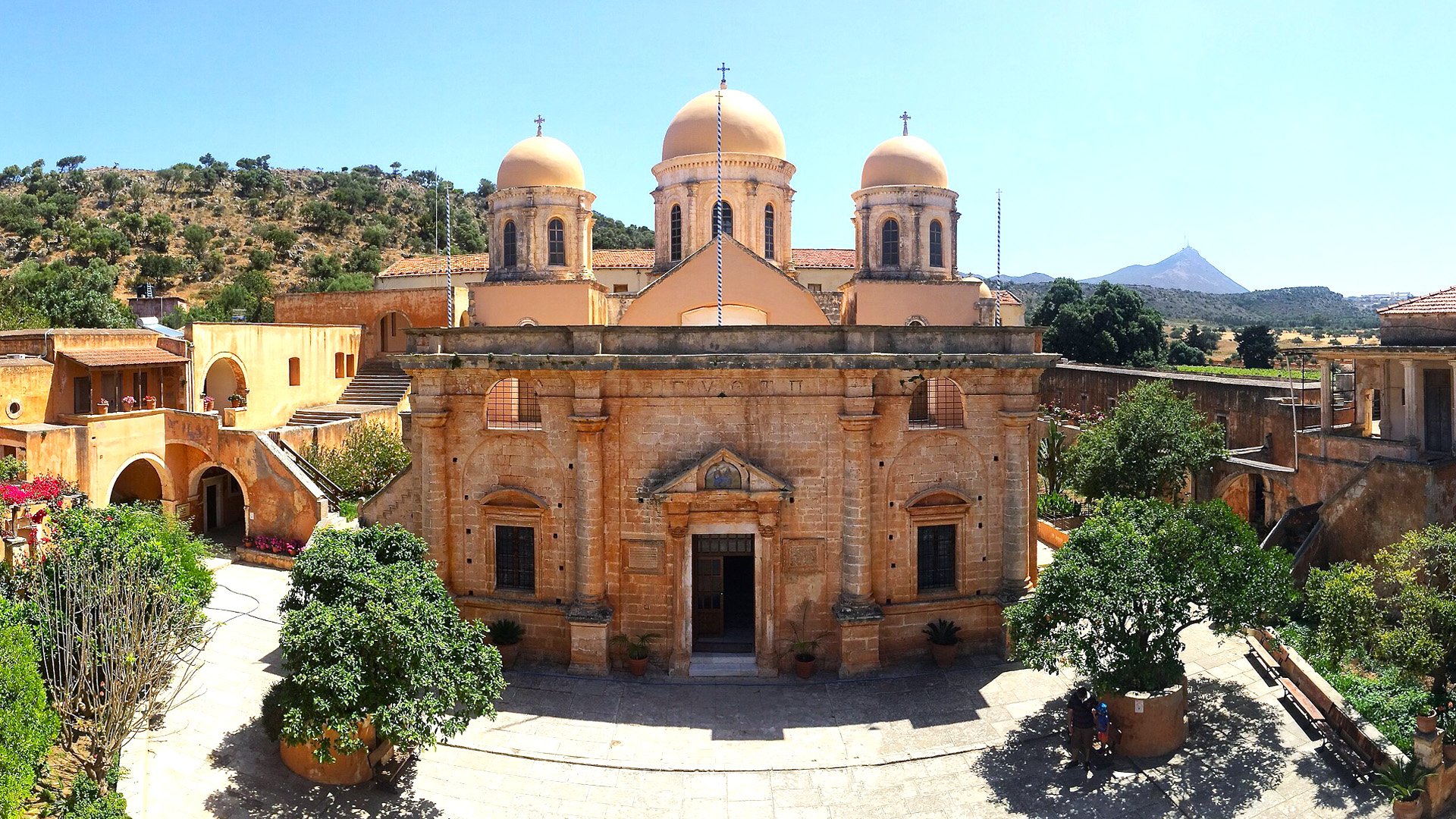
Agia Triada Monastery Chania is one of the most accessible and rewarding cultural stops in the whole of western Crete. It sits on the Akrotiri Peninsula, less than 20 kilometres from the city centre, close enough to reach before breakfast and combine with a morning swim at Stavros. Most tourists drive straight past it on the way to the airport. That is their loss.
This is not a ruin or a museum piece. The monastery is still inhabited. Monks continue their traditions of prayer and communal living within its walls. You can feel the difference the moment you walk through the gate. The courtyard is swept. The garden is tended. The smell of incense drifts from the church. It has the quiet weight of a place that has been continuously cared for across four centuries.
Go on a weekday morning in May or October and you may have the place almost to yourself. Go on a Tuesday in August at 11am and you will share it with several coach parties. Both experiences are valid. But one is considerably better.
| Distance from Chania | 15 to 20km, about 25 to 30 minutes |
|---|---|
| Time needed | 1 to 2 hours |
| Best season | Year-round. Spring and autumn are quietest |
| Opening hours (summer) | Daily 08:00 to sunset |
| Opening hours (winter) | Daily 08:00 to 14:00 and 16:00 to sunset |
| Entrance fee | Small fee at the gate. Cash only, no ATM nearby |
| Parking | Free on site |
| Rental car needed? | Recommended |
| Family friendly? | Yes |
The History of Agia Triada Monastery Chania
According to historical sources, including the Venetian archives, the monastery was built by the brothers Jeremiah and Lavrentios Tzagarolon, descendants of a great Venetian-Cretan family. Construction began in 1611 and was completed after the fall of Chania to the Ottoman Turks in 1645. The brothers were already monks at the nearby monastery of Gouverneto. It is said that Jeremiah travelled to Mount Athos to copy the construction plans for the new monastery. That detail alone tells you something about the seriousness of what they were building.
During the Ottoman period, the monastery was known as the “Selvili Manastir”, meaning the “Monastery with the cypress trees”. The cypress trees lining the entrance road are still there. They are enormous now.
The monastery survived the Ottomans for generations. The outbreak of the Greek War of Independence in 1821 forced the monks to abandon it, and the building was then looted and burned by the Turks. The period of desolation ended in 1834 when reconstruction began, followed by a new thriving phase. In 1892, a Church School was erected here, which trained notable priests and teachers, and in 1930 it evolved into a seminary.
Today the monastery is Stavropegic, meaning it is directly managed by the Ecumenical Patriarchate of Constantinople. That puts it in rare company. It answers to Constantinople, not to the local bishop.
Local tip: The drive up to the monastery through the Akrotiri Peninsula passes some of the finest olive country in western Crete. The groves are ancient. Keep your eyes on them rather than your phone.
What to See Inside
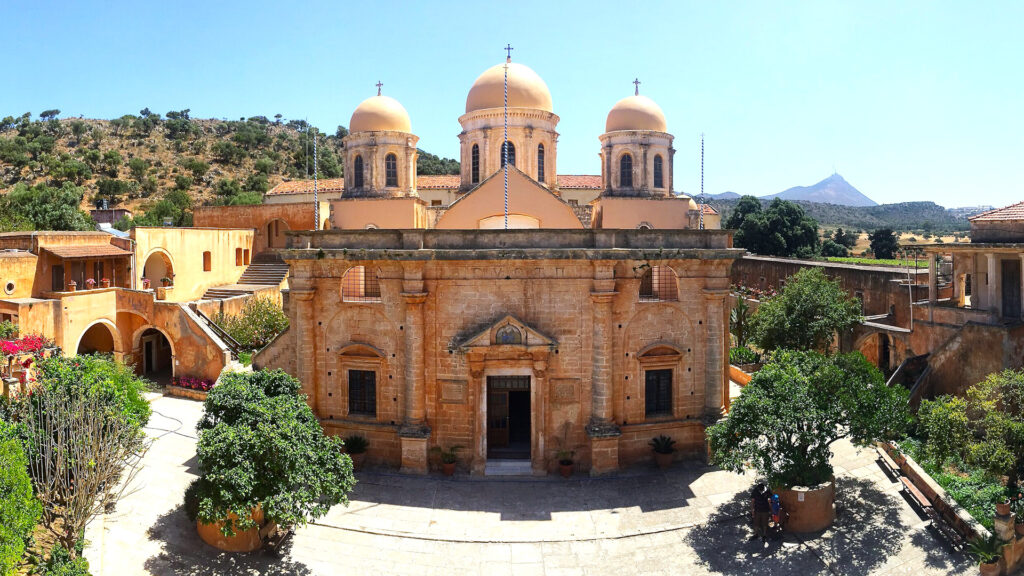
The Main Church (Katholikon)
The Holy Trinity Monastery is probably the most impressive monastic complex of the final period of Venetian rule on Crete, due to both its scale and architectural form. It combines elements of the Orthodox monastic style with western architectural forms, reflecting the spirit of convergence of the two dogmas on the island of Crete.
The facade of the church has double columns of Ionian and Corinthian style and bears an inscription in Greek, dated to 1631. The church is built in the Byzantine cruciform style with three domes. The main church is flanked by two smaller domed chapels, one dedicated to the Life-Giving Spring (Zoodochos Pigi) and the other to Saint John the Theologian.
Inside, the air is cool and heavy with incense. The iconostasis is gilded. Your eyes adjust slowly after the bright Cretan sun outside. Take a moment. It earns one.
The Museum
The monastery also has a library containing some rare books, and a museum which contains a small but valuable collection of icons and ecclesiastical heirlooms that have survived the catastrophes of the past. Among the most important exhibits are a 12th-century manuscript and an ensemble of 16th to 17th-century icons, including the “Enthroned Christ”, the “Source of Life” and the “Second Coming” (1635 to 1645), works attributed to the artist from Chania Father Emmanuel Skor.
The folk museum, located in the basement, holds a fascinating collection of historical objects, including agricultural tools, an old mill, and a traditional screw press. It is easy to overlook and worth seeking out.
The monastery also contains a room with human skulls and bones. It surprises most visitors. It is a traditional Orthodox ossuary. Worth knowing before you go in with children.
The Roof and Upper Walkways
Many visitors highlight the opportunity to explore the monastery’s roof and upper walkways, which offer panoramic views of the surrounding landscape. The views over the olive groves toward the sea are genuine. This is not a feature most visitors know to look for. Ask at the entrance if access is open.
The Shop and Tasting
The monastery cultivates organic olive groves and vineyards, producing extra virgin olive oil, fine wines, and traditional tsikoudia (a local spirit). Visitors can also purchase pure thyme honey and balsamic vinegars infused with thyme honey or fresh orange, all made on site. Tasting the monastery’s fine organic products, including olive oil, wine, tsikoudia, and thyme honey, is free of charge.
The olive oil of Agia Triada Monastery has won many awards. Buy a bottle. It travels well and it is the real thing.
The Gardens and Grounds
The monastery is surrounded by large fields planted with olive groves, vineyards, and cypress trees. The approach road alone is worth the drive. The entrance to the monastery is impressive, and the road leading to it is lined with huge cypress trees.
Inside the walls, the central courtyard is planted with flowers and citrus trees. Cats appear from everywhere. They are resident, friendly, and completely unbothered by tourists. The garden has the slightly chaotic look of something that has been growing for centuries without a landscaper’s interference. It is better for it.
Local tip: Come early in the morning if possible. Tour buses from Chania begin arriving from around 10am in peak season. The monastery between 8am and 9:30am on a weekday is a completely different experience to midday on a Saturday in August. The light is also better for photographs.
What to Wear
This is an active place of worship. Proper attire is essential, with covered shoulders and knees. That applies to everyone, regardless of the heat outside. Loose scarves are available at the entrance for those who arrive unprepared, but it is better to come ready. ATMs are scarce nearby, so come with cash. The entrance fee is small and the shop is cash-preferred.
Warning: Photography inside the main church is not permitted. The monks take this seriously. Photograph the courtyards, the gardens, the rooftop views. Put your camera away before you enter the church.
The Honest Notes
Agia Triada is genuinely worth visiting. It has substance: real history, working monks, excellent products, and architecture that earns your attention. But it is not without its frustrations.
Warning: Opening hours can shift around religious holidays and feast days without much advance notice. The summer hours (daily from 08:00 to sunset) are generally reliable, but check before you make it the main event of your day. A quick call to the monastery (+30 28210 63572) is worth it if you are travelling specifically for this.
Warning: Wheelchair access is limited once inside the monastery walls. There is a dedicated entrance, but movement through the grounds and gardens is difficult. Be aware of this if travelling with anyone with mobility challenges.
The commercial element, the shop and the tasting area, sits at the entrance and some visitors find it jarring. It is not. The monastery has always been an agricultural and economic enterprise as much as a spiritual one. Buying their olive oil is a reasonable exchange.
Before You Go
- Dress code: shoulders and knees covered for all visitors. Bring a scarf or light layer.
- Cash: bring cash for the entrance fee and the shop. No ATM on site or nearby.
- Photography: permitted in the grounds and gardens. Not permitted inside the church.
- Toilets: available in the parking area. Use them before entering the monastery.
- Timing: arrive before 10am in summer to avoid coach parties.
- Opening hours: vary by season. Check in advance, especially around Easter and August religious feast days.
Getting There
By Car
The easiest and most flexible option. Driving from Chania takes around 30 minutes via the main coastal highway. The route is straightforward: take the exit toward Stavros village and follow signs leading to the monastery. There is free parking available at the monastery. The road through the Akrotiri Peninsula is well-paved and straightforward.

By Bus
Public transport options to the monastery are limited. There are a couple of buses from Chania to nearby villages like Kalathas, but schedules are sparse and involve a longer walk to reach the monastery. If you are without a car, the bus to Kalathas followed by a short taxi ride is workable but slow.
By Taxi
A taxi from Chania is straightforward. Taxis from Chania are possible but can be expensive for solo travellers. For couples or families, the fare is more reasonable. There is no Uber or Bolt in Chania.
By Organised Tour
Many day tours from Chania include a visit to Agia Triada Monastery, often combined with other attractions on the Akrotiri Peninsula. If you do not want to drive, this is the most practical option.
Practical Information
| Address | Akrotiri Peninsula, Chania, Crete |
|---|---|
| Phone | +30 28210 63572 |
| Opening hours (summer) | Daily 08:00 to sunset |
| Opening hours (winter) | Daily 08:00 to 14:00 and 16:00 to sunset |
| Entrance fee | Small fee per adult. Children under 18 free. Cash only. |
| Dress code | Shoulders and knees covered. Mandatory for all. |
| Photography | Permitted in grounds. Not in the church. |
| Parking | Free on site |
| Distance from Chania | 15 to 20km, approx 25 to 30 minutes by car |
Combine With
Agia Triada sits on the Akrotiri Peninsula, which is one of the most rewarding half-day circuits from Chania. These are the obvious pairings.
Gouverneto Monastery. Just 4km north of Agia Triada, Gouverneto Monastery offers a deeper look into the monastic heritage of the Akrotiri Peninsula. It is older, wilder, and much less visited. From Gouverneto, a hiking trail descends through a gorge to the ruined monastery of Katholiko and then to a sea cave on the northern coast. Allow two to three hours for the full route.
Stavros Beach. About 10 minutes by car from Agia Triada. The sheltered bay where the final scene of Zorba the Greek was filmed. It is calm, family-friendly, and has a taverna on the beach. A good place to go after a morning at the monastery.
Kalathas and Tersanas. Two of the most reliable beaches on the Akrotiri Peninsula for families and anyone who prefers organised facilities. Both are within 15 minutes of the monastery.
Chania Old Town. The monastery is close enough to Chania that you can combine it with a late afternoon in the old harbour. Visit the monastery in the morning, drive back by lunchtime, and spend the afternoon in the Venetian quarter.
Frequently Asked Questions
Is Agia Triada Monastery worth visiting?
Yes, for most visitors. It is one of the most intact and active monasteries in western Crete, with genuine history, working monks, excellent produce to buy, and architecture that rewards attention. The entrance fee is small and an hour of your time is all you need. If you are anywhere near the Akrotiri Peninsula, it is an easy stop.
How long does a visit to Agia Triada Monastery take?
Most visitors spend between 45 minutes and one and a half hours. If you want to walk the grounds slowly, visit the museum, spend time in the shop, and walk the upper walkways, allow two hours.
What is the dress code at Agia Triada Monastery?
Shoulders and knees must be covered for both men and women. This is strictly observed. Scarves are available at the entrance if you arrive unprepared, but it is better to bring your own. It is an active place of worship, not a tourist attraction.
Can children visit Agia Triada Monastery?
Yes. Children under 18 enter free. The garden, the cats, the rooftop views, and the ossuary (if they are old enough to find it interesting rather than frightening) all hold their attention well. Keep an eye on noise levels inside the church.
Is Agia Triada Monastery open every day?
The monastery operates daily from 8am to sunset during summer, with different timings in winter. It does not have the same Wednesday and Friday closure pattern as some other Cretan monasteries, but hours can change around religious feast days. Call ahead if your visit depends on it.
Can I buy products at Agia Triada Monastery?
Yes. The monastery produces organic olive oil, fine wines, and traditional tsikoudia. You can also buy thyme honey and balsamic vinegars, all made on site. Tasting is free. The olive oil in particular is worth buying. It is the real article.
Local tip: If you have a car, leave Agia Triada and drive the last 4km up to Gouverneto Monastery before heading back. It only takes 10 minutes more. Gouverneto is austere and nearly empty by comparison, and the contrast between the two, the grand Renaissance monastery and the bare fortified one further up the hill, tells you more about Cretan history than most guidebooks manage in a chapter.