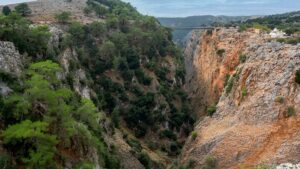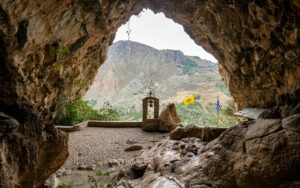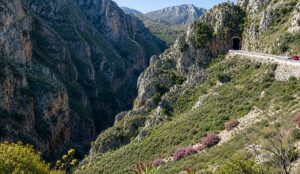
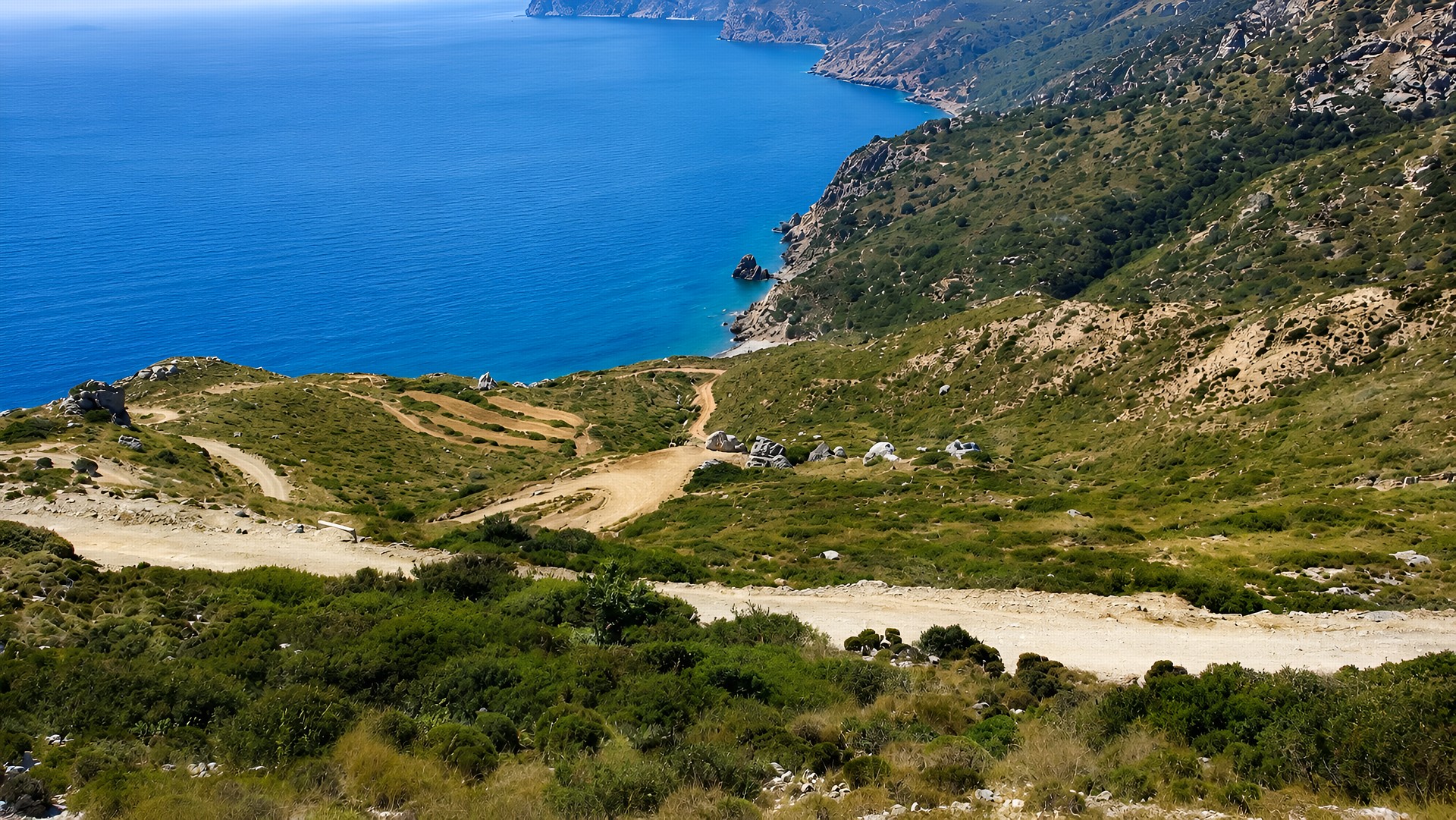
Avlaki Gorge Chania is one of the most rewarding short hikes you can do on the Akrotiri Peninsula, and almost no one knows it exists. That is not a marketing line. Most visitors to Chania spend their days on beaches and in the old harbour. They never make it out to Akrotiri. Of those who do, most stop at the first monastery and turn back. The ones who keep going find something different. A paved stone path dropping through a canyon, two abandoned monasteries, caves used by hermits for centuries, and a narrow fjord at the end where the limestone walls fall straight into dark water.
The gorge stretches roughly 2 km with a 280 metre altitude drop. That sounds modest on paper. Going down, it is comfortable. Coming back up is a different story, especially in the heat of July or August. Plan accordingly.
| Distance from Chania | About 20 km, 30 to 35 minutes by car |
|---|---|
| Difficulty | Easy to Moderate (easy going down, moderate return) |
| Time needed | 2 to 3 hours for the full round trip to the bay |
| Best season | April, May, June, September, October |
| Parking | Free parking at Gouverneto Monastery |
| Entrance fee | Small fee at Gouverneto Monastery trailhead |
| Rental car needed? | Yes |
| Family friendly? | With older children (8+) who are confident walkers |
What Makes Avlaki Gorge Worth the Effort
It is one of the most important gorges in Crete with a particular religious value, as many monks and hermits found shelter in its caves. Inside the small canyon there is the deserted Katholiko Monastery, one of the oldest monasteries in Crete. This is why the gorge is also called Katholiko Gorge.
Most hikes on Crete are about scenery. This one is about history too, and they layer on top of each other in a way that most other trails do not manage. You start at an active 16th-century monastery, pass a cave that was used as a pagan temple long before Christianity arrived, descend to the ruins of an even older monastery, and then walk through a dry riverbed to a cove that once served as a working harbour.
The path you are about to take has been used by pilgrims since the 17th century to pay their respects at nearby monasteries. That continuity of use is something you feel on the trail. This is not a path invented for tourists.
The canyon is a landscape filled with towering trees and steep inclines, home to dittany or diktamos, a herb endemic to Crete. In spring the slopes are green and the air smells of wild herbs. In summer the vegetation dries out and the stone walls dominate. Both versions have their appeal.
The Trailhead: Gouverneto Monastery
Gouverneto Monastery is one of the oldest monasteries in Crete, built in 1537. It sits on the Akrotiri Peninsula, about 4 km from Agia Triada Monastery, or 19 km north of Chania. From the outside it looks like a fortress, with towers at each corner and thick stone walls.
The monastery has very strict opening hours. It is officially closed on Wednesdays and Fridays. It is open 09:00 to 12:00 and 17:00 to 19:00 on Mondays, Tuesdays and Thursdays, and 09:00 to 11:00 and 17:00 to 20:00 on Saturdays and Sundays.
Here is the important detail most people miss: you do not need the monastery to be open to do the hike. Even when the monastery is closed, you can still pay to walk through the grounds, passing the front of the monastery through a gate, which eventually leads down to the sea.
When visiting, be aware that entrance is prohibited to people dressed in shorts, swimwear or sleeveless blouses. Smoking is forbidden inside the monastery, and so is using cameras or video cameras.
The monastery accepts cash payments for entry fees, donations, and souvenirs. Visitors are advised to bring sufficient cash, as the monastery does not currently accept credit cards or mobile payments.
Warning: Gouverneto Monastery is closed every Wednesday and Friday. Plan your visit on a Monday, Tuesday, Thursday, Saturday, or Sunday. Arriving on the wrong day is a frustrating mistake that is easy to avoid.
The Trail: Section by Section
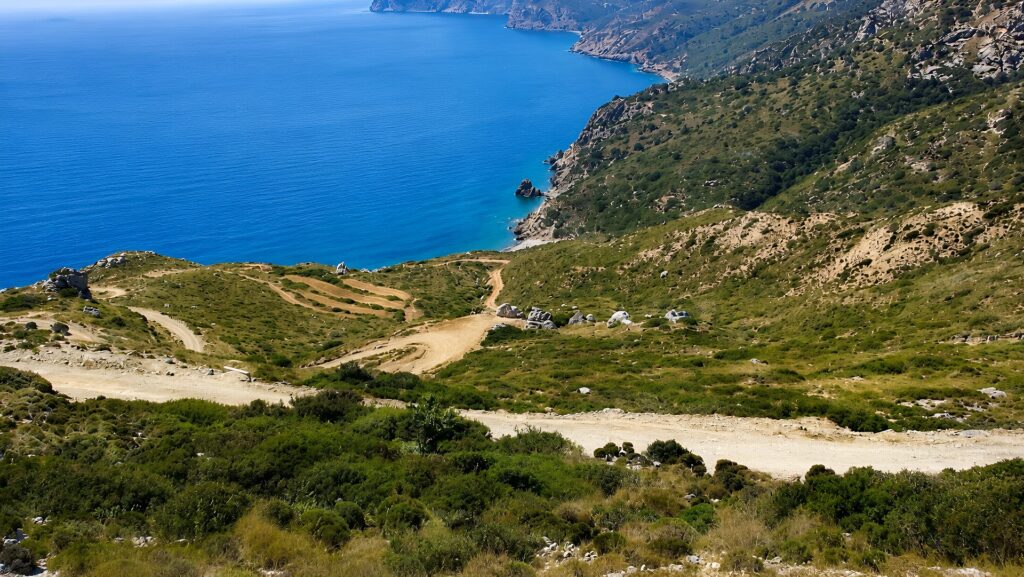
A paved footpath leads north of Gouverneto Monastery and into the Avlaki Gorge, which runs down to the sea. The first few minutes are disorienting. You pass a WW2 memorial. Then the path opens up and the descent begins.
First you will see a WW2 memorial and then the path descends. Take a moment here. There is a monument over a village where all the inhabitants were killed by the Nazis during WW2. Worth a stop, worth reading.
The Bear Cave (Arkoudospilios)
In Hellenic times, the large Arkoudospilio Cave served as a temple dedicated to the goddess Artemis. It is called Bear Cave, named for the large, animal-shaped stalagmite near its entrance. You reach it after about 10 to 15 minutes of walking. Step inside. The cave is deep and dark. Bring a torch, not just your phone light.
Later, the cave was turned into a Christian chapel and monastery. So the site has been in continuous religious use from ancient Greek times through the Byzantine period and beyond. That is a long time.
Local tip: Bring a proper torch with good batteries, not just your phone. The Bear Cave goes back further than it looks from the entrance. The animal-shaped stalagmite is inside, not at the mouth. You will miss it if you only peer in from the front.
Katholiko Monastery
After 10 more minutes from the cave, you arrive at the abandoned monastery of Katholiko and the cave of Saint John the Hermit, who lived here.
The monastery is considered to be the oldest in Crete. The ruins are substantial. Arches still standing. Stone walls that have absorbed five centuries of sun. The cave where Saint John the Hermit lived is accessible nearby. He used to live in a 150-metre-long cave, which is located where the monastery is situated, and it is accessible to visitors.
The monastery was eventually evacuated because the shores of Crete became a target of piracy. The monks had to retreat to the inland, where the Gouverneto Monastery stands. That is the reason Gouverneto exists at all.
The bridge at Katholiko Monastery is one of the trickier moments on the trail. There is a short scramble to get down from the bridge level into the gorge bed. Use your hands. It is not dangerous but it is not obvious. Go left behind the bridge.
The Gorge Floor and Katholiko Bay
From the monastery, the trail follows the riverbed for 15 to 25 minutes to the sea, featuring narrow passages and deep blue water.
This final section is different from everything before it. The walls close in. The path is rocky and uneven. There is no shade. And then you arrive at the bay. It is a narrow inlet. High walls on both sides. The water is very dark blue where it drops off.
From the Katholiko monastery there are two hiking options: right in the gorge toward the ancient port of the monastery (red markings), and left in the narrow gorge creek bed toward Stavros. The ancient port was destroyed by the Saracens. The boat garages are still very well preserved. The old stone boathouses at the water’s edge are worth looking at carefully. You can still see how they were used.
Warning: Swimming at Katholiko Bay is officially prohibited by the monastery, which owns this land. The rocks are sharp, entry and exit from the water is difficult, and the depth drops off quickly. Many people do swim there anyway. Be aware of the rules and the physical risks before you decide.
How Difficult Is Avlaki Gorge, Honestly?
The gorge is rated easy, around 2 out of 10 for difficulty. But that rating is a bit misleading for some visitors.
Going down: comfortable for most people with basic fitness. The path is easy downhill, but more challenging on the way back, with slippery stones and steep sections. There is one section near the bridge at Katholiko where you will need to get low and use your hands to climb down or up. It is not dangerous for an able-bodied adult. It would be awkward and potentially risky for anyone with knee or mobility issues.
The return climb in summer heat is the part that catches people out. The entire path back is shadowless. The ascent without shade always makes you sweat. Allow more time and more water than you think you need.
The Honest Notes
While summer hiking is possible, the heat can be quite intense, so starting early in the morning is highly recommended. In July and August, be at the trailhead by 8am at the latest. The exposed return climb in full afternoon sun is brutal.
Warning: There are no water sources anywhere on this trail. None. Bring at least 1.5 litres per person. In hot weather, bring two litres. The return climb is exposed, steep, and long enough to cause real dehydration problems if you underestimate it.
Local tip: The best time of day in summer is late afternoon. Leave Chania around 3pm. You hike down as the heat eases, spend time at the ruins and bay in the shade of the canyon walls, and return as the temperature drops. The light on the stone cliffs during the return climb is also better in the late afternoon.
Before You Go
- Water: bring at least 1.5 litres per person. There is absolutely no water on the route.
- Shoes: trail shoes or hiking boots with grip. The stone path is polished and slippery in places. No sandals.
- Torch: essential for the Bear Cave and the Hermit’s Cave. A good torch, not just a phone light.
- Sun: very little shade anywhere on the trail, especially on the return. Hat and sunscreen required.
- Toilets: none on the route. Use facilities at or near Gouverneto before you start.
- Dress code: if entering Gouverneto Monastery, cover shoulders and knees. No shorts.
- Cash: the entrance fee at Gouverneto is cash only. No card payment accepted.
- Signal: mobile signal is unreliable inside the gorge.
Getting There
By car: Follow the road leading to Chania Airport. Once you arrive at the airport, follow the signs to Agia Triada Monastery. From Agia Triada Monastery, follow the signs to Gouverneto, which is 4 kilometres further. There is free parking at the monastery. The road all the way to Gouverneto is paved and in good condition.

By bus: There is no direct bus to Gouverneto Monastery or Avlaki Gorge. If you prefer public transportation, the KTEL bus from Chania goes as far as Agia Triada Monastery. From Agia Triada you still have 4 km of road to walk to reach Gouverneto, without a footpath for most of it. This is not a practical option for most visitors.
By taxi: A taxi from Chania to Gouverneto is a reasonable option. Take a cab there and pre-book a cab for the return journey. Agree on a pick-up time before the driver leaves. There is no mobile signal in the gorge so you cannot call from the bottom.
By organised tour: Another option is to join a guided tour of Agia Triada Monastery, Gouverneto, and Katholiko. This removes the logistics and adds context from a guide who knows the history.
Practical Information
| Location | Akrotiri Peninsula, about 20 km from Chania |
|---|---|
| Trail start | Gouverneto Monastery trailhead |
| Trail length | Approximately 2 km one way to Katholiko Bay |
| Altitude drop | 280 metres |
| Return time | Allow 2 to 3 hours for the full round trip |
| Monastery opening | Mon, Tue, Thu: 09:00-12:00 and 17:00-19:00. Sat/Sun: 09:00-11:00 and 17:00-20:00 |
| Monastery closed | Every Wednesday and Friday |
| Entrance fee | Small fee per person at trailhead. Cash only |
| Parking | Free at Gouverneto Monastery |
| Facilities | None on the trail |
| Best months | April, May, June, September, October |
| Dogs/drones | Prohibited on monastery grounds |
| Photography | Prohibited inside Gouverneto Monastery |
Combine With
Avlaki Gorge is on the Akrotiri Peninsula, which has several other places worth visiting on the same trip.
Agia Triada Monastery: You pass it on the way in. Stop on the drive to Gouverneto. This is a 17th-century monastery with baroque architecture, an olive oil press, and a small wine cellar. The monks sell their own olive oil and wine.
Stavros Beach: Famous for its crystal-clear turquoise waters and the filming of Zorba the Greek. Ideal for families and calm swimming. A good place to cool off after the hike. About 20 minutes from Gouverneto by car.
Seitan Limania: One of the most dramatic beaches in Crete, also on Akrotiri. A steep descent to a narrow cove between white cliffs. Do not attempt it after the gorge hike on the same day. Your legs will not thank you.
Marathi Beach: A quieter, family-friendly beach on the north coast of Akrotiri with some small tavernas. Good for lunch after the hike.
Frequently Asked Questions
How difficult is the Avlaki Gorge hike?
Going down is straightforward for anyone with basic fitness. The trail is mostly paved stone with one short scramble near the bridge at Katholiko Monastery that requires using your hands. The return climb is where it gets harder. The entire path back is exposed with no shade, and the 280-metre ascent in summer heat is genuinely tiring. Wear proper shoes, bring more water than you think you need, and allow plenty of time.
Can children do the Avlaki Gorge hike?
Wear sturdy shoes, bring plenty of water, and consider snacks, especially if travelling with children. Older children who are used to walking can manage the trail. Younger children and pushchairs cannot. The scramble near the bridge and the rough gorge floor in the lower section make it unsuitable for small children or anyone with limited mobility.
How long does the Avlaki Gorge hike take?
The hike typically takes 1.5 to 2 hours round trip, depending on pace and stops. If you spend time in the Bear Cave, at the Katholiko ruins, and at the bay, add another 45 minutes to an hour on top of that. A comfortable visit including all stops is around 3 hours from trailhead to trailhead.
Is Avlaki Gorge better than Samaria Gorge?
They are completely different experiences. Samaria is 16 km long, runs through the White Mountains, and requires a full day and a boat transfer. Avlaki is 2 km, can be done in a morning, and is about history as much as nature. Avlaki is a better choice for people with limited time, those who want to combine a hike with monastery visits, or anyone who wants to avoid the crowds. Samaria is the bigger adventure.
Can I swim at the end of the gorge?
The aquamarine water would be very inviting for a swim before the climb back up to Gouverneto, if this were not strictly prohibited by the monks. The monastery owns the land. Entry and exit from the water is genuinely difficult on the sharp rocks. Many people do swim there despite the rule. That is your decision to make.
Do I need to visit Gouverneto Monastery to access the gorge?
The trailhead is on monastery grounds. You pay a small fee to access the path whether the monastery itself is open or not. Even when the monastery is closed at midday, you can still pay to walk through the grounds, passing the front of the monastery, fenced on either side, to reach the gorge.
Local tip: If you drive back through Agia Triada Monastery in the late afternoon and the monastery is still open, stop in. The monks sell their own olive oil and wine directly from a small shop inside the complex. The olive oil is as good as any you will find on the island. Pick up a bottle. It travels well and it is the right price.