Argiroupoli Chania is one of the most layered day trips you can make from western Crete. Not because of one single thing, but because of everything at once. A mountain village sitting on top of a dead Roman city. Running water in summer, when every other landscape around is scorched brown. Tavernas built into waterfalls. History you can touch with your hands. It is unusual, and it is genuinely worth the drive.
Most visitors coming from Chania treat it as a half-day excursion, often combined with Lake Kournas. That is a perfectly reasonable way to see it. But if you take the time to park, walk the upper village properly, have a long lunch at the springs, and find the Roman tombs before heading back, you will understand why people who live on Crete keep returning here.
One thing to say upfront: the “waterfalls” are not what some photos suggest. Come with the right expectations and you will not be disappointed. Come expecting Niagara and you will be.
| Distance from Chania | 55km, about 65 to 75 minutes |
|---|---|
| Difficulty | Easy to moderate. Steps and uneven ground in places. |
| Time needed | 2.5 to 4 hours including lunch |
| Best season | April through October. Most tavernas closed November to March. |
| Parking | Limited near the springs. Easier near the upper village square. |
| Entrance fee | Free |
| Rental car needed? | Yes |
| Family friendly? | Yes, with some cautions |
What Argiroupoli Chania Actually Is
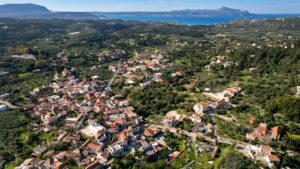
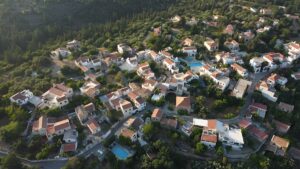
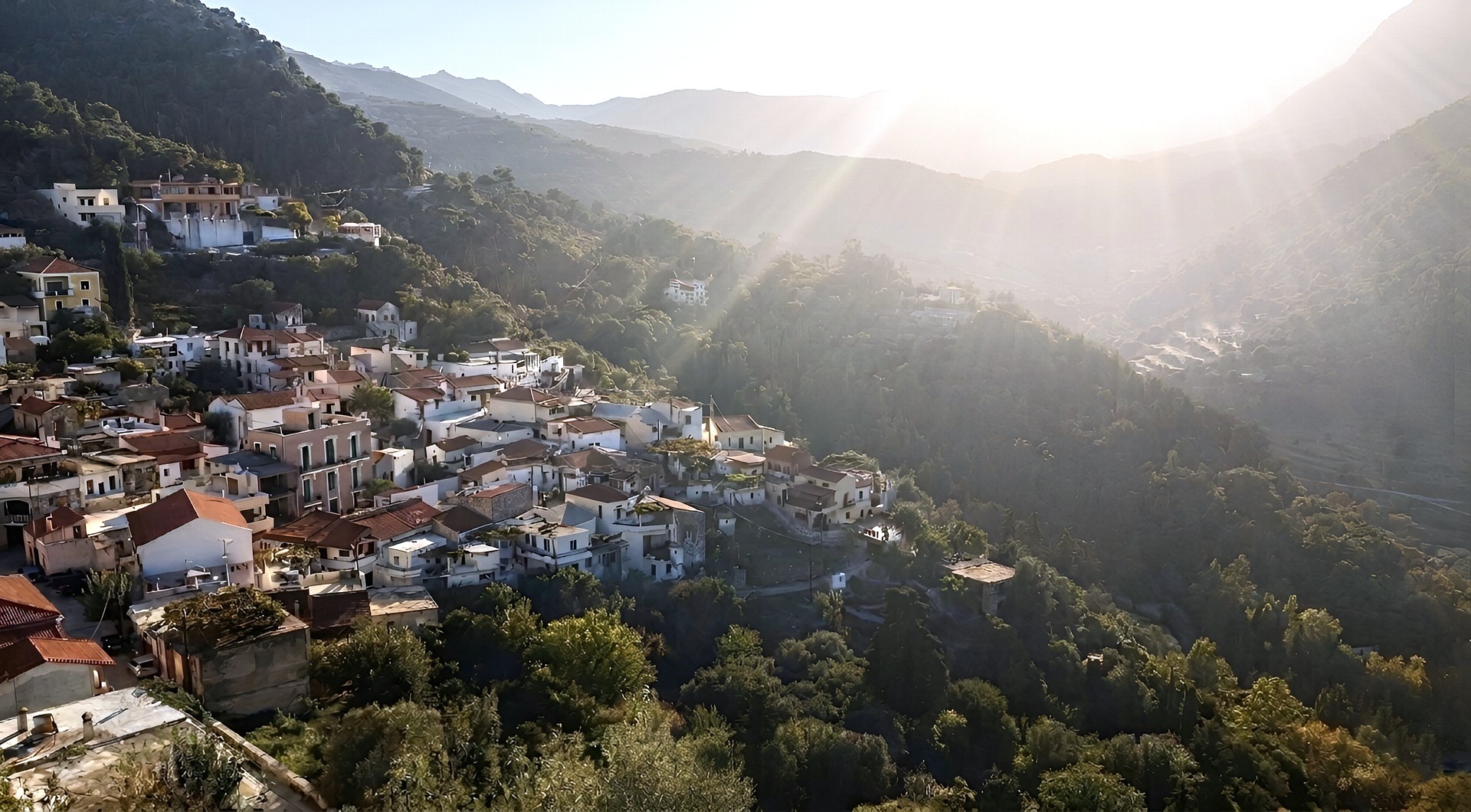
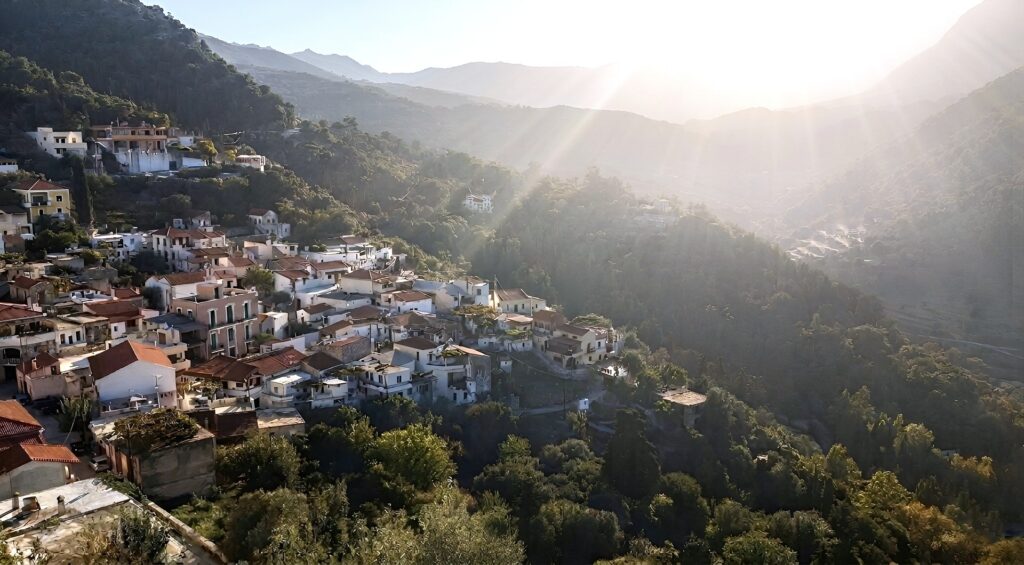
Argiroupoli is located 55km southeast of Chania, a small village of about 400 inhabitants built in a green landscape between the rivers Mouselas and Petres. It sits at an altitude of 260 metres, and the waters of those two rivers form what locals call the ten founts of the Mouselas River, also known as Agia Dinami, or Holy Power.
The modern village, divided into Pano Chorio (Upper Village) and Kato Chorio (Lower Village), is a historical continuation of ancient Lappa, one of the most powerful cities of Crete. That history is not just a plaque on a wall. It is under your feet. It is in the carved stones of the doorways. It is in the tombs cut into limestone just outside the village.
Many small waterfalls, wild flora, ancient plane trees, ponds and streams which once powered watermills, and one of Crete’s most impressive natural monuments, a huge 2,000-year-old plane tree: all of this was created by the Agia Dinami. One surviving watermill is still there. Most of the others have become tavernas. That is the honest truth of the springs, and it is actually fine.
The History: Ancient Lappa
This place has been continuously occupied for an extraordinarily long time. Lappa was a powerful city state going back at least to 300 to 400 BC. It became very powerful during the Roman period and was then destroyed by Arab pirates during the Byzantine period. At one time the city had its own mint and encompassed ports on both the north and south coasts of Crete.
The Lappa of the Roman years featured luxurious hot baths and a mint, while it is reported that there were silver, gold and tin mines in the area. The water from the springs you are looking at while eating lunch once fed those Roman baths.
Following the Roman period, Lappa was destroyed by the Arabs in 828 CE, and its ancient name was forgotten for a time. During the Ottoman rule, the village was called Gaidouropoli or Samaropoli. The current name Argyroupoli was acquired in 1822 by the revolutionary committee. Here was carried out the General Assembly of the Cretans in 1867 and 1878, which decided the union of Crete with Greece.
Scattered monuments from the Roman, Byzantine and Venetian periods indicate the strategic importance of the city that flourished throughout the centuries. Excavations have revealed parts of the ancient city, Roman remains, Venetian buildings, traces of mosaic floors and Byzantine churches.
Local tip: Start in the upper village before heading down to the springs. Park at the square near the church of Agios Ioannis, then walk the old archway route. There is a 400-metre stroll past a Venetian noble house with the inscription “Omnia Mundi Fumus et Umbra” (everything in the world is smoke and shadow) carved into the stone portal. A visible Roman mosaic floor and old Byzantine churches are along the same route. Do this before lunch, not after.
The Springs: What to Actually Expect
The springs of Argyroupolis are a popular attraction, particularly the spring in the cavernous chapel of Agia Dynami. The area is lush with several small waterfalls and numerous restaurants.
In the same place, under a rock, is the chapel of Agios Ioannis (Agia Dynami). The sanctuary of the church is formed in a cave, where water springs and is channelled through an underground tunnel into the area surrounding the temple. The water which flows into the chapel is said to be miraculous.
Here is the honest version: many of the springs and smaller waterfalls are integrated into the tavernas. Some visitors find the springs themselves less impressive than the photos suggest, describing them as more like small fountains or water features within the restaurants rather than natural waterfalls. This has surprised and disappointed a number of visitors who arrived with expectations of dramatic cascades.
These sources once powered mills for grinding grain, which explains the existence of water mills in the area. The sense of history is real. The scale is modest. But on a hot July afternoon, sitting under a massive plane tree with cold water running past your table and a plate of antikristo lamb in front of you, you will not be complaining.
Warning: The springs are most impressive earlier in the season, when rainfall is higher. In late summer, the flow is reduced. If you visit in August or September, manage expectations accordingly. The greenery and shade remain, but the water volume is lower.
Eating at the Springs
This is, honestly, one of the main reasons to come. It is primarily a place to eat under large sycamore trees. Many tavernas raise trout and sturgeon in the cold waters. Other Cretan foods include pilafi, antikristo lamb roasted on indirect coals, Sfakian pitas, and grilled pork and lamb.
If you visit Argiroupoli, make sure you have a meal in one of the traditional taverns. There you can admire the live trout and sturgeon and also taste antikristo, lamb roasted in a traditional Cretan way. The antikristo is the regional specialty. Lamb cooked slowly in front of an open fire, not over it. Worth ordering if you see it on the menu.
You can even try your fishing skills by fishing your own trout and having it grilled to order. Not every taverna offers this, but some do.
Many of the smaller waterfalls are integrated into the tavernas. Be prepared to dine or have a drink to fully experience the unique setting. The atmosphere is the point. Water flowing next to your table. Shade from trees that were old when your grandparents were born. That is the experience.
Local tip: If the roadside tavernas look too busy, try Taverna Kastro, which requires a short walk up a path from the road. Visitors consistently report it as quieter than the tavernas directly on the road, and the food is good. Reservations are not usually required outside peak weekends, but arriving before 1pm avoids the worst of the lunchtime rush.
The Roman Tombs and the Church of the Five Virgins
Do not miss this. Just five minutes’ drive outside of Argiroupolis is a small chapel with a pleasant walk to a Roman necropolis further down the road. There visitors should admire the carved Greco-Roman tombs, the evergreen plane tree with its impressive trunk diameter, and the temple of the Five Virgins.
Locals insist this tree is one of the oldest, and definitely the largest, in Crete. Standing next to it is worth doing once in a life. The trunk diameter alone is extraordinary.
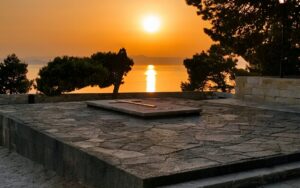
Another historical church is that of Pente Parthenes, devoted to five holy women who lived and were martyred during the pogroms of Emperor Decius at around 250 AD, according to local tradition. The necropolis here, with tombs cut directly into the limestone, is open and free to visit. No ticket office. No barriers. Just ancient stone.
The Roman mosaic floor in the upper village is a genuine piece of ancient decoration that survived in place. Look for the signs from the main village road.
What to Do Beyond the Springs
The village is characterised by narrow streets lined with old Venetian villas. Many of these buildings still have their original stone walls and ornate doors, giving the village a distinctive, historic character.
There is a Cretan Gastronomy Centre in the upper village. Worth a stop. They sell local products and run cooking classes. Call ahead if you want to book a class. The Lappa Avocado store in Argiroupolis stocks an extensive range of avocado-based products, ideal for gifts. The area around Argiroupoli is one of the few avocado-growing zones in Crete, and the local producers have leaned into it hard.
The abandoned village of Nisi is one of the best-kept secrets around Argiroupoli. The village was abandoned in the 1960s and has long since crumbled into a state of disrepair. The only residents now are herds of goats and the occasional shepherd. If you make it to Nisi, you will be rewarded with a beautifully desolate village with plenty of crumbling architecture to admire, but watch your step.
The Honest Notes
Some visitors find the springs less impressive than the photos suggest, describing them as more like small fountains or water features within the restaurants rather than natural waterfalls. Several reviewers note the area can be quite touristy and crowded, especially during peak season. Some visitors express disappointment that the springs have been largely incorporated into the tavernas.
Warning: Parking at the springs is genuinely difficult, especially on summer weekends. The road down to the tavernas is narrow, with cars parked on both sides, and can become completely blocked when it is busy. The better option is to park at the upper village square and walk down. It takes about ten to fifteen minutes on foot and you avoid the chaos entirely.
The terrain can be hilly and involve steps, making it difficult for those with mobility issues to fully explore the area. Be aware of the physical demands before visiting. The lower springs area along the road is accessible without steps if you drive directly there. The upper village and the necropolis route involve more walking on uneven ground.
If you visit in November, be aware that all the tavernas were closed by the end of the season. Most tavernas at the springs are open from roughly April through October. The village itself is accessible year-round, but the springs experience depends heavily on the tavernas being open.
Warning: Do not go on Greek national holidays such as Easter Monday, Clean Monday, or Assumption Day (15 August). These are the days when large numbers of Greek families drive up for lunch together. The road becomes blocked, parking is impossible, and the tavernas are completely full. A Tuesday or Wednesday in June or September is a completely different experience.
Before You Go
- Shoes: wear proper walking shoes. The cobbled paths and stairs in the upper village are uneven. Flip-flops are fine for the taverna terrace but not for exploring.
- Cash: bring cash. Not all tavernas take cards reliably.
- Parking: park at the upper village square and walk down to the springs. Saves a lot of frustration.
- Timing: arrive before noon on weekends. The lunch rush at the tavernas gets busy by 1pm in summer.
- Mobility: the springs road level is manageable for most people, but the upper village and tombs route involves hills and steps.
- Season: tavernas at the springs are typically open April to October only.
Getting There
By car: From Chania, take the E75 coastal motorway east toward Rethymno for around 40km. Near Episkopi beach there is a sign that takes you to the country road to the village. Follow the road south through the hills. The drive is straightforward and takes about 65 to 75 minutes from Chania depending on traffic. The route along its entire length is easy.

By bus: There are no bus routes to Argyroupolis. This is a rental car destination. Full stop.
By taxi: Possible from Chania but expensive. Check current rates with local taxi companies before committing.
By organised tour: Organised tours from Chania typically combine Lake Kournas with a stop at Argiroupolis springs. At Kournas, guests can swim and relax. The tour then moves to the ancient village of Lappa, followed by the springs, where there is an option for lunch. This is a reasonable way to see both in one day if you do not have a car.
Practical Information
| Address | Argiroupoli village, Rethymno Prefecture, Crete |
|---|---|
| Entrance fee | Free (springs and village open access) |
| Parking | Limited near springs. Park at upper village square. |
| Tavernas open | Approximately April to October |
| Best months | May, June, September, October |
| Facilities | Tavernas with toilets. No dedicated public facilities at springs. |
| Accessibility | Lower springs road: manageable. Upper village and tombs: steps required. |
| Mobile signal | Generally good in the village |
Combine With
Lake Kournas. The village of Argiroupolis, known for its springs and lush greenery, and Lake Kournas are natural companions. Kournas is about 25 minutes north of Argiroupoli. Crete’s only freshwater lake. Pedal boats, swimming, tavernas on the water. Do Kournas in the morning and Argiroupoli for lunch.
Georgioupolis. A small town on the coast about 30 minutes north of Argiroupoli, where a river meets the sea. Good beach. Good eating. Works as an end to the day after lunch at the springs.
Vrysses village. On the main Chania to Rethymno road, about 20 minutes from Argiroupoli. Another village built around running water, with old plane trees shading a central square. Yogurt with honey at one of the kafeneions here is a Cretan institution.
Apokoronas villages. The whole inland area between Chania and Rethymno, including Vamos, Gavalochori, and Douliana, rewards slow driving and exploration. Argiroupoli fits naturally into a day spent in this part of western Crete.
Local tip: The drive back from Argiroupoli toward Chania, if you take the smaller inland road through Vamos and Gavalochori instead of the motorway, is one of those stretches of western Crete that rarely appears in travel guides. Olive groves, old village squares, the occasional goat in the road. Give it an extra 25 minutes and take it slow.