Now I have comprehensive information to write the article. Let me compose it.
The Venizelos Tombs Chania is one of the most historically significant and quietly moving sites in all of western Crete. It sits on the Profitis Ilias hill on the Akrotiri peninsula, just a few kilometres east of the city centre. Two simple stone graves, an ancient chapel, a broken statue, and the best free view in the Chania region. That is what you get. For anyone with even a passing interest in modern Greek history, it is essential. For everyone else, the view alone makes the trip worthwhile.
Most tourists visiting Chania never come here. That is a mistake. The graves of Venizelos, located in a small park on a hill overlooking Chania, are very much worth a visit, if only for the superb view. The site takes about 45 minutes to see properly, it costs nothing to enter, and it gives you a perspective on Chania, literally and historically, that the Old Harbour simply cannot.
| Distance from Chania | 5.5km, about 10 to 15 minutes by car |
|---|---|
| Difficulty | Easy, flat walking within the site |
| Time needed | 45 minutes to 1 hour |
| Best season | Year-round. Best at sunset in summer |
| Parking | Available at the site, free |
| Entrance fee | Free |
| Rental car needed? | Recommended, but bus available |
| Family friendly? | Yes |
Who Was Eleftherios Venizelos?
You cannot fully appreciate this site without knowing who is buried here. Eleftherios Venizelos is widely considered one of the greatest statesmen in the history of modern Greece. Born in Chania in 1864, he played a significant role in Crete’s struggles for political autonomy from the Ottoman Empire and eventually integration into Greece, before going on to serve as Greek Prime Minister for a combined 13 years between 1910 and 1933.
Under his leadership Greece doubled in area and population during the Balkan Wars of 1912 to 1913, and also gained territorially and diplomatically after World War I. He negotiated treaties, reorganised the army, wrote liberal legislation, and dragged a nineteenth-century Ottoman-influenced state into the modern era. In Greece today, his name is everywhere. Streets, squares, and Greece’s largest international airport in Athens all bear his name.
Eleftherios Venizelos, one of the most important figures in modern Greek history, was born in Turkish-occupied Crete in 1864 and died in self-imposed exile in Paris in 1936. He chose his burial site himself, a few kilometres east of his house in Chalepa. He died in Paris on March 18, 1936 due to a stroke. His body was transported directly to Crete, for fear of incidents in Athens. He was buried in Akrotiri of Chania, which was inextricably linked to his fighting presence for the realisation of his visions.
His son, Sofoklis Venizelos, is buried alongside him. Here lies the charismatic Greek politician, and seven times Prime Minister of Greece, Eleftherios Venizelos, and his son Sofoklis Venizelos, who was also Prime Minister of Greece from 1943 to 1952. In 1936 a tomb was built for Eleftherios. Later, in 1965, opposite the tomb of Eleftherios Venizelos, a grave was erected for his son Sophocles.
Two prime ministers. Father and son. Both buried on a windswept hill above the city where the older one was born. There is something right about that.
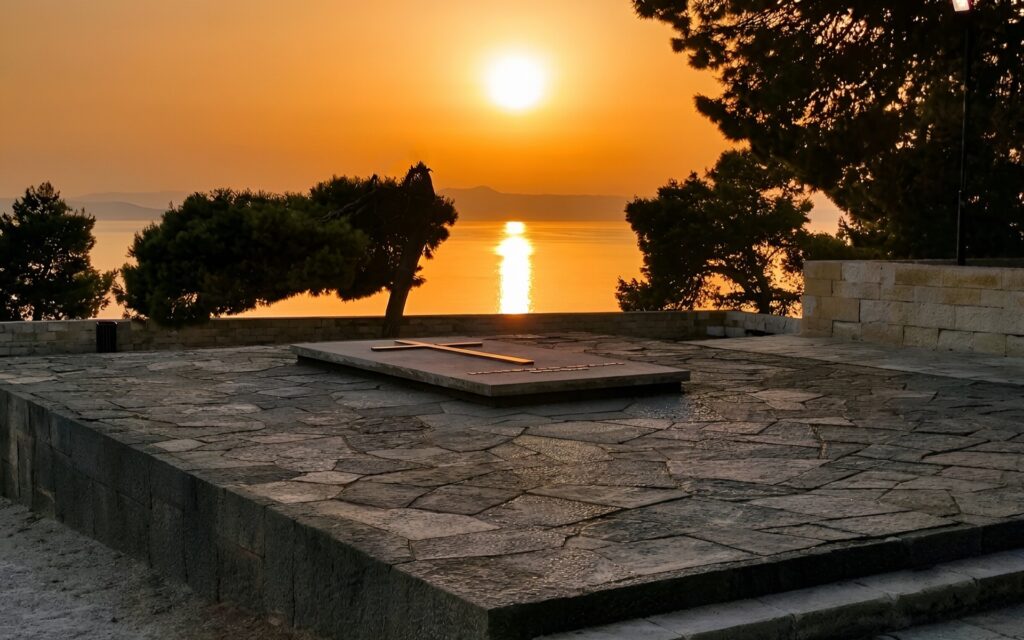
Local tip: The tombs themselves are deliberately simple. Two stone slabs in a small walled enclosure. Do not expect marble grandeur. The restraint is the point. Venizelos chose this hill, this view, this understated resting place. The simplicity says more about the man than an elaborate mausoleum ever could.
What You Will Find at the Venizelos Tombs Chania
At the hilltop of Profitis Ilias at Akrotiri, within a beautiful landscape, you will find the memorial tombs of Eleftherios and Sofoklis Venizelos, the 16th-century Venetian chapel of Prophet Elias, and the memorial statue of Spyros Kagiales, hero of the 1897 rebellion.
That is the full inventory of the site. Four things. Let us take them in turn.
The Tombs
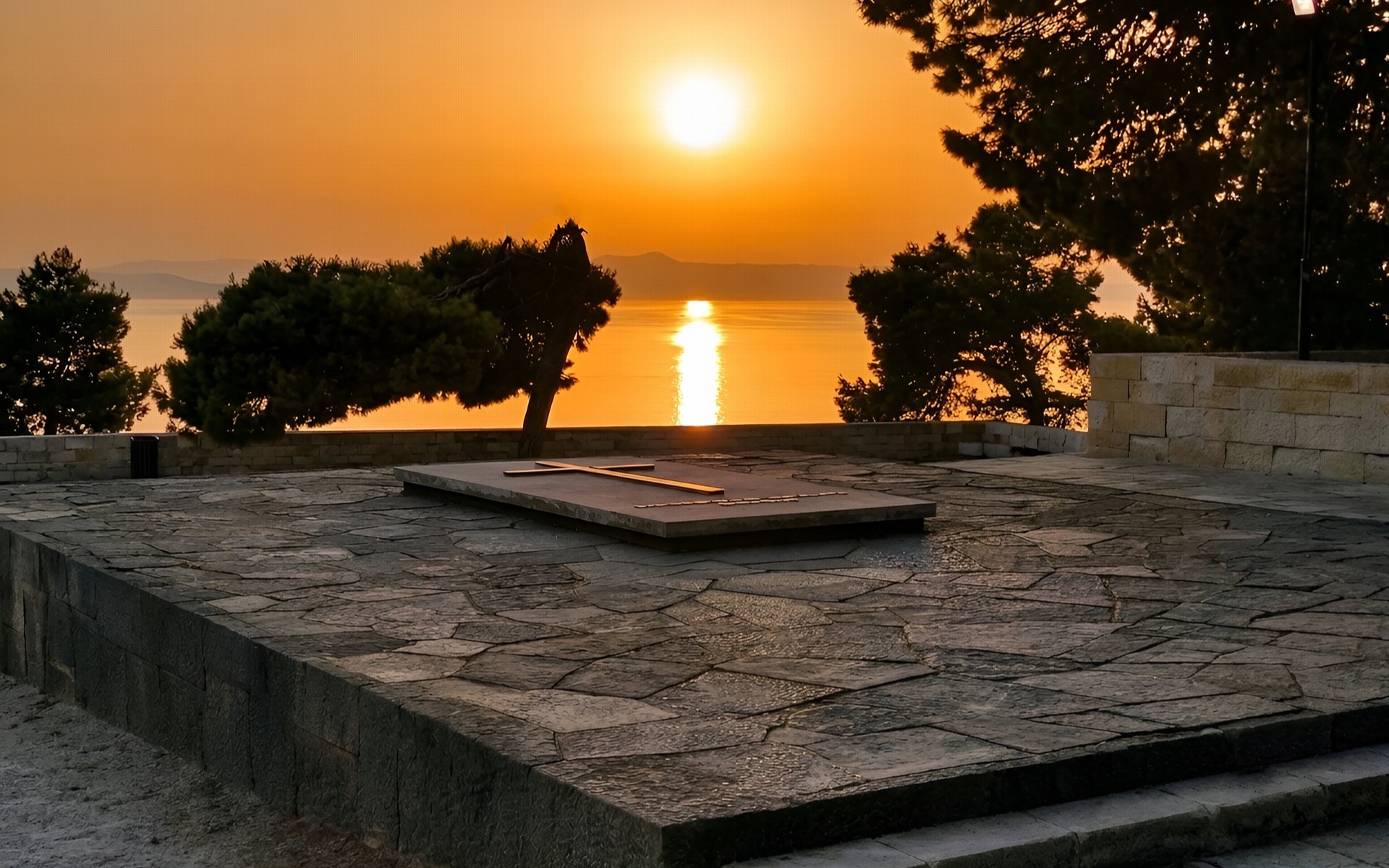
The burial site is distinguished by its remarkable simplicity and lack of unnecessary pomp. Stone tombstones are harmoniously integrated into the landscape. The memorial’s main highlight, however, is its location. The park around the tombs is shaded by pine trees and kept tidy. The tombs are located in a peaceful park full of needle trees, with great views to the city of Chania. On the wall that surrounds the tombs, the patriotic poet Kostis Palamas wrote an inscription comparing the flame on the tomb to Greece itself, one that cannot be extinguished. Worth reading when you are there.
The Chapel of Profitis Ilias
The two-nave temple of Prophet Elias was dedicated in the 16th century. It was built according to Venetian standards of ecclesiastic architecture. In 1897, following the bombardment of the hill during the Greek rebellion against the Turks, the chapel was destroyed. The Tsar of Russia, Nicholas, funded its entire restoration. That detail is not in any guidebook. A Russian Tsar paid for the chapel you see today.
Today the chapel of Profitis Ilias is very popular among locals for ceremonies, such as weddings and christenings, and the gardens are daily visited by locals and tourists for a walk and a glimpse of the amazing panoramic views of Chania city. On Sundays, there is a service in the adjoining church, and baptisms and weddings take place here often. If you visit on a weekend afternoon in summer, there is a reasonable chance you will catch a wedding. The celebration spills out into the garden. Do not feel awkward. Nobody minds.
The Statue of Spyros Kagiales
This is the most overlooked element of the site. In the same plot of woodland, you will find the statue of national hero Spyros Kagialedakis, or Kagiales. On February 9, 1897, during the Revolution of 1897, during the bombing of the revolted Cretans by the fleet of the great powers, Spyros Kagialedakis used his body as a flagstaff to raise the Greek flag that had been dropped by the ships’ bombshells.
His act impressed the Generals of the Great Powers, reversing their stance against the Greek rebellion of 1897. Think about that for a moment. One man used his own body as a flagpole. The admirals watching from their warships were so struck by it that they reconsidered their position. The statue stands a few metres from the tombs. Most visitors photograph the view and walk past it. Stop.
The Fragments of the Eleftheria Statue
In honour of Eleftherios Venizelos and in memory of all the freedom struggles of the Cretans, the Freedom Monument was erected next to the graves on the hill near Chania in 1937. It had a height of 20 metres, carved out of marble and resembling Athena. It was called the Eleftheria statue. The remaining parts of the Eleftheria statue are collected in a corner of the garden, looking lonely up to the sky. It is an odd thing to encounter. Pieces of a 20-metre marble goddess scattered in a park. Ask a local what happened and you will get three different stories.
The View: Why Everyone Actually Comes Here
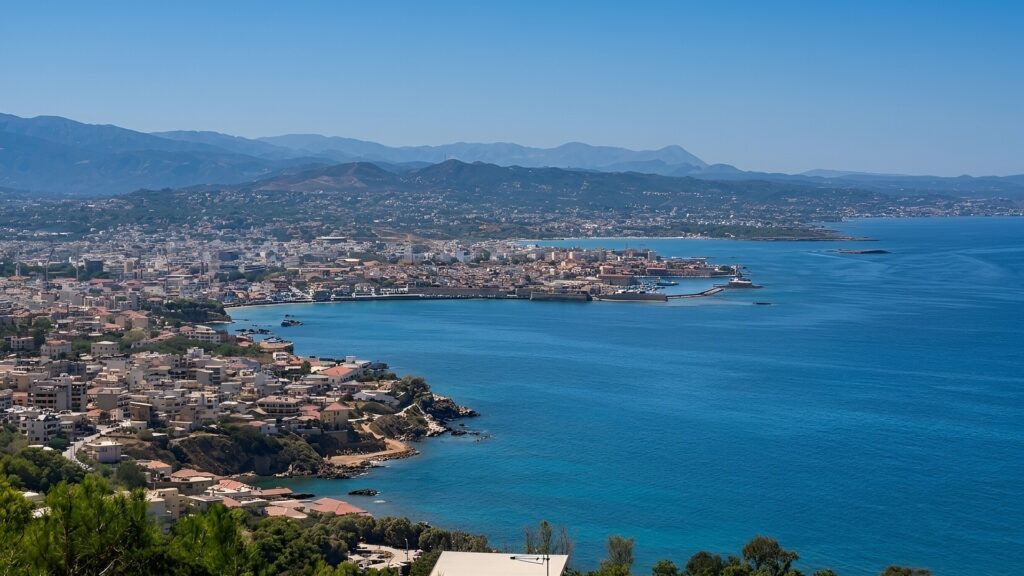
The site offers a breathtaking panoramic view of the old port, the endless sea, and the city rooftops, making it one of the best viewing platforms in all of Crete.
That is not an exaggeration. From this hill you can see the Venetian lighthouse, the curve of the harbour, the White Mountains behind the city, and on a clear day the coastline stretching west all the way to Kolymbari. The city looks entirely different from up here. You understand its shape, its relationship to the sea, its scale.
During summer, in order to avoid the heat, it is better to visit during afternoon hours so you get to enjoy the sunset. This is good advice. The light hits the water differently in the late afternoon. The harbour turns gold. The mountains behind the city go purple. It is the kind of view that justifies the whole trip.
Warning: Sunset is increasingly popular with tour groups and day-trippers. If you want the view to yourself, arrive in the morning or at midday. You will have the whole park almost to yourself and the light on the old city is still excellent.
The Cafes Above the City
Nearby the Venizelos tombs there are three cafes with lovely views of Chania during the sunset and excellent sweets: the Ostria, the Nimfes, and the Koukouvayia. They are worth a visit for lovers of sweets and pastries. The mille-feuille, and other delights, are known throughout the city.
Sitting at one of these cafes with a coffee and looking down at Chania is one of those simple pleasures that costs almost nothing and stays with you for a long time. Do not skip it.
Local tip: The Koukouvayia cafe, positioned behind the graves, has the most unobstructed view of the city and bay. It is also the one most locals use. Come on a weekday morning, sit outside, and you will have it largely to yourself.
The Honest Notes
The Venizelos Tombs is a genuine historical site, not a tourist attraction manufactured for visitors. That is precisely what makes it worth visiting. But there are a few things to know before you go.
Warning: The tombs themselves are simple stone graves. Some visitors arrive expecting an elaborate monument and feel underwhelmed by the austerity. If you come for the history and the view, you will not be disappointed. If you expect grandeur, you may be.
The members of numerous tour groups who are transported here every day by bus to the adjacent church of the Prophet Elijah unfortunately overlook the tombs themselves in large numbers. This is accurate. Many visitors are here for the view, the cafes, and the wedding photo opportunities. The graves of two prime ministers sit quietly nearby, visited by fewer people than the selfie viewpoint. That is a shame, but it means you can usually stand at the tombs in near-silence.
There are public toilets adjacent to the chapel. Although they are clean, there is no toilet paper or soap. Bring your own. This is a consistent complaint in visitor reviews.
Warning: The area is open all hours but visiting after dark is not recommended. There is very little lighting in the park itself and the parking area can be poorly lit. Stick to daylight or the early evening hours around sunset.
Entrance to the Venizelos Tombs is completely free. No ticket, no booking, no opening hours. Open every day, year-round.
Frequently Asked Questions
Is the Venizelos Tombs worth visiting?
Yes, without question. It is free, takes under an hour, and gives you the best panoramic view of Chania in the entire region. The historical significance is real, not manufactured. Even if you have no particular interest in Greek history, the view from the Profitis Ilias hill is reason enough to make the trip.
How long do you need at the Venizelos Tombs?
To explore the tombstones without rushing, visit the church of Prophet Elias, and admire the Spyros Kayales monument, most tourists need about 30 to 60 minutes. This time is sufficient for a peaceful walk through the park area and for taking photos. If you plan to have a coffee, watch the sunset, or combine your visit with exploring nearby areas, it is better to set aside 1.5 to 2 hours.
Can children visit the Venizelos Tombs?
Yes. The site offers a peaceful outing for families, combining historical context with views. The open space allows children to move around, and the presence of stray cats often delights younger visitors. While the historical aspect might be less engaging for very young children, the panoramic views and the opportunity to enjoy a snack at the nearby cafes can make it a pleasant stop.
Is there parking at the Venizelos Tombs?
The tombs can be reached from Chania by car in 10 to 15 minutes, depending on traffic. Parking spaces are available. However, parking is limited and fills up quickly at sunset. Arrive early or be prepared to park slightly down the hill and walk up.
Can I walk to the Venizelos Tombs from Chania city centre?
Technically yes. One visitor walked from Chania, which took around 1 hour 15 minutes. It probably was not the wisest idea as it was 30 degrees and the majority of the route is uphill. In summer, do not walk. Take the bus, a taxi, or drive.
What else is nearby to combine with a visit?
At the same site you find the 16th-century Venetian chapel of Prophet Elias and the memorial statue of Spyros Kagiales. Beyond the site itself, the Akrotiri peninsula has three monasteries, the Souda Bay War Cemetery, and several excellent beaches, all within 20 to 30 minutes.
Getting There
By car: The monument is located 5.5 kilometres east of Chania on the way to Akrotiri. Follow signs from the city centre toward Akrotiri and look for signs to Profitis Ilias or Venizelos Tombs. The road is clear and well-signposted. From the Venetian harbour, allow 10 to 15 minutes.

By bus: Take the No. 11 public bus from the centre of Chania, with end destination El. Venizelos Tombs. This is a regular urban bus service running throughout the day on weekdays. Check current schedules at chaniabus.gr before you go, as timetables change seasonally.
By taxi: Taxis in Chania are easy to find near the market and the harbour. The ride from the Old Town takes under 15 minutes. Ask the driver for Venizelos Tombs or Profitis Ilias. There is no Uber or Bolt in Chania.
By foot: Only for the very determined and the very early. The ascent from the city centre is steep and long. Not recommended in summer heat.
Before You Go
- Entrance: Free. No booking needed. Open every day.
- Toilets: Available next to the chapel. Bring your own tissue and hand sanitiser.
- Water: Bring water, especially in summer. No facilities within the park itself.
- Sun: The viewpoint area has limited shade. Hat and sunscreen in summer.
- Shoes: Flat, paved paths throughout. Any footwear is fine.
- Dress code: No formal dress code for the park. If you wish to enter the chapel, cover shoulders and knees out of respect.
- Cash: The cafes nearby are small local businesses. Bring some cash, though most now accept cards.
Practical Information
| Address | Profitis Ilias Hill, Akrotiri, Chania |
|---|---|
| Opening hours | Open daily, all hours |
| Entrance fee | Free |
| Distance from Old Town | 5.5km, approximately 10 to 15 minutes by car |
| Bus | Urban bus No. 11 from Chania centre |
| Parking | Free, limited spaces on site |
| Toilets | Yes, next to the chapel |
| Cafes nearby | Yes, Koukouvayia, Nimfes, Ostria |
| Best time to visit | Late afternoon for the view, mornings for peace and quiet |
| Accessibility | Mostly flat within the site. Some uneven ground near the viewpoint. |
Combine With
The Venizelos Tombs makes an excellent starting point for a half-day or full-day exploration of the Akrotiri peninsula.
Souda Bay War Cemetery: Twenty minutes by car to the east. The cemetery holds over 1,500 graves of Allied soldiers who died during the Battle of Crete in 1941. Quietly powerful. Free entry. Worth pairing with the Venizelos Tombs for a reflective morning of history.
Agia Triada Monastery: Continue deeper into the Akrotiri peninsula. One of the most impressive and photogenic monasteries in Crete, dating to the 17th century. Note that most monasteries are closed on Wednesdays and Fridays.
Gouverneto Monastery and Katholiko: Further north on the peninsula, Gouverneto leads to a ruined monastery and cave sanctuary below. Allow two to three hours for the walk if you have the energy.
Chalepa neighbourhood: On the road back into Chania, the Chalepa area is the upmarket suburb where Venizelos actually lived. His residence has been restored as a museum. Worth a short stop to complete the historical picture of the man.
Local tip: Come to the Venizelos Tombs on a Tuesday or Thursday morning in late September or October. The tour buses are gone, the cafes are quiet, the air is cool and clear, and you can stand at the viewpoint looking over the whole of Chania with nobody else around. The White Mountains behind the city have their first dusting of snow. The harbour is still turquoise. That combination, the graves of a man who shaped a country behind you and the city he loved spread below, is one of the genuinely unexpected moments that Chania gives you if you slow down long enough to find it.