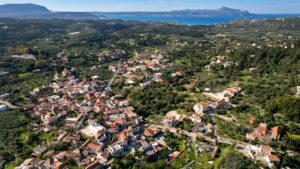
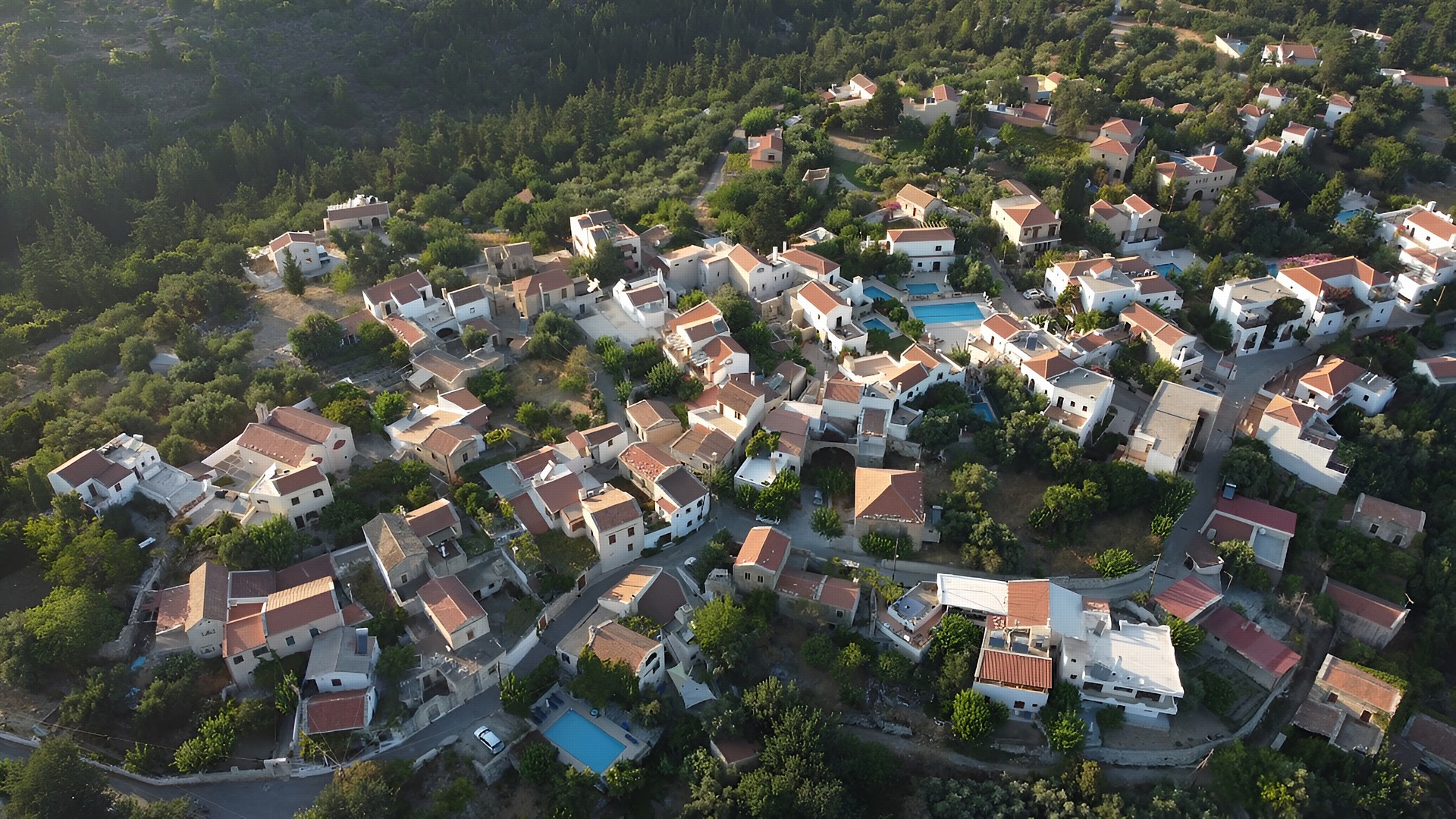
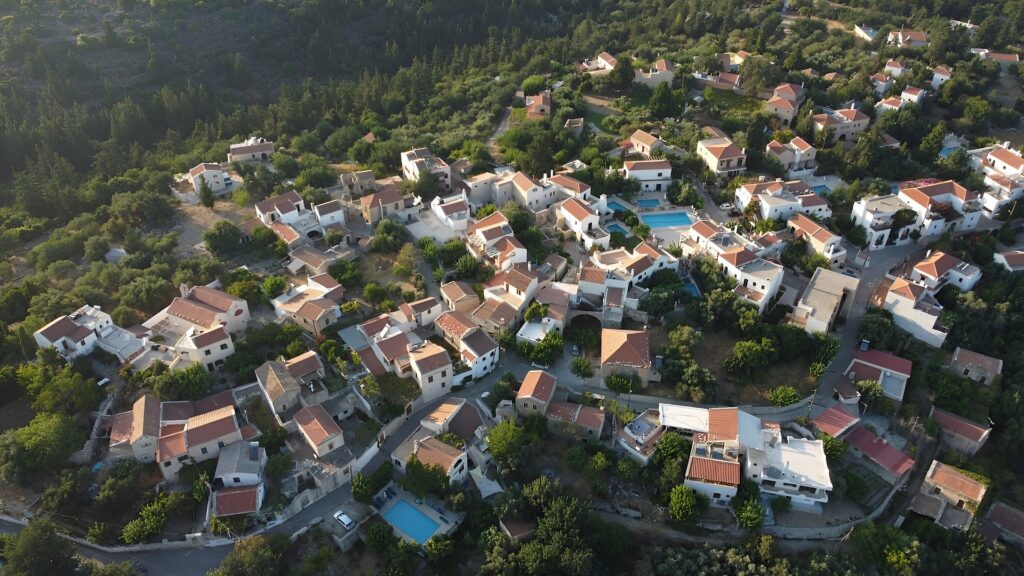
Douliana Chania is one of those places most tourists drive straight past on the way to somewhere else. A signpost on the road between Kalyves and Vamos. Easy to miss. That would be a mistake. The village has been officially declared a place of preserved traditional architecture, and when you walk its narrow stone lanes and look out over the olive groves rolling down toward Souda Bay, you understand why. This is not a reconstructed heritage village. People live here. Goats wander. An old man sits outside the kafeneio and does not particularly care that you are visiting.
With around 40 houses and a population of about 200 people, Douliana sits at 100 metres above sea level. It is a small place by any measure. But it punches well above its weight. The whole area offers tremendous views overlooking Souda Bay and the White Mountains. To the north the sea. To the south the Lefka Ori. And all around, as far as you can see in almost every direction, olive trees. The groves here are old. Some of the trees in the surrounding fields have trunks like twisted sculptures, gnarled and massive, far beyond the scale you expect. The average lifespan of an olive tree in Crete is 300 to 600 years, and in this part of Apokoronas you believe it.
| Distance from Chania | 25km, about 30 minutes |
|---|---|
| Difficulty | Easy |
| Time needed | 2 to 4 hours |
| Best season | Year-round. Harvest season November to January is special |
| Parking | Free at the village square |
| Entrance fee | None |
| Rental car needed? | Yes |
| Family friendly? | Yes |
What Makes Douliana Chania Different
Most villages in the Apokoronas region are worth a quick look. Douliana is worth a slow one.
The village has been officially designated as a place of preserved traditional architecture and is sometimes called the “architectural capital” of the Apokoronas peninsula. That is a bold claim in a region full of handsome stone settlements. But walk around for twenty minutes and you start to see what they mean. Inside the village you find houses and community buildings, many of them centuries old, that are astonishingly well-preserved. The main materials are Cretan stone and wood, combined in architectural styles that reflect real craftsmanship.
Douliana is a small settlement with interesting folk architecture, which has been largely preserved thanks to the sensitivity and efforts of the locals, as well as foreigners who often come or have settled here. That last part matters. The village has attracted a quiet community of European residents who have restored old houses without destroying them. The result is a place that feels lived in and cared for rather than frozen or touristified.
The origin of the village name is thought to be connected to the Slavic root meaning “down” or “valley”, which fits, as the village sits between two valleys and is lower than the neighbouring settlement of Vamos.
The village also has two 19th-century Orthodox churches, both architecturally sound and adorned with Byzantine icons. Neither requires a ticket. Neither has set visiting hours. If the doors are open, you go in.
Local tip: Park at the small central square and walk the full loop of the village lanes before doing anything else. It takes 20 minutes and covers nearly every interesting corner. The back alleyways are where the oldest stonework is. Do not skip them.
The Olive Groves Around Douliana
The olive trees are the reason to come here, not just the backdrop.
The area surrounding Douliana is full of olive groves and carob trees, with traditional dry stone walls between the harvest fields. These walls are as old as the trees in many cases, and they mark the boundaries of family plots that have been worked for generations. The groves here are not decorative. Every year the island of Crete produces between 80,000 and 120,000 tonnes of olive oil, with 80% of it being extra virgin olive oil, and a significant share of that comes from precisely these kinds of small family plots in Apokoronas.
Walking through the groves on the path that descends from the village toward the gorge below, you start to notice the scale of the trees. The trunks of the older specimens are extraordinary. Wide, deeply grooved, twisted into shapes that look like they have been sculpted rather than grown. Hundreds of ancient olive trees live in Crete, and according to scientists, several of these trees are over 1,500 years old. You are walking among them without any fuss, no entrance fee, no visitor centre, just a dirt path and some very old wood.
Crete has more than 36 million olive trees. Over 50% of the island is covered in olive cultivation. The groves around Douliana are among the oldest farmed landscapes in western Crete.
The olive harvest in Crete runs from mid-November through to January. This is when the olives are ripe and ready to be picked. If you visit the Douliana area during this period, you will see activity in the groves that the summer tourist never witnesses. Families spread green nets under the trees. Wooden rakes pull branches. Tractors move slowly along the dirt tracks. It is hard, physical work and nobody is performing it for tourists. That is exactly what makes it worth seeing.
Local tip: If you want a structured olive grove experience rather than self-guided wandering, several operators run olive oil and harvest tours from Chania into this area. You’ll find organised activities offered by local mills and growers, ranging from joining the harvest itself to informative workshops and short seminars on olives and olive oil. These are worth doing if you want context, not just scenery.
The Walk to Gavalochori and the Cave Chapel
One of the best things to do from Douliana is to walk the old path that connects the village with Gavalochori, passing through a small gorge and the church of Agios Ioannis, which has been built inside a cave.
The circular walk from Douliana to Gavalochori and back covers roughly 7 kilometres. It is not a strenuous route. The gorge section is the most atmospheric part. The path drops from the village through dense vegetation, the temperature drops noticeably, and then the track opens out at the cave chapel.
At the chapel of St. John you find old olive trees in the garden and a chapel built inside a cave, giving a feeling of genuine serenity. There was also historically a small cemetery here where unbaptized children were buried. The combination of the ancient trees, the cave setting and that history makes it a more weighted place than it might first appear.
The path continues on to Gavalochori, a historic village whose folk architecture reflects Byzantine, Venetian and Ottoman influences and which has been officially protected for its cultural value. In Gavalochori, look for the arched olive oil mill dating from 1360 and the Folklore Museum, which gives useful context for the whole Apokoronas region.
The full circular walk is easy, taking you along gravel paths, hiking trails and small roads through olive groves, meadows and light forest. Good shoes are enough. You do not need hiking boots for this.
Warning: Some sections of the path between Douliana and Gavalochori are not paved and can become slippery after rain. If you choose to do this walk in winter, some sections may be a bit slippery due to moisture. Wear appropriate footwear and avoid the route in wet weather if you are with young children.
Eating and Drinking in the Village
For such a quiet and tiny village, the eating and drinking options are reasonable. The traditional kafeneion serves raki (tsikoudia), ouzo, and other drinks, with every order accompanied by a small meze of local products like feta, olives or sliced cucumber and tomatoes.
The first restaurant you are likely to find is Ivgoritis, with views over the hills and valleys of Apokoronas. The food is straightforward Cretan cooking. Grilled meat, local cheese, seasonal vegetables. Do not expect a sophisticated menu. Do expect genuine ingredients. The village also has a small mini-market for basic supplies.
Warning: Douliana is a small village. Do not arrive expecting multiple restaurants to choose from or flexible opening hours. In low season, even the kafeneion can be closed on weekday mornings. It is sensible to have a snack and water with you before you start walking.
Before You Go
- Water: bring at least one litre per person. No water sources on the walking route.
- Shoes: comfortable walking shoes for the village lanes. Trail shoes if you plan the gorge walk to Gavalochori.
- Sun: very little shade in the groves in summer. Hat and sunscreen essential from May to September.
- Cash: the kafeneion and taverna are unlikely to take cards. Bring cash.
- Toilets: no public facilities on the walking route. Use the kafeneion before you set off.
- Dress code: if visiting the churches, covered shoulders and knees are appropriate.
Frequently Asked Questions
Is Douliana worth visiting on a day trip from Chania?
Yes, but pair it with something else nearby. Douliana alone takes two hours at a comfortable pace. Combine it with Gavalochori and the gorge walk, or continue to Kalyves beach for a swim afterward, and you have a full day with variety.
Can you walk the olive groves without a guide?
Yes. The path from the village square down through the gorge to Agios Ioannis chapel is well enough marked and straightforward. The hike is possible all year round. No guide is needed unless you want the historical and agricultural context, in which case an organised tour is a better option.
Is Douliana suitable for families with young children?
The route from Douliana features only gentle inclines and declines, making it manageable for children who can walk a few kilometres. The village itself is quiet, traffic is minimal, and the chapel at the gorge tends to capture children’s attention. Factor in time at the kafeneion square where there is space to sit and relax.
When is the best time to visit Douliana?
The groves are at their most dramatic in autumn, particularly November when harvest begins. Spring (April to June) brings wildflowers and green vegetation. Summer works but is hot and airless in the lanes by midday. Winter is quiet and uncrowded, and the landscape has a different quality worth seeing.
Is there public transport to Douliana?
Public transport to Douliana is very limited. While buses serve nearby larger towns like Kalyves and Vamos, you would need a taxi or pre-arranged transfer from those points to reach the village itself. A rental car is the practical solution.
How long does the Douliana to Gavalochori walk take?
The gentle 7km circular walk from Douliana to Gavalochori and back takes most people around two to two and a half hours at a relaxed pace, including time at the cave chapel and the village of Gavalochori. Allow three hours if you plan to visit the Folklore Museum.
The Honest Notes
Douliana is genuinely one of the most complete village experiences within easy reach of Chania. But a few things are worth being clear about.
Warning: The village is very small. If you arrive expecting a busy cultural programme, multiple eating options or a visitor centre, you will be disappointed. This is a real working village, not a heritage attraction. Its value is in atmosphere, walking and the surrounding landscape, not in formal things to do.
Warning: The village lanes are narrow and not always well-surfaced. Comfortable flat shoes are essential. Some visitors turn up in sandals and struggle on the cobbled sections near the gorge entrance. This is not a place for flip-flops.
What the village does deliver, it delivers consistently. The stone architecture is the real thing. The groves are ancient and genuinely remarkable. The views over Souda Bay are as good as anywhere in the region. And the pace is different to anywhere near the coast.
Getting There
By car
From Chania, take the national road east toward Rethymno. Exit at Kalyves. Follow signs through Kalyves and then toward Gavalochori. From the national road, take the turn to Kalyves and then keep going until you reach the signs for Gavalochori. Douliana is signed from that junction. The drive is about 25 minutes. There is free parking at the village square.

By bus
KTEL buses serve Kalyves from Chania. From Kalyves you would need a taxi to reach Douliana, which is about 3km uphill. There is no direct bus service to the village.
By organised tour
Several tours from Chania combine Apokoronas village exploration with olive oil tasting, gorge walks and local food. These are good value if you want context rather than just logistics.
Practical Information
| Location | Apokoronas, Chania Prefecture, Crete |
|---|---|
| Distance from Chania | 25km, approximately 30 minutes by car |
| Distance from Kalyves beach | 3km |
| Entrance fee | None |
| Parking | Free at the village square |
| Facilities | Kafeneion, one taverna, mini-market |
| Best months | April, May, June, September, October, November |
| Churches | Two village churches. Open when unlocked. |
| Walking route | Douliana to Gavalochori, approximately 7km return |
Combine With
Gavalochori. A 15-minute drive or the gorge walk from Douliana. Gavalochori preserves a vaulted olive press from the 18th century, along with several churches and old houses from the Venetian period. The village also has a Folklore Museum under the Ministry of Culture, founded in 1967. The museum is small and excellent.
Kalyves. The beaches of Kalyves and Almyrida are only about 3 kilometres from Douliana and are accessible by foot along the old path down the hillside. A morning in the groves followed by lunch at the waterfront in Kalyves is a very good day.
Vamos. Just 2km from Douliana toward Kalyves lies Vamos, a lively village with its own tavernas, shops and a good central square. Vamos also has a winery nearby and a cheese factory that visitors can stop at.
Lake Kournas. Crete’s only freshwater lake is a short drive from the Apokoronas area and is a good spot for birdwatching and paddle boating. It fits naturally into a half-day loop from Douliana heading east.
Local tip: If you time your visit for late afternoon in autumn or early winter, the light on the olive groves between Douliana and the coast takes on a quality that photographs cannot replicate. The silver-green of the leaves, the long shadows, the smell of soil being turned. Take the long way back to Chania through Kalyves rather than straight back to the motorway. It adds ten minutes and is a different drive entirely.