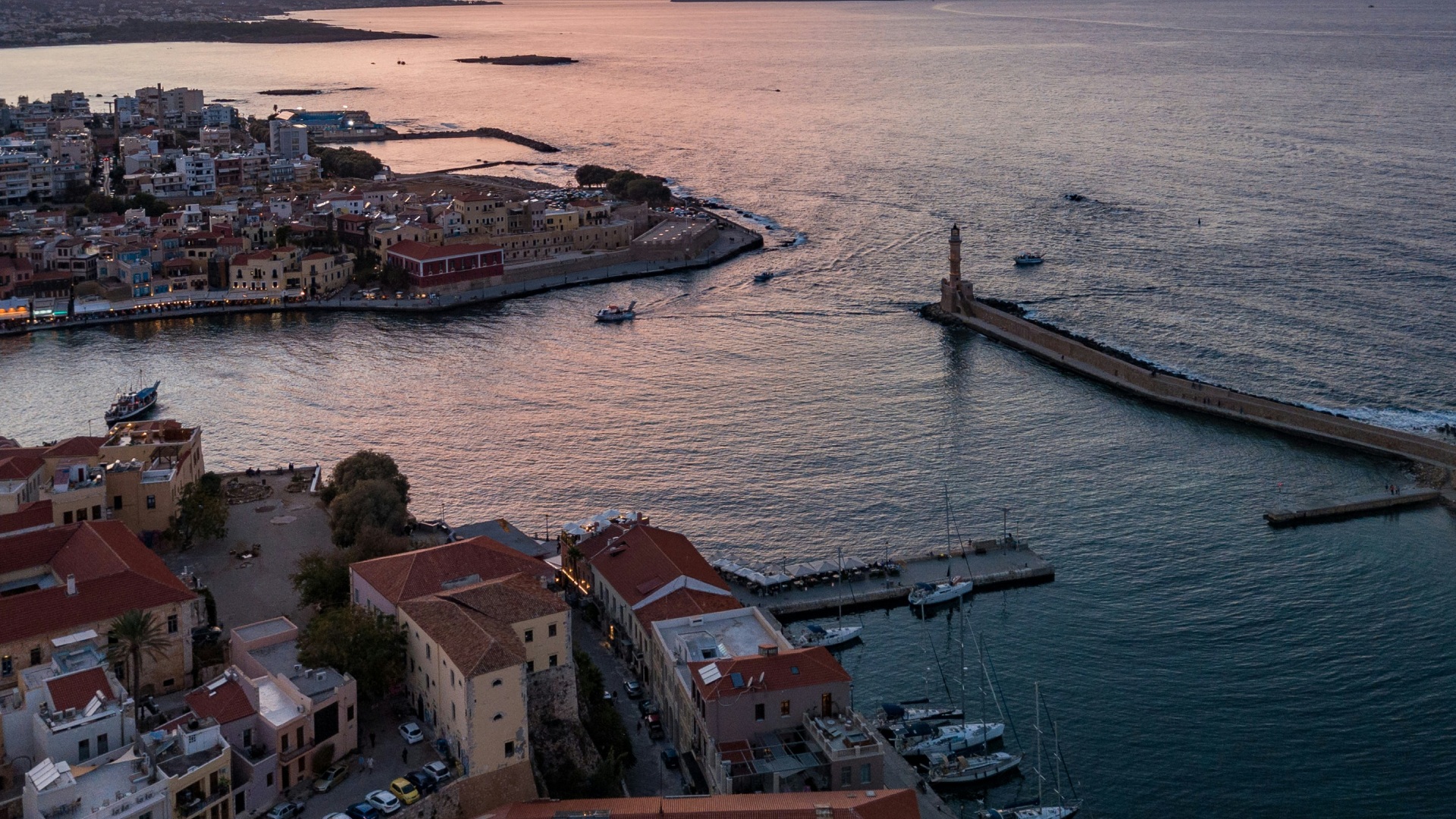
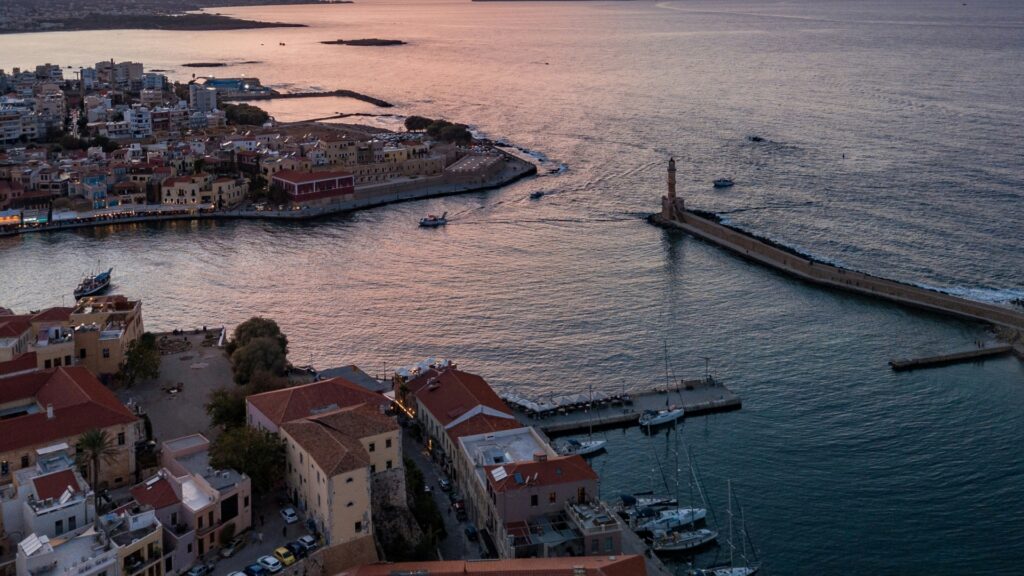
The Chania Venetian Harbour and its lighthouse are the most recognisable image in western Crete: a pale stone tower at the end of a long breakwater, the Old Town stacked in pastel colours behind it, and the White Mountains in the distance. Everyone who comes to Chania ends up here. The question is not whether to go, but when, because the same harbour is magical at 7am and at sunset, and hot, crowded and overpriced at 1pm in August.
| Where | The waterfront of Chania Old Town |
|---|---|
| Time needed | 2 to 4 hours, plus an evening |
| Cost | Free. The Maritime Museum charges a small entrance fee. |
| Lighthouse walk | Free, open at all hours, 20 to 30 minutes there and back |
| Best time of day | Before 9am, or from late afternoon onwards |
| Avoid | Midday in July and August |
| Car needed? | No. Park outside the Old Town and walk. |
A Short History
The Venetians built the harbour in the 14th century, when Chania, then called La Canea, was one of the most important ports in the eastern Mediterranean. They designed two basins: one for trade, one for building and repairing galleys in the long vaulted shipyards called the Neoria. In the 16th century, as the Ottoman threat grew, they fortified it, building Firkas Fortress at the entrance and the lighthouse at the end of the breakwater. A heavy chain could be stretched between the two to close the harbour.
The Ottomans took the city in 1645, and the harbour changed hands and shapes over the centuries that followed. In 1965 the walled Old Town was declared a protected monument, which is why there are no concrete hotels on the waterfront today and why it still looks the way it does.
What to See
The Lighthouse and the Breakwater
The lighthouse has three layers of history. Its octagonal base is Venetian, from the late 16th century. The tower above it was rebuilt in the 1820s and 1830s, during the period of Egyptian rule, in a shape that recalls a minaret, which is why locals sometimes call it the Egyptian lighthouse. Damaged in the Second World War and by earthquakes, it was restored in 2005. You cannot go inside, but you can walk along the breakwater right to its base.
The walk takes 20 to 30 minutes there and back, longer if you stop to look back at the city, which you should. The path is narrow in places and becomes a slow shuffle in both directions on summer evenings.
Local tip: Walk to the lighthouse before 8am in summer. The breakwater is almost empty, the light is low and golden, and you have the whole sweep of the harbour to yourself. Around 7pm is equally beautiful, as the light drops behind the mountains and the lighthouse is lit, but you will share it.
Firkas Fortress and the Maritime Museum
At the western entrance to the harbour, Firkas Fortress is where the Greek flag was raised on 1 December 1913 to mark Crete’s union with Greece, which still matters a great deal to people here. Inside is the Maritime Museum of Crete, small but well done, with ship models, a large model of the Venetian city, and a section on the Battle of Crete. Allow an hour. It is not air-conditioned, so go in the morning in summer, and check the current opening hours before you go.
The Mosque of the Janissaries
The domed building on the waterfront is the Küçük Hasan Mosque, built shortly after the Ottoman conquest and one of the oldest Ottoman buildings in Crete. It no longer functions as a mosque and is used for exhibitions. When it is open, step inside: the domes alone are worth it.
The Venetian Shipyards (Neoria)
On the eastern side of the harbour stand the remaining Neoria, the arched halls where Venetian galleys were built and repaired. Seven survive side by side. The largest, the Grand Arsenal, has been restored as the Centre for Mediterranean Architecture and hosts exhibitions and events.
Eating at the Harbour: The Honest Version
The harbour is beautiful, and some waterfront restaurants are good. But you pay for the view, and in the busiest stretch, near the mosque, quality and prices are the most uneven. Visitors regularly describe the front-row tavernas as touristy and overpriced. The simple rule: have a coffee or a drink on the waterfront, enjoy the view, then walk one or two streets back into the Old Town for dinner.
On the harbour itself, the eastern side, between the old shipyards, tends to have more locals and better value than the stretch near the mosque. Look for handwritten specials and fishing boats moored nearby. If you want a waterfront table at sunset in August, book or arrive by 6pm.
Warning: Chania is a safe town, but the harbour is where the crowds are, and visitors do report pickpocketing on busy summer evenings, including wallets and passports taken from backpacks. Wear your bag in front, keep phones out of back pockets, and leave passports in the hotel safe.
The Harbour at Night
Save at least one evening for the harbour. The lights reflect on the water, the lighthouse glows at the end of the breakwater, street musicians play along the promenade and the bars stay open until late. This is the harbour at its best, and it costs nothing to walk.
Where to Stay in Chania Old Town
To see the harbour at its best, early in the morning or after the day visitors leave, stay in the Old Town. Rooms with a harbour view book up quickly in summer, while the side streets are usually quieter.
The Honest Notes
- Midday heat. In July and August the stone breakwater reflects heat from every side and there is almost no shade. Go early or late.
- Parking. You cannot drive into the Old Town, and parking around it fills from mid-morning in summer. Walk, take a taxi, or arrive early.
- Uneven ground. The waterfront is mostly flat, but the back streets are uneven cobblestones, which can be hard with a pushchair or limited mobility.
- Slippery stones. The breakwater can be slippery after rain or spray. Shoes with grip are better than smooth sandals.
Getting There
On foot is the only real way. From the Municipal Market it is about a five-minute walk, and from the bus station around 10 to 15 minutes.
By car, park around the edge of the Old Town and walk in. In August, arrive before 9am or take a taxi. There is no Uber or Bolt in Chania: taxis are metered, and you can find them at the ranks around the Old Town or ask your hotel to call one.
On a walking tour, you get the history explained as you go. Most Old Town tours include the harbour and the lighthouse.
Frequently Asked Questions
Can you go inside the lighthouse?
No. You can walk along the breakwater to its base for free, at any time.
Is the harbour good for children?
Yes. Children love the boats and the lighthouse walk, and the ship models in the Maritime Museum. Keep a hand on small children on the breakwater, which runs right beside the water.
Is it worth visiting out of season?
Very much so. Chania is a living town all year. In spring, autumn and even winter, the harbour is calmer, many restaurants stay open, and you can actually stop and look without being nudged along.
Combine With
Splantzia, ten minutes southeast, is the Old Town neighbourhood where locals actually live, built around a shaded square. Quieter and less photographed.
Koum Kapi, a short walk east along the sea walls, has a relaxed seafront with tavernas on the water and fewer tourists.
Nea Chora Beach, about 15 minutes west on foot, is the nearest sandy beach to the Old Town. Good for a morning swim.
The Municipal Market (Agora), the cross-shaped covered market from 1913, is a few minutes’ walk away. It is still closed for a long restoration, so admire the building from outside for now.