The Maritime Museum of Crete, Chania is one of the few places in the old town where you actually learn something you did not already know. It sits inside the Firkas Fortress at the western end of the Venetian harbour, a red-walled building that most people walk past without going in. That is a mistake. This is not a grand, polished national institution. It is a compact, genuinely absorbing museum with over two thousand years of seafaring history packed into two floors of an old fortress. And it costs next to nothing.
At the entrance of the port of Chania is situated the Venetian Fortress Firkas, where on December 1st 1913, the Greek flag was hoisted, sealing the union of Crete with the motherland Greece. The museum came later. It was founded in May 1973 by Vice Admiral A. Giannopoulos, who was serving as an Admiral Commander in Chania. It has grown considerably since then, and today it is the second most important museum in the city after the Archaeological Museum. Come with at least an hour. More if you like history.
| Location | Firkas Fortress, Akti Koundourioti, Chania Old Harbour |
|---|---|
| Distance from city centre | On foot, 5 to 10 minutes from Chania Market Hall |
| Time needed | 1 to 1.5 hours for the main building; add 30 minutes for the Shipyard Moro annex |
| Best season | Year-round. Ideal on a hot afternoon or a rainy day |
| Entrance fee | Small fee; check official website (mar-mus-crete.gr) for current prices |
| Rental car needed? | No. Walkable from anywhere in the old town |
| Family friendly? | Yes |
What the Maritime Museum of Crete, Chania Actually Contains
This is a museum that takes Crete’s relationship with the sea seriously. The exhibition is divided into 13 sections and covers two floors. Downstairs, documents are exposed concerning the Union of Crete with Greece in 1913, while the first floor is dedicated to the Second World War, the present day, and the Battle of Crete. The permanent exhibition includes around 2,500 exhibits such as relics, objects found at sea, paintings, maps, photographs, ship models, and various nautical instruments.
The collection moves chronologically. All the exhibits from the naval tradition of Greece are classified according to their historical periods: Bronze Age, Classical and Hellenistic (2800 BC to 6th century AD), Venetian period (1200 AD to the 17th century), Byzantine and post-Byzantine period (650 AD to the 18th century), the period of Ottoman rule and the struggles for Independence (1650 to 1909), the Balkan Wars (1912 to 1913), World War II (1940 to 1944), and the post-war period.
That is a lot of ground, and the museum mostly handles it well. The Bronze Age and Minoan sections are genuinely interesting if you have any curiosity about how this island became a Mediterranean power. Exhibits include models of ancient ships, maritime tools, and artifacts from underwater excavations, illustrating the Minoans’ extensive Mediterranean trade routes.
The Venetian Period Section
There are old maps, models of Venetian ships, and a large model of the Venetian town of Chania with its fortification and dockyards. One model depicts three dockyards constructed by the Venetians, which were used for the mooring and the protection of the galleys and for small repairs. If you have already walked the harbour and wondered what those arched stone buildings at the waterfront once were, this section answers that question clearly.
The Independence and Modern Sections
The next section focuses on the Greek War of Independence and the many separate attempts of the Cretan people to unite with the rest of Greece, such as in 1866. Other sections focus on the Balkan Wars and the two World Wars, including exhibits on the world-famous Averoff battleship, whose pictures and models are presented here.
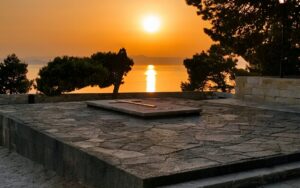
Special sections exist for the merchant navy, lighthouses, and postage stamps, as well as the “Altar of the Fatherland”, dedicated to the fallen of World War II, while on the first-floor level, visitors can find the life-size reconstruction of a destroyer’s bridge. Children particularly like this section. Adults do too, if they are honest about it.
There are also several videos playing with English subtitles and excellent footage about the Greek struggles for independence that involved a great deal of naval fighting.
Local tip: Do not skip the upper floor. Many visitors spend all their time downstairs and miss the Battle of Crete section and the destroyer bridge reconstruction entirely. Go upstairs first if you have children with you. They will thank you for it.
A Note on English Translations
The honest version: the quality of English translations has received mixed feedback from visitors; some found them adequate, while others described them as occasionally awkward in phrasing. In some cases the translations are genuinely good. In others, they are a bit earnest and dated. This does not diminish the exhibits themselves. Bring some patience and you will be fine.
The Shipyard Moro: The Second Part of the Museum
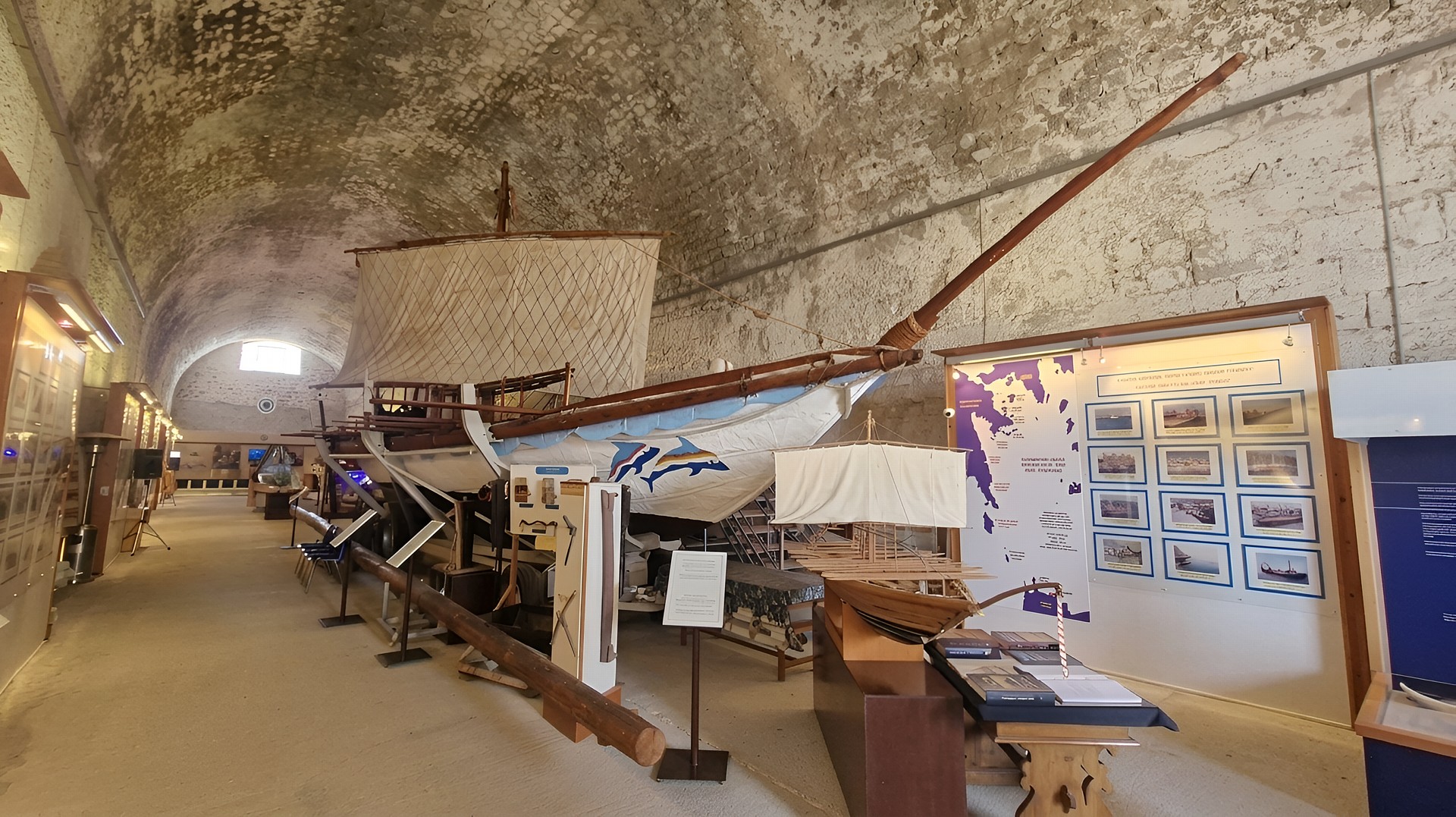
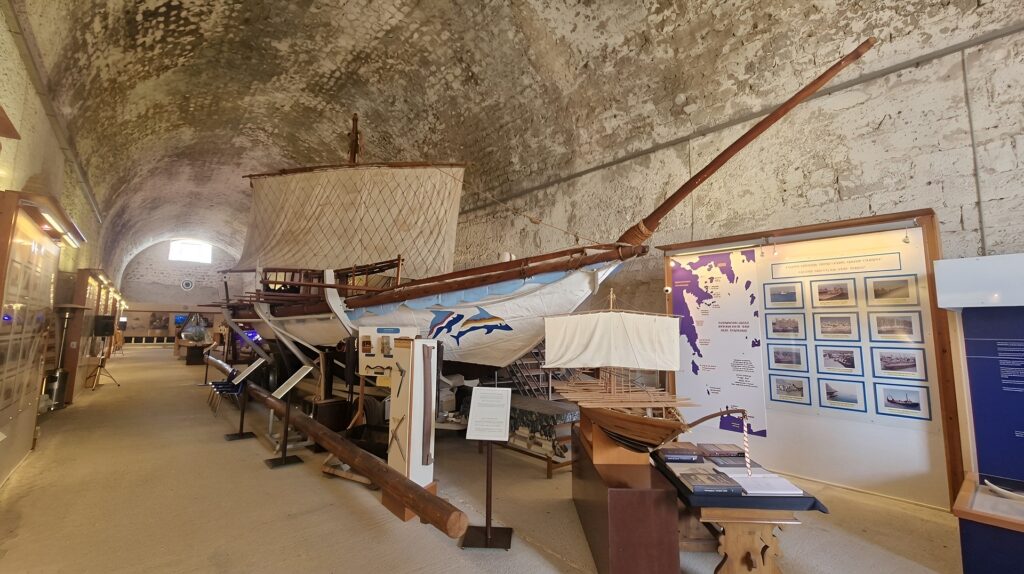
Another remarkable part of the museum is the Shipyard Moro, an extension located close to the Venetian Harbour. This site hosts a seasonal permanent exhibition on Greek traditional shipbuilding. Its highlight is a reconstructed model of a Minoan-era ship, which brings ancient seafaring to life.
In 1467, the Most Serene Republic of Venice ordered the construction of the shipyards in the harbour of Chania for the repair of its fleet. By 1593, sixteen shipyards had already been built, and in 1607 the construction of the Moro Shipyards began. The building you walk into today is part of that original structure. That context matters. You are standing in a working Venetian shipyard.
The representation of the Minoan ship “Minoa” of 16th to 15th century BC was launched in December 2003, and in 2004 it made its maiden trip from Chania to Piraeus, accompanying the Olympic flame. The replica is full-sized, built using ancient techniques, and it actually sailed. Worth the short walk to the other end of the harbour.
Visitors can also observe an experimental ship model, explore the tools and materials used in traditional construction techniques, and browse a rich photographic archive documenting each stage of the shipbuilding process, including the trial voyage.
Local tip: The Shipyard Moro is at the eastern end of the harbour, a ten-minute walk from the main Firkas building. A combined ticket covers both sites and saves you money. Buy it at the main entrance before you head over. The Moro exhibition is open from May to the end of October only.
The Firkas Fortress Itself
The fortress is worth a few minutes of your time beyond the museum. The Firkas Fortress was constructed in 1629 in Chania to protect the Venetian harbour entrance from raiders. “Firka” in Turkish means a military division, and the building was used as the barracks of the Turkish army in Chania.
On December 1, 1913, in an official ceremony, the Greek flag of the Union of Crete with Greece was raised in the corner turret of the fortress. Present were the then King of Greece Constantine, Prime Minister Eleftherios Venizelos, Admiral Kountouriotis, the surviving fighters and chieftains of the Cretan Revolutions, and crowds of people. That moment ended centuries of foreign occupation. The flag still flies from the same tower.
You can walk around the fortress with its view of Chania and the sea and the Venetian Harbour for free when it is open. Do this before you go inside. The view back toward the old town and lighthouse from the fortress walls is one of the better free views in Chania.
Warning: In July and August, the museum’s small rooms can get uncomfortably warm. It has no air conditioning, and on hot afternoons the upper floor especially can be stifling. Visit in the morning when it is cooler, or go in the evening during extended summer hours.
The Honest Notes
This is a small museum. Do not arrive expecting the grandeur of a national institution. The building is old, the rooms are compact, and because of its small size and many displays it easily becomes overcrowded, and when temperatures are high, uncomfortable.
The museum lacks a café or drink options, which may be inconvenient for visitors planning to spend a significant amount of time exploring the exhibits. There are plenty of cafés directly outside, so this is not a serious problem. But do not go in thirsty expecting a coffee on the way out.
What is special is how personal some exhibits feel: many items were donated by Cretan sailors or their families, giving a real human touch to naval history. This is the part that sets the museum apart from more polished alternatives. These are not anonymous artefacts sourced for display. A lot of what you see came from real people’s homes and lives.
Warning: Opening hours and entrance fees change between summer and winter seasons. Always check the official website at mar-mus-crete.gr before visiting, as the information varies across other travel sites and some of it is outdated.
Warning: The Shipyard Moro annex is closed from November through April. If you are visiting in the off-season, plan accordingly. The main Firkas building is open through the winter, with shorter hours and closed on Sundays.
Before You Go
- Tickets: Pay at the entrance. A combined ticket for the main museum and Shipyard Moro is available and recommended.
- Photography: Allowed inside without flash. Some of the ship models are worth the shot.
- Toilets: There is a small WC on the second floor of the main building.
- Accessibility: Some upper areas of the museum involve stairs and may be less accessible for visitors with limited mobility.
- Language: Most exhibit labels are in both Greek and English.
- Timing: Allow 1 hour for the main building, 30 minutes for the Shipyard Moro if visiting in summer.
Getting There
The Maritime Museum of Crete is one of the easiest places to reach in all of Chania. No car required.
On foot: From Chania’s Old Town, the museum is a short stroll along the promenade. Walk west along the harbour waterfront, past the restaurants and the Egyptian Lighthouse, and the red fortress building is at the far end. You cannot miss it.
By bus: Local buses serving Chania stop close to the harbour; check stops near the Venetian Harbour. From the main bus station on Kydonias Street, the old town is a 15-minute walk or a short taxi ride.
By taxi: A taxi from anywhere in central Chania will drop you right at the museum entrance. Fares within the city are short and inexpensive. There is no Uber or Bolt in Chania, so use a street taxi or ask your hotel to call one.
By organised tour: Some walking tours of Chania’s old town include a stop at the museum or at least the Firkas Fortress.
Parking: If you are driving from outside the old town, park in one of the paid car parks near the market hall or along Halidon Street. The old town roads around the harbour are narrow and often restricted. Do not try to drive to the museum itself.

Practical Information
| Address | Firkas Fortress, Akti Koundourioti, Chania Old Harbour |
|---|---|
| Official website | mar-mus-crete.gr |
| Summer hours (May to October) | Daily 09:00 to 17:00; Sundays 10:00 to 18:00 |
| Winter hours (November to April) | Daily 09:00 to 15:30; closed Sundays |
| Entrance fee | Small fee for adults; reduced for students and children; under 6 free. Check website for current prices. |
| Combined ticket | Available for the main museum and Shipyard Moro annex |
| Shipyard Moro annex | Open May to end of October only |
| Languages | Greek and English labels throughout |
| Photography | Allowed without flash |
| Toilets | Available on the second floor |
Combine With
The museum sits at the edge of the old town and is ideally placed for a half-day cultural loop. Here are the best things to combine with your visit.
The Venetian Harbour and Lighthouse. Walk the full length of the harbour after leaving the museum. The Egyptian-built lighthouse at the end of the breakwater is about a 15-minute walk across. The contrast between what you have just seen in the museum and what you are looking at from the waterfront is worth thinking about.
The Byzantine and Post-Byzantine Collection of Chania. The Byzantine and Post-Byzantine Collection of Chania is housed in the catholicon of the monastery of San Salvatore, a monument of the 15th century. Mosaics, funerary inscriptions, frescoes, icons, architectural sculptures, ceramics, miniature works, and coins depict the historical and artistic identity of Chania during the Byzantine and post-Byzantine period. It is a ten-minute walk from the Maritime Museum, inside the old town.
The Chania Old Town and Splantzia Quarter. After the museum, walk back through the backstreets rather than along the waterfront. The Splantzia neighbourhood is quieter and less touristy, with good local cafés and some of the best-preserved Ottoman-era architecture in the city.
The Chania Municipal Market (Agora). The covered market building is a short walk east of the old harbour. It has been operating since 1913. A good place to buy local food before or after the museum.
Frequently Asked Questions
How long does the Maritime Museum of Crete take to visit?
Allow between 30 minutes to two hours for a visit, depending on your level of interest. For most visitors, one hour covers the main Firkas building comfortably. If you are also visiting the Shipyard Moro annex at the other end of the harbour, add another 30 minutes and factor in the walk between the two.
Is the Maritime Museum of Crete worth visiting?
Yes, for most tourists spending time in Chania’s old town. It is inexpensive, genuinely informative, and located in a building with its own significant history. It is not one of Greece’s great museums, but it punches well above its size. By visiting the Maritime Museum of Crete, you gain insight not only into naval battles or ship types, but also into Crete’s identity as an island. For centuries, control of Crete meant control of Eastern Mediterranean sea lanes.
Is the Maritime Museum of Crete good for children?
Yes. A mock-up of a ship control room provides an interactive element that is particularly engaging for children. The scale models of ancient, Venetian, and modern warships hold attention well. There is also a collection including seashells, sponges, crustaceans, and starfish that depicts the diversity of marine life. Children under six enter free.
What are the opening hours of the Maritime Museum of Crete?
Opening hours in summer (May to October) are daily 9:00 to 17:00, with Sundays 10:00 to 18:00. From November to April, hours are daily 9:00 to 15:30, and the museum is closed on Sundays. Always confirm on the official website before visiting, as hours can change without notice on public holidays.
Is the Firkas Fortress the same as the Maritime Museum?
The Fortress Firkas was constructed by the Venetians. Today, at the entrance of this Fortress is situated the Maritime Museum of Crete. The fortress and the museum share the same building, but you can walk through parts of the fortress courtyard without paying museum admission. The museum occupies the interior rooms.
Where exactly is the Maritime Museum of Crete?
The museum is at the entrance of the historic Firkas Fortress (Akti Kountourioti), at the west end of the Venetian Harbour in Chania Old Town. It is the red building at the far western tip of the harbour promenade. Walk the full length of the waterfront heading west and you will arrive at it naturally.
Is there parking near the Maritime Museum?
The museum itself is inside the pedestrian zone of the old town. Drive to the edge of the old town and use one of the paid parking areas near the market hall or along Pireos Street. From there it is a ten to fifteen minute walk along the waterfront to the museum.
Local tip: If you visit on a December 1st, you will find an annual ceremony at the Firkas Fortress tower marking the anniversary of Crete's union with Greece. The Greek flag is raised again on the same mast where it first flew in 1913. King Constantine and Eleftherios Venizelos stood here. The ceremony is short and open to everyone. It is the kind of local moment that stays with you long after the holiday photographs have faded.