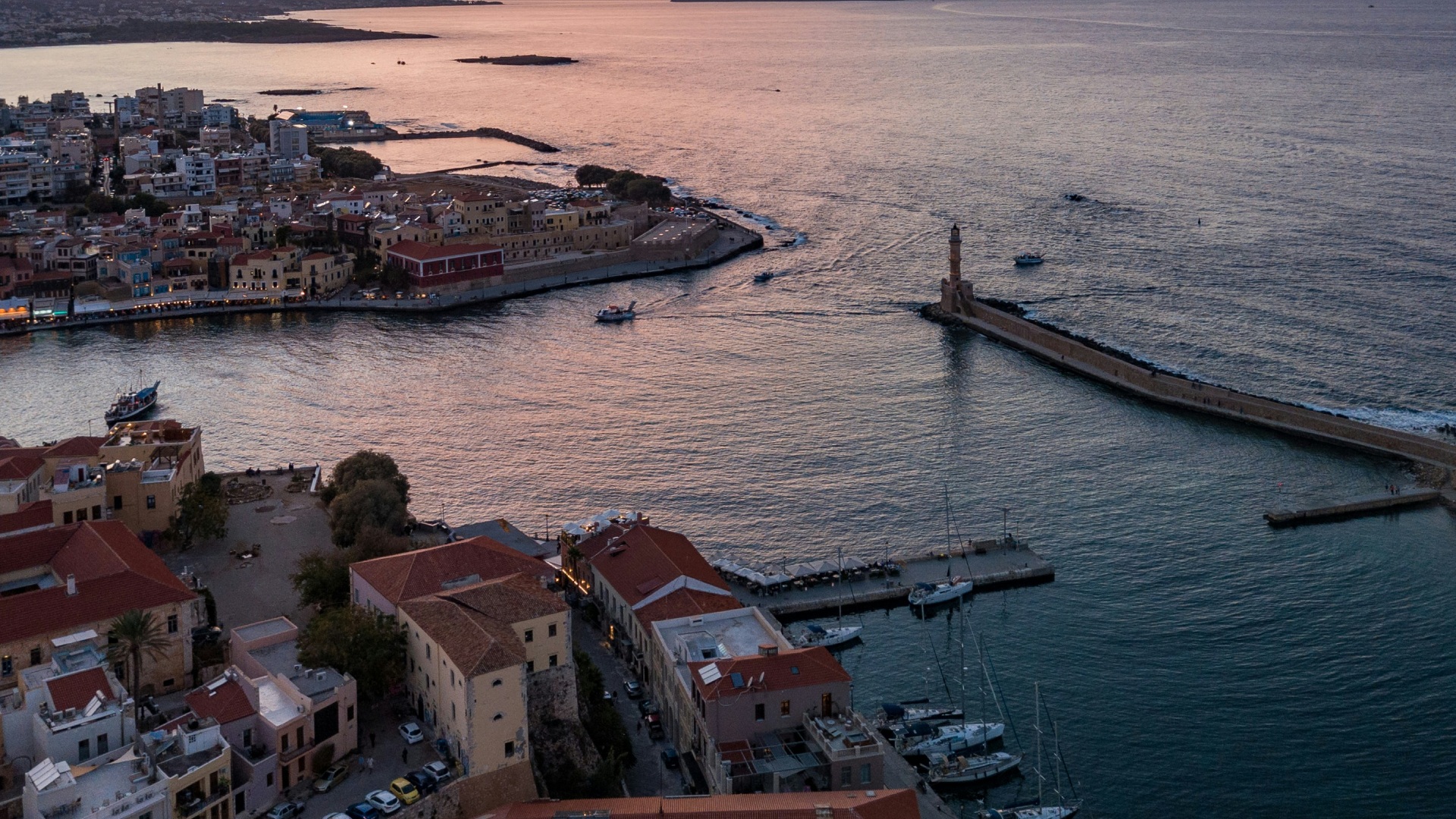
The Chania Venetian Harbor and Lighthouse is the most recognizable image in all of western Crete. One photograph of that pale tower at the end of the breakwater, the old town stacked behind it and the White Mountains rising in the distance, has appeared on more postcards, Instagram feeds, and travel brochures than anything else in the region. Every visitor to Chania comes here. The question is not whether to visit but how to make the most of it without falling into the obvious traps.
This is not just a pretty backdrop. The harbor has been a working port, a battleground, a place of occupation and liberation, for over 700 years. Walk it slowly and you will understand Chania far better than any museum can explain. Walk it at the wrong time and you will be fighting your way through tour groups and overpriced coffee in 35-degree heat. Timing matters here.
| Distance from Chania center | You are already here. The harbor is the Old Town. |
|---|---|
| Time needed | 2 to 4 hours for a thorough walk, longer with museum |
| Best season | All year. Best in May, June, September, October |
| Entrance fee | Free to walk. Maritime Museum has a small entrance fee |
| Rental car needed? | No. Walk from anywhere in the Old Town |
| Family friendly? | Yes |
| Best time of day | Early morning or evening |
The History of Chania Venetian Harbor and Lighthouse
Constructed between 1320 and 1356 during Venetian rule, this historic port became a vital naval station and one of the most important commercial hubs in the eastern Mediterranean. The Venetians were methodical engineers. They designed the harbor with two basins: a western basin for unloading goods into warehouses and an eastern basin dedicated to shipbuilding and repairs. Massive stone shipyards known as the Neoria were built along the water from 1467 to 1599 to house and repair ships.
The harbor clearly shows the grave importance of the city during the Venetian era of Crete, from 1204 to 1669. During that time, when Chania city was known as La Canea and served as capital of the island, the harbor of Chania ranked second only to Venice itself. It had a capacity of more than 40 galleys, which controlled naval trade in the eastern Mediterranean.
In the 16th century, the Venetians fortified the port to counter Ottoman expansion. The Firkas Fortress at the harbor’s entrance was key to these defenses, and a thick chain could be extended from the fortress to the base of the lighthouse to block access when necessary.
Because Chania was quite poor and derelict in the 1960s, there was very little interest in developing the area to tourism, leaving the harbor and its jumble of Venetian buildings essentially untouched. In 1965, the part of Chania enclosed within the fortification walls was declared a protected historical monument. This controlled any further development and means it now remains one of the most beautiful Venetian harbors in the Mediterranean.
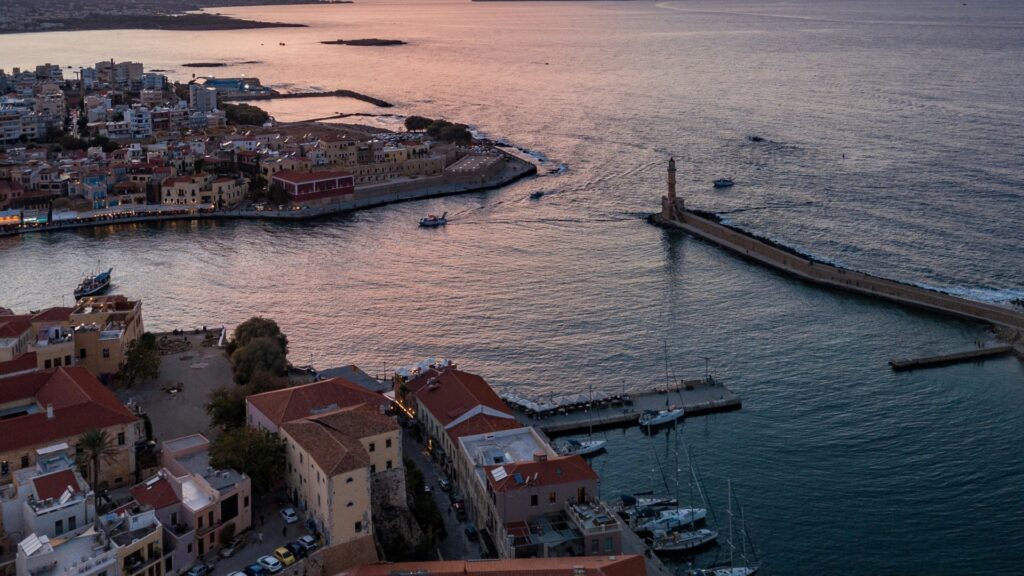
The Lighthouse: History in Three Layers
Between 1595 and 1601, the Venetians erected the bastion of Agios Nikolaos, the Firkas Fortress, and the lighthouse at the end of the mole of Chania. Its original octagonal base can still be seen today. A chain could be attached to it, stretching up to Firkas, to close the harbor.
During the Turkish occupation, the lighthouse fell into disrepair and was eventually rebuilt between 1824 and 1832 in the form of a minaret. The modern lighthouse is often referred to as “Egyptian” because it was built during a time when Crete was occupied by Egyptian troops who were supporting the weakening Ottoman Empire.
The base of the lighthouse is still the original Venetian base, although the Lion of St. Mark which was carved there has long gone. Look for the recess in the stone where it once sat. The lighthouse was leaning badly due to bombings during World War II and earthquakes, but it was extensively renovated in 2005 and now looks as good as new.
It stands 21 meters high and its light covers a distance of 7 miles. It is one of the oldest restored lighthouses in the world.
The lighthouse interior is not open to the public. The walk to its base, however, is completely free.
Local tip: Walk to the lighthouse in the early morning, before 8am in summer. The mole is almost empty, the light is low and golden, and you have the whole sweep of the harbor to yourself. By 10am it will be crowded and the sun will be directly in your eyes looking back at the Old Town. The evening walk at sunset is equally good but busier.
What to See Around the Chania Venetian Harbor
The Venetian Shipyards (Neoria)
Lining the eastern side of the harbor, the Neoria are the arched shipyard halls where Venetian ships were built and repaired. Seventeen were originally built between the 16th and 17th centuries: long vaulted structures open on the seaside so galleys could be dragged in for repairs.
The seven remaining attached Venetian shipyards today act as an almost theatrical stage setting on the Chania Marina. They were initially built for the construction and maintenance of the Venetian galleys, but later, when the Ottomans invaded Crete, they served as the city’s storehouses for food during the Ottoman sieges.
The largest, known as the Megalo Arsenali or Grand Arsenal, was extensively restored in 1997 and transformed into a building that hosts various exhibitions and events. It also houses the Center of Mediterranean Architecture and important Greek and international events related to architecture.
The Firkas Fortress and Maritime Museum
Housed within the Firkas Fortress, the Maritime Museum of Crete is a must-see for history enthusiasts and curious travelers. It is small. Allow an hour, perhaps an hour and a half if you read everything carefully.
Established in 1973, the Maritime Museum of Crete spans two floors and encompasses 13 distinct sections, each meticulously curated and showcasing different eras of maritime history. The exhibits include models of ancient ships and an impressive model of the fortified town and port under Venetian rule. A section of the museum is dedicated to the German invasion of Crete. A more recent section of the museum is located at the eastern end of the harbor at the Moro Docks and houses the replica of a Minoan ship.
The fortress holds particular historical importance, as it was here on December 1, 1913, that the Greek flag was first raised on the island during Enosis, Crete’s union with Greece. That fact carries real weight for locals. Worth knowing before you visit.
Opening hours are Monday to Saturday, 09:00 to 15:40. The museum is closed on Sundays. Check the official website for current ticket prices before you go.
Warning: The Maritime Museum has no air conditioning. In July and August, visiting after 11am can be genuinely uncomfortable. Go first thing in the morning.
The Mosque of the Janissaries (Yiali Tzami)
The Mosque of the Janissaries is a distinctive domed structure gracing the harbor front and is the oldest Ottoman building in Crete, built around 1645 shortly after the Ottoman conquest. Its official name is Kioutsouk Hasan Mosque, in honor of the first Janissary commander of Chania. Featuring an elegant cubic base and multiple domes, the mosque was once an Islamic house of worship and ceased religious function in the early 20th century. After restoration, with the minaret removed long ago, it now serves as an exhibition hall for art and local crafts.
Entry is free when exhibitions are running. Worth a quick look inside even if you are not interested in the current show. The architecture alone is worth it.
The Old Sea Wall and the Walk to the Lighthouse
The Old Sea Wall connects the Firkas Fortress to the Venetian Lighthouse, creating a favorite spot where visitors stroll and enjoy views of the sea and town. The breakwater area all the way to the lighthouse affords a panoramic view of the harbor, the old town of Chania, against a backdrop of the White Mountains.
The walk is a bit narrow, so keep that in mind and be mindful of people coming in the opposite direction. In high summer this stretch becomes a slow shuffle in both directions. Go early.
The round trip from the harbor to the lighthouse and back takes roughly 20 to 30 minutes at a relaxed pace. Allow more time if you want to stop and look back at the city.
Eating at the Harbor: What the Locals Actually Do
This is the part most travel guides get wrong. The harbor is beautiful. Some of the restaurants directly on the waterfront are not bad. But many are. Restaurants and shops in the immediate waterfront area tend to be more expensive compared to those slightly further away in the back streets.
The honest advice: have a coffee or a drink at the waterfront. Enjoy the view. Then walk one or two streets back into the Old Town for your actual meal.
In the backstreet of the Venetian harbor, Tamam is a local restaurant with a unique vibe. An old European style is evident and will bring you to another era. The menu offers simple Mediterranean food with traditional Greek dishes and local specialties. It sits in a converted Turkish hammam on Akti Tombazi. Book ahead in summer.
Lithos is one of the few restaurants facing the Old Venetian Harbor that will surprise you with a creative menu based on fresh and genuine Cretan products. This all-day restaurant and café serves tasty dishes, creative cocktails, sweets, and coffee only steps from the waterfront, inside one of the best-preserved buildings in the old town. They take pride in supporting local flavors and featuring creative Greek cuisine and fantastic Greek wines.
For the harbor itself, the far eastern end near the marina is generally better value than the tourist-facing stretch near the mosque. Along the harbor and between the Venetian arsenals, there are many fish tavernas which are well-frequented by locals and foreigners alike.
Local tip: The fish tavernas tucked between the Venetian arsenals on the eastern side of the harbor tend to be busier with locals than the prominent spots near the mosque. They are not hidden. But they are slightly off the main tourist circuit and that makes a difference. Look for handwritten specials boards and boats still moored nearby.
The area can get extremely busy, especially during peak season, leading to crowded streets and difficulty finding seating at restaurants. If you want a waterfront table at sunset in August without a reservation, arrive by 6pm or book ahead. Otherwise you will stand and watch others eat.
The Honest Notes
This is what most travel articles leave out.
Walking around the harbor, especially to the lighthouse, can be hot during the day with limited shade available, requiring sun protection. In July and August, the stone mole reflects heat from both sides. It is genuinely unpleasant at midday. This is not a complaint, it is a practical fact. Go early or go in the evening.
Warning: Parking near the harbor in summer is very difficult. The streets of the Old Town are narrow and often restricted to residents. If you are staying outside the center, come by taxi or walk. If you are staying in the Old Town, you do not need a car at all for this visit.
The harbor is also a working sea lane. In 1965, the part of Chania enclosed within the fortification walls was declared a protected historical monument. This has controlled development and means it remains the most beautiful Venetian harbor in the Mediterranean. That protection is real and it shows. The buildings have not been replaced with concrete hotels. The scale is intact. But it also means the streets are narrow, the cobblestones uneven, and some sections genuinely difficult for anyone with mobility issues or a pushchair.
Warning: The mole leading to the lighthouse can be slippery in places, particularly if there has been spray or rain. Wear shoes with grip. Sandals are fine in dry conditions but be careful near the water’s edge.
One more thing. The harbor at night is genuinely worth seeing. The Old Venetian Harbor anchors Chania’s most popular nightlife strip: a 700-metre waterfront promenade where bars, street performers, and waterfront tavernas operate until midnight or later. The lights reflecting on the water, the lighthouse in the background, the sound of live music drifting from the back streets. This is when the harbor is at its best. Save time for an evening here even if you visit during the day.
Frequently Asked Questions
Is there an entrance fee to visit the Chania harbor and lighthouse?
There is absolutely no entrance fee to walk to the base of the Chania Venetian Lighthouse. The harbor itself is public space. The Maritime Museum inside Firkas Fortress has a small entrance fee. Check the official museum website for current prices before you visit.
How long does it take to walk to the lighthouse and back?
The walk to the lighthouse is free and there is no admission. It takes about 20 to 25 minutes to walk to the lighthouse and back. If you want to stop, look around, and take photographs, allow 40 minutes to an hour.
Can you go inside the lighthouse?
The Chania Lighthouse is not open for visitors to climb to the top. However, visitors can enjoy views of the lighthouse and the harbor from the surrounding area. You can walk right up to the base. That is as far as it goes.
Is the harbor suitable for children?
Yes, completely. The waterfront promenade is wide and flat for most of its length. Children enjoy the boats, the water, and the lighthouse walk. The Maritime Museum is also good for families, as the marine biology section and model ships are especially engaging for children. The cobbled back streets require some attention with small children or buggies.
When is the best time of day to visit?
Early morning or late afternoon and sunset are the best times. Mornings offer a serene atmosphere with fewer crowds and soft, beautiful light, perfect for capturing architectural details. The harbor is open at all hours. In peak summer, midday visits are uncomfortable and crowded.
Is the harbor worth visiting out of season?
Absolutely. The harbor in October, November, or even winter has a completely different character. The restaurants are open, the crowds are gone, and you can actually stand and look at things without being nudged forward. May, September, and early October offer a more relaxed atmosphere with good weather and fewer crowds. These are, honestly, the best months to be here.
Getting There
The Chania Venetian Harbor is in the Old Town, which is the historic center of the city. From anywhere in central Chania, you can walk here.
On foot: From Chania’s central market on Stivanadika Street, the harbor is a 5-minute walk north. From the bus station on Kidonias Street, allow 10 to 15 minutes on foot.
By car: You cannot drive into the Old Town. Park on the periphery, on the streets around Plateia 1866 or along the coastal road east of the harbor near Koum Kapi, and walk in. Parking fills quickly from mid-morning onwards in summer. In August, consider arriving before 9am or using a taxi.
By taxi: Taxis in Chania are metered. Ask to be dropped at “Limani” (the harbor) or at Akti Kountourioti. There is no Uber or Bolt in Chania.
By organized tour: Many walking tours of Chania Old Town include the harbor and lighthouse as part of the route. These are a reasonable option if you want historical context provided as you walk.
Practical Information
| Location | Akti Kountourioti, Old Town, Chania |
|---|---|
| Lighthouse walk | Free, open at all hours |
| Maritime Museum | Monday to Saturday, 09:00 to 15:40. Closed Sundays |
| Maritime Museum fee | Small entrance fee. Check official website for current prices |
| Best time to visit | Early morning or evening |
| Avoid | Midday in July and August |
| Nearest parking | Perimeter of Old Town. Free parking near old walls fills quickly |
| Facilities | Toilets available at cafes and in the Maritime Museum |
| Accessibility | Promenade is mostly flat. Mole to lighthouse is manageable. Back streets are uneven cobblestone |
Combine With
The harbor sits at the heart of the Old Town. Everything in this list is within easy walking distance.
Chania Old Town and the Splantzia Quarter. Walk 10 minutes southeast of the harbor into the residential heart of the old Venetian city. The neighborhood around Plateia Splantzia is where locals actually live. Quieter, less photographed, and genuinely interesting.
Koum Kapi. A five-minute walk east of the harbor along the sea walls brings you to Koum Kapi, a small beach neighborhood with a different atmosphere. Less touristy, with good seafood tavernas right on the water.
Nea Chora Beach. A 15-minute walk west of the harbor is the closest proper beach to the Old Town. Sandy, free, local. Decent for a morning swim before the harbor crowds arrive.
The Chania Municipal Market (Agora). A 10-minute walk southeast. The covered market was built in 1913 and is still a working food market. Olives, cheese, honey, herbs, fresh fish. Worth an hour of your time and a good place to buy local produce to take home.
Local tip: The harbor in the early evening, around 7pm in summer, has a specific quality that is hard to describe accurately. The light drops behind the White Mountains. The tour groups have mostly gone back to their hotels. The tavernas are beginning to fill. The lighthouse is lit. Walk the mole at this hour, slowly, and look back at the city. It is the best version of Chania there is, and it costs nothing.