The Venizelos Museum Chania is one of the most underrated cultural stops on the island. Most tourists who visit Chania spend their days at the harbour, at the beaches, at the gorge. They miss this place entirely. That is their loss. This is a house museum that actually works, in a neighbourhood that most visitors never reach, telling a story that shaped not just Crete but the entire modern Greek state.
The Eleftherios Venizelos Museum is a historic house museum in Chania. It is the paternal home of Eleftherios Venizelos (1864–1936), perhaps “the” Greek politician, where he lived from 1880 to 1910 and occasionally from 1927 to 1935. Today, it has been restored to its original state and transformed into a museum under the responsibility of the National Institution of Researches and Studies “El. Venizelos,” granted by the Greek state. It only opened to the public in 2015. It is still relatively quiet, even in high summer. Go while that is still the case.
| Location | Halepa neighbourhood, Chania |
|---|---|
| Distance from Old Town | About 2.5km, 30 minutes on foot |
| Difficulty | Easy |
| Time needed | 1 to 1.5 hours |
| Best season | Year-round |
| Parking | Street parking available nearby |
| Entrance fee | Small fee. Check official website for current prices |
| Rental car needed? | No, walkable or by bus |
| Family friendly? | Yes |
Who Was Eleftherios Venizelos?
If you are not Greek, the name may not mean much to you yet. Spend an hour in this museum and it will.
Eleftherios Venizelos is widely considered one of the greatest statesmen in the history of modern Greece. Born in Chania in 1864, he played a significant role in Crete’s struggles for political autonomy from the Ottoman Empire and eventually integration into Greece, before going on to serve as Greek Prime Minister for a combined 13 years between 1910 and 1933. Venizelos achieved international fame in his lifetime, and is often called “The Maker of Modern Greece” for his transformative role.
In 1910 he moved to mainland Greece, where he became Prime Minister and founded the “Liberal Party.” He was the moving spirit in the political and economic progress of Greece and in the victorious outcome of the Balkan Wars (1912–1913). Greece was redoubled in size and population.
His life was not clean. It was complicated, turbulent, and at times violent. He served seven times as Greece’s prime minister. For most people, he was viewed as the country’s most important politician because he expanded Greek borders and brought constitutional reforms that modernized Greece. Others believe he was responsible for dividing the Greek people. The museum acknowledges most of this, though as one reviewer noted, his responsibility for the Asia Minor Catastrophe of 1922 is somewhat understated. That is a fair criticism. But for an introduction to a century of Greek history, this house is the best starting point in Chania.
The end of his career was marked by the attempt against his life (June 1933) and the failed Venizelist coup of March 1935. He went into self-exile in Paris where he died on 18th March 1936. His body was brought back to Crete by ship, buried on a hill above Chania with a view across the bay he had spent his life fighting for.
What to See Inside the Venizelos Museum Chania
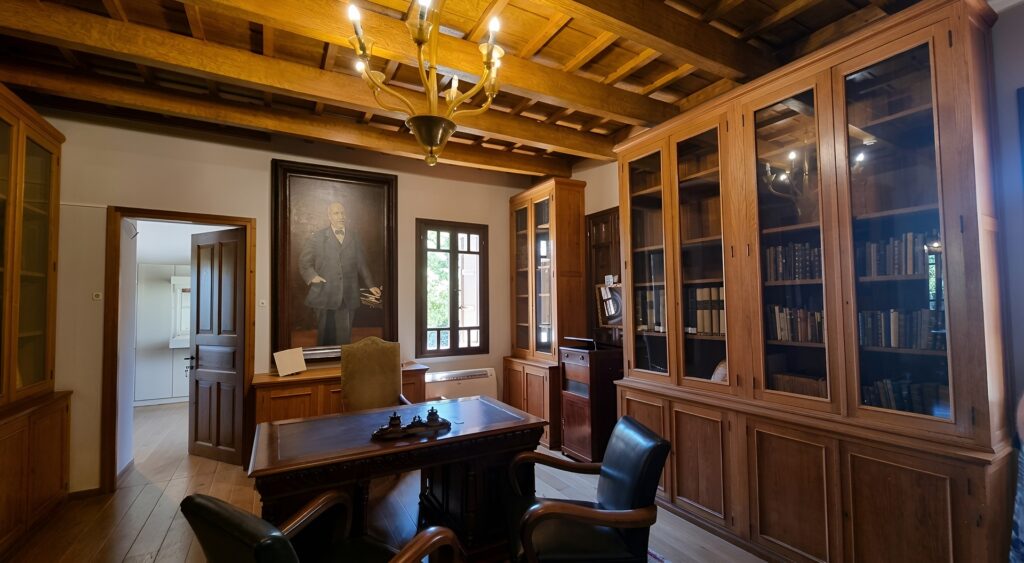
There are 2 floors and an attic, with 18 visitable rooms in total, as well as walkable gardens outside the house. Each room has a purpose.
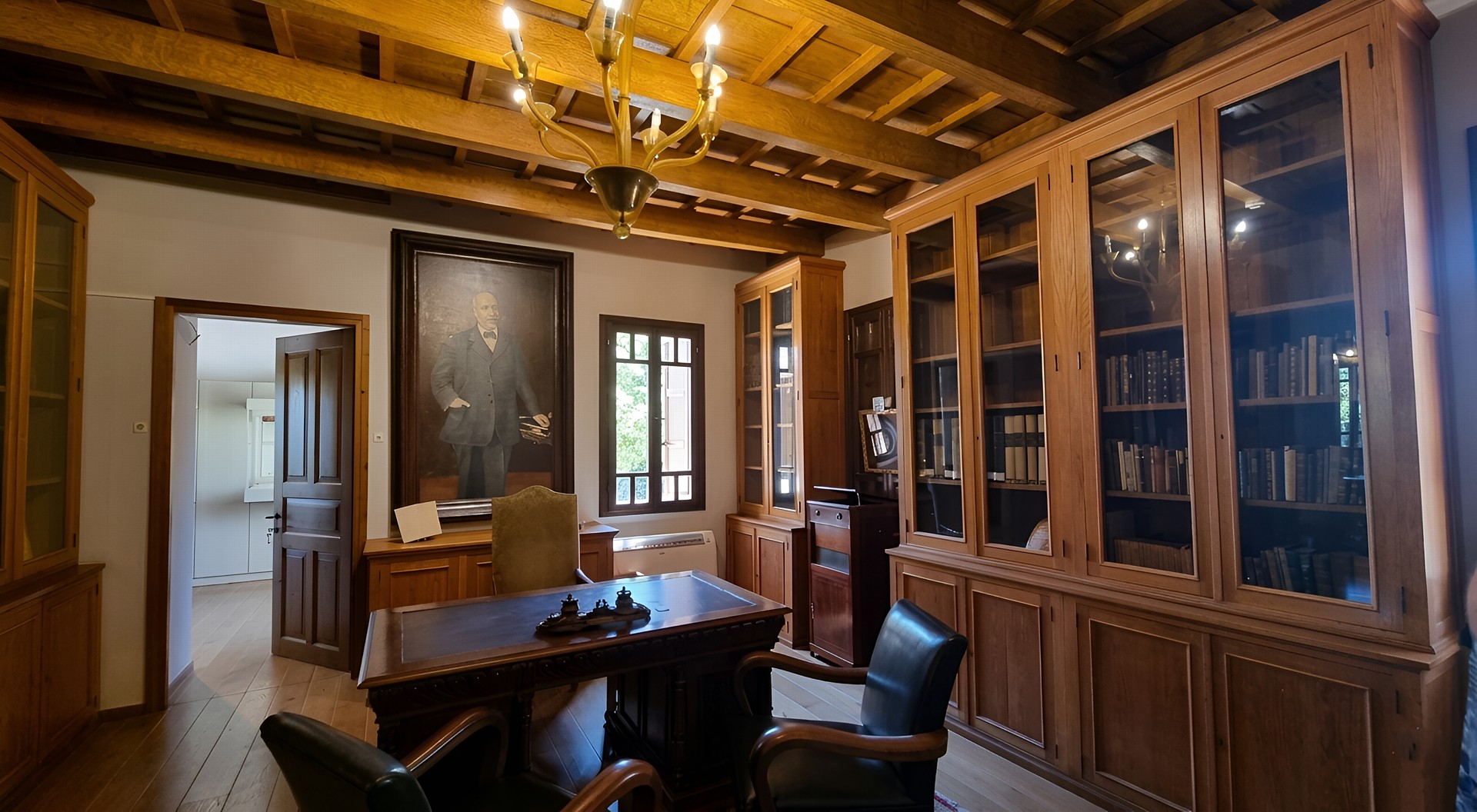
The museum’s main collection consists of photographs, paintings, personal objects and decorative items, as well as antique furniture, handpicked by Venizelos and his wife, which came from Athens or abroad. Every room of the residence has maintained its authentic interior as it was when Venizelos used to live in.
There are also special rooms dedicated to the specific parts of Venizelos’ life: “The Rebel,” “The Politician,” “The Diplomat,” “The Man,” and “The Myth,” as well as sections on the two assassination attempts he faced. That structure works well. You do not need to know anything coming in. By the time you leave the second floor you will have a clear picture of why this person matters.
Local tip: The two items visitors remember most are on different floors. Do not rush through the ground floor to get to the car in the garage. The ground floor rooms contain personal objects that make the man feel real, including objects from the assassination attempts that are quietly disturbing. Take your time upstairs first, then head outside to the garage last. That sequence makes more impact.
The Assassination Car
This is the single object that stops people cold. The collection ranges from oil paintings to the car with 60 bullet holes from an assassination attempt. Venizelos was lauded for restoring Crete to Greek sovereignty from Ottoman rule, and was the subject of many assassination attempts. The house has been restored to its original state and is full of artefacts and information; the car in which one of the assassination attempts took place is housed in a garage in the gardens and can be viewed.
Always a controversial figure, he was the target of two assassination attempts, and one striking exhibit is the bullet-riddled car in which he was nearly killed in 1933. Also on display there is a wonderful 1929 Packard, like the one Venizelos was travelling in, which is reputedly only one of two still in existence.
A protagonist of the museum would be said to be the original Venizelos car that has traces from bullets from Venizelos’ second attempted murder. Remarkable are his clothes with stains of his blood from the first attempted murder. These are not replicas. They are the real objects. That matters.
The Attic: Something for Families
The attic has been furnished with an Interactive Activities Area, which offers activities and games for children to help bolster their learning process and bring them closer to history. It is a thoughtful addition. Children who have been dragged around adult museums all holiday will engage with this.
The Digital Guide
The entrance fee includes a loan of a tablet with a guide to each of the rooms. The layout is easy to follow as you go on a self-guided tour, assisted by a hand-held device that is programmed to the language of your choice and a map. The collection has signs in Greek and English. They have an app with a description of many objects written in several languages. You can download the app in advance or use the tablet at the entrance. The tablet guide is thorough. Most visitors find it helpful without being overwhelming.
The Building Itself and Its History During WWII
There is a layer to this building that goes beyond Venizelos himself. Much of the ground and first floors are preserved exactly as they would have been during this time period, with Venizelos’ own furniture, in many cases unmoved. During the subsequent Axis occupation, it was restored and functioned as the German governor’s headquarters. During this period, the Germans painted various murals on the walls, some of which are preserved on the ground floor.
The Halepa house was built in 1880 by Kyriakos Venizelos for his son. During World War II it served as the German governor’s headquarters in occupied Crete. German murals from that period survive on the ground floor walls.
Following the end of World War II, it was returned to the Venizelos family, including Sofoklis Venizelos, who also served as Prime Minister. The family maintained the house until 2002, when it was purchased by the Greek government and passed to the Venizelos Foundation. It was eventually turned into a museum, with its doors first opening in 2015.
The Gardens and Views
Do not skip the gardens on the way out. The gardens surrounding the museum are a lovely place to stroll, and the views back to the Old Venetian Harbour from here are spectacular, especially at sunset. There is also a small café in the courtyard. It has a small basic café in a lovely location in the rear courtyard. On a warm evening, this is a genuinely good place to sit.
Local tip: The museum is in Halepa, one of the most elegant and overlooked neighbourhoods in Chania. Halepa was the most aristocratic spot of Chania when it was the capital of Crete, attracting foreign embassies and the grand mansions of wealthy merchants. Walk the streets around the museum before or after your visit. The neoclassical architecture here is unlike anything in the Old Town. Most tourists never see it.

Frequently Asked Questions
How long does a visit to the Venizelos Museum take?
You should allow about 1 hour for the visit. If you read everything and explore the gardens, budget 90 minutes. The tablet guide encourages a slower pace, which is worth it.
Is the Venizelos Museum in Chania worth it?
Yes, and honestly one of the better-value cultural visits in the city. The former home of Eleftherios Venizelos is an excellent, well-maintained house museum. It provides a wealth of information, personal artifacts and historical exhibits on a man who was a significant figure in the history of Crete and Greece in the early 20th century. If you are interested in learning about the history of Crete this is a great place to start.
Is the museum suitable for children?
For younger children but also for adults, there are many games, quizzes, etc. in the attic of the house in relation to Eleftherios Venizelos. The interactive attic area makes it genuinely viable for families. Children around 8 and up will get something from it. Younger children will likely find it slow.
Does the museum have information in English?
Yes. Each room is very well interpreted with information boards in both Greek and English. The tablet guide is also available in multiple languages. English speakers are well catered for.
Is the museum accessible for visitors with mobility difficulties?
There is a lift in the building for those with mobility difficulties. This is worth knowing. Many historic house museums in Greece are not accessible. This one is.
What is the difference between this museum and the Venizelos Graves?
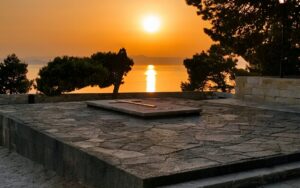
They are two separate sites. This museum is the house where Venizelos lived, in Halepa. The tombs of Venizelos are on the hill of Profiti Ilia in the east of Chania, where Eleftherios Venizelos (1864–1936) and his son Sofoklis Venizelos (1894–1964) are buried. The tombs are located in a small park with pine trees and spectacular views of Chania. The graves are a separate excursion, best done by bus or car, and worth doing on the same day if you are already in the area.
The Honest Notes
Warning: The museum is closed on Sundays year-round, and also closed on a long list of Greek public holidays. Check the official website at venizelos-foundation.gr before you go. Several TripAdvisor reviewers arrived to find it closed. This is the single most common complaint. The opening hours also shift significantly between summer and winter.
The museum operates on a seasonal schedule: from October 1 to May 31, it is open Monday to Saturday 11:00 to 17:30. From June 1 to September 30, it is open Monday to Friday 11:00 to 20:00, and Saturday 11:00 to 18:00. Note that the museum is closed on Sundays throughout the year.
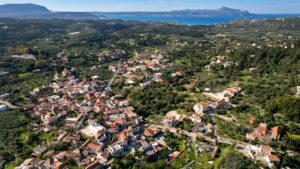
Warning: Do not confuse this museum with the birthplace of Venizelos, which is in the village of Mournies, south of Chania. This house is not to be confused with Venizelos’ birth house, situated in Mournies. The Halepa residence is the family home where he lived and worked during his political years. They are entirely different sites.
Warning: Some mapping apps misplace the museum. The correct address is Elena Venizelou Square, Halepa, Chania. Use that as your navigation destination rather than just “Venizelos Museum,” which can return the wrong location.
One honest note on the content: the museum is arranged by theme rather than chronologically, but the visitor will come away with a very clear idea of the importance of one of the political giants of the twentieth century. One small criticism: Venizelos’ responsibility for the Asia Minor Catastrophe is somewhat understated. If you want a balanced historical view rather than a reverential one, read around the subject before or after your visit.
Getting There
By Foot
You can reach the museum by foot in around 30 minutes along the waterfront from the Venetian harbour, which is the best way to enjoy the architecture and atmosphere of Halepa. The walk is flat, mostly coastal, and passes through the Tabakaria neighbourhood. One of the better walks in the city.
By Bus
A bus service (No. 11) connects Chania Old Town with Halepa, passing the museum. Check current schedules at chaniabus.gr before you travel. The bus is cheap and runs frequently during the day.
By Taxi
A taxi from the Old Town to Halepa takes around 10 minutes depending on traffic. There is no Uber or Bolt in Chania. Taxis only. You can hail one from the harbour area or ask your accommodation to call one.
By Organised Tour
Many visitors only discover the museum because of a brilliant guide they had in Chania. A good city tour will include Halepa and the museum.
Practical Information
| Address | Elena Venizelou Square, Halepa, Chania 731 33 |
|---|---|
| Phone | +30 28210 56008 |
| museum@venizelos-foundation.gr | |
| Website | venizelos-foundation.gr/en |
| Summer hours | Mon–Fri 11:00–20:00, Sat 11:00–18:00 (Jun–Sep) |
| Winter hours | Mon–Sat 11:00–17:30 (Oct–May) |
| Closed | Sundays all year, and major public holidays |
| Entrance fee | Small fee. Check official website for current prices |
| Accessibility | Lift available for upper floors |
| Parking | Street parking on nearby roads |
| Café | Small café in rear courtyard |
| Gift shop | Books in Greek and English available |
Combine With
The Venizelos Museum is in Halepa, an area that rewards a full half-day rather than a single stop. Here is what works well together:
Archaeological Museum of Chania. Walking distance from the Venizelos Museum and well worth a visit. The new building is in Halepa, literally a short walk away. One reviewer combined both in a single morning by taking a taxi to the Archaeological Museum first, then walking down to the Venizelos house, and continuing on foot back toward the harbour. That is a solid half-day route.
Halepa Neighbourhood Walk. Halepa was the diplomatic and aristocratic hub of Chania in the late 18th and early 19th century. The neighbourhood walk from the Old Town to the Venizelos Graves is the most demanding of Chania’s walks, rising 150 metres by the end of 3.5km, but it includes some of the most impressive buildings of Chania’s modern history and rewards with the best view in town.
Venizelos Graves. Up on the Profiti Ilia hill, about 2.5km further from the museum. The tombs are located in a small park with pine trees and spectacular views of Chania. Do not drive. Walking up from Halepa takes about 30 minutes and the views on the way up are worth it. Near the tombs there are cafés with views, including Carte Postale and Koukouvaya.
Tabakaria Waterfront. On the walk back from Halepa toward the Old Town, the Tabakaria neighbourhood along the water has some of the city’s best tavernas, set right on the rocks. Locals eat here. It is not in any of the mainstream tourist guides in the way the harbour restaurants are. Worth knowing.
Before You Go
- Hours: Check the official website before visiting. The museum is closed Sundays and on Greek public holidays. Hours shift significantly between summer and winter seasons.
- Language: Exhibits are labelled in Greek and English. A multi-language tablet guide is included with entry.
- Accessibility: Lift available for upper floors.
- Café: Small café in the rear courtyard. Bring cash as a backup.
- Photography: Generally permitted in most areas. Check on arrival.
- Combine: The New Archaeological Museum of Chania is a short walk away. Both in one morning is very manageable.
Local tip: If you visit in the evening during summer, the museum stays open until 20:00 on weekdays. The light through the garden at that hour, and the view back across the harbour from the grounds, is the kind of thing that does not make it into the brochures. Come late afternoon if you can. You will likely have the place nearly to yourself, and the walk back along the waterfront toward the Old Town at dusk is one of the best free experiences in Chania.