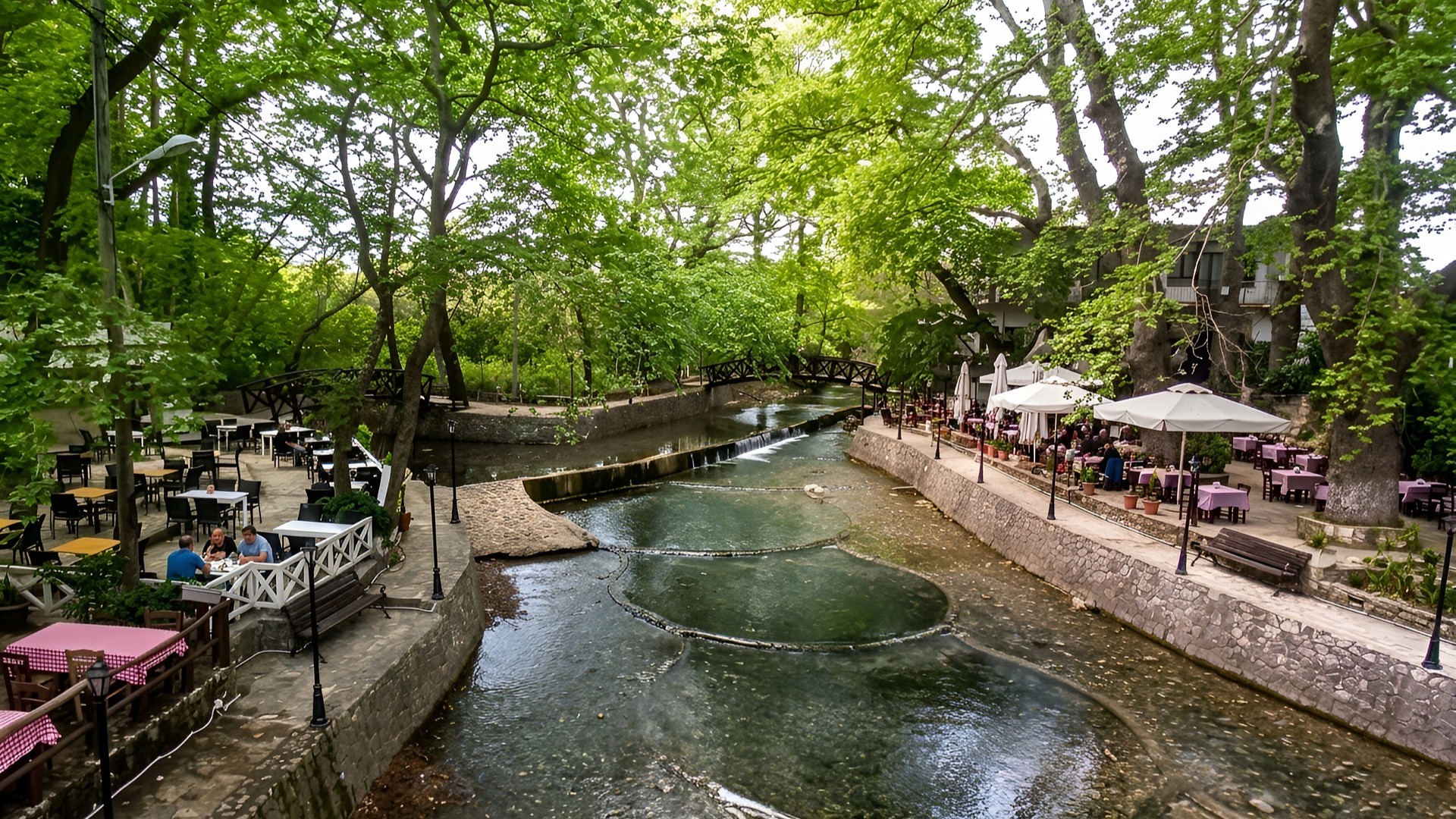
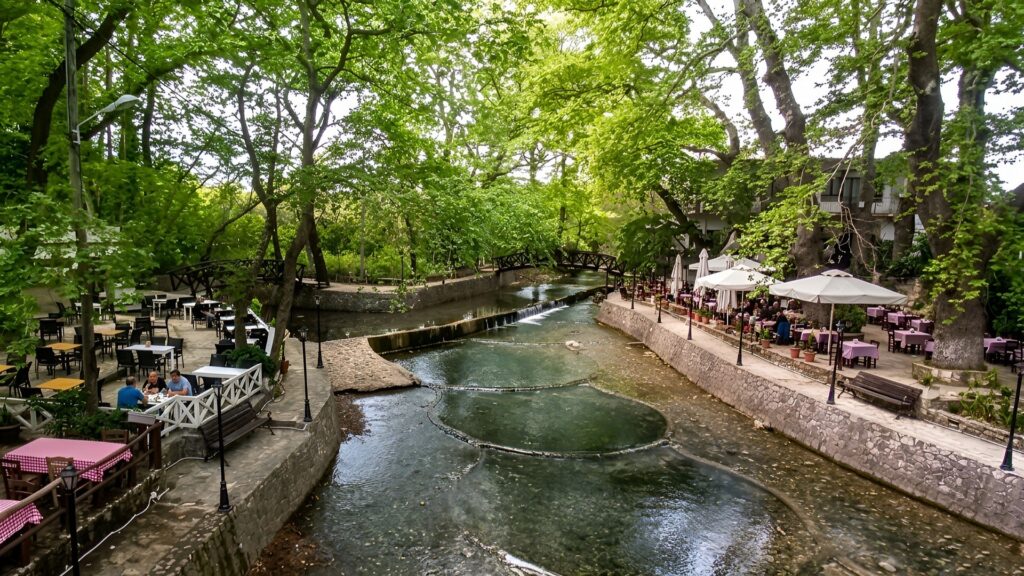
Vrisses Chania is the kind of stop that most tourists drive past on the way to somewhere else. A junction village on the road between Chania and Rethymno. Easy to miss if you are moving fast. Worth stopping at if you are not. The plane trees alone are worth it. Old, enormous, their roots in permanent contact with the two rivers that meet here, they form a roof of green over the central square that drops the temperature by several degrees even in the height of August. This is not marketing. It is just what happens when water and old trees share the same ground.
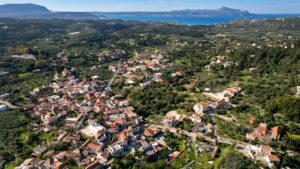
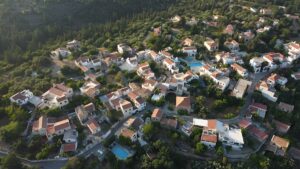
Vrisses is a traditional rural village in the south of the Apokoronas Peninsula, at the foot of the White Mountains of Crete. The village sits about 30 kilometres southeast of Chania city, close to the national road connecting Chania to Rethymno. It is not a resort. There are no sunbeds here, no tourist shops, no organised entertainment. What there is: a river square, a café with plastic chairs, yoghurt that people drive specifically to eat, and a quiet that is unusual this close to the main road. The village has one foot in the working present and one foot in something considerably older.
The name Vrisses means springs. In Crete, that is not poetry. That is a statement of fact, almost like a label on a jar. A village called Springs is telling you what it depends on, what it offers, and why it exists in the first place.
| Distance from Chania | 30km, about 35 to 40 minutes |
|---|---|
| Difficulty | Easy |
| Time needed | 1 to 2 hours for a stop, half a day if exploring nearby villages |
| Best season | Year-round, most useful as a cool break in July and August |
| Parking | Free street parking in and around the village |
| Entrance fee | None |
| Rental car needed? | Recommended, though buses do stop here |
| Family friendly? | Yes |
What Makes Vrisses Chania Worth Stopping
The centre of the village, where the two rivers meet, is home to a large park full of plane trees offering an abundance of shade, and when the waters flow they are often graced by ducks, creating a soothing environment to enjoy a snack or a coffee at one of the park’s verandas.
That is the functional description. The experience is harder to put precisely. You park the car, walk two minutes, and suddenly it is cooler. The sound of traffic from the main road fades. The trees are not just large, they are old in a way that becomes obvious when you stand under them. Roots thick as a man’s torso grip the riverbank. The canopy overhead is continuous. On a day when the rest of western Crete is baking, sitting here with a Greek coffee feels like a minor act of good sense.
The best place to enjoy the cool summer shade of the village is the central square of Vrisses, where you can sit by the river, under the large, centuries-old plane trees and experience the natural air conditioning for which Vrisses is known.
Local tip: In July and August, the taverna tables under the trees fill up by mid-morning with Cretan families on day trips. Arrive before 10am for a quiet coffee, or come after 3pm when the lunch crowd has cleared. The light is better in the late afternoon too.
Apart from the cool shade, Vrisses is also known for its excellent dairy produce. In the taverns of the village you can enjoy the local goat cheese and yoghurt, well known all over Crete Island, with their characteristic taste. Vrisses is one of the best places to try one of the landmarks of west Crete cuisine: the traditional Sfakian pies, which are pancakes with cheese and honey.
The yoghurt and honey is the thing people mention most. It is thick, cold, and served in ceramic bowls. Eaten under a plane tree with the sound of ducks nearby, it is very good. It is a proper Cretan working town rather than a resort, and locals like to say that they invented yoghurt and honey here. They probably did not. But the yoghurt is genuinely excellent.
The prettiest part of the village is by the river where there are some tavernas shaded by the trees. There is also a shop which sells excellent olive oil and local cheeses situated next to the tavernas.
A Village Built on a Junction
Vrisses is situated in the centre of the Vrisses valley on the way to Sfakia. It is a relatively new village, developed after 1925, on two hania (inns) which were there to accommodate the merchants and travellers to and from Sfakia. Now it is an important traffic junction with beautiful natural surroundings, rich in greenery because of the Vryssano river which flows through it.
This origin matters for understanding the village. Vrisses did not grow around a church or a fortress. It grew around the need to stop. Merchants coming down from Sfakia and the White Mountains needed water, shade, food, and somewhere to rest their animals. The site offered all of it. The village formalised what the landscape had always provided.
People travelling between Chania and Rethymno needed a break, and the village offered a break that felt almost inevitable. You could pretend you stopped because you needed fuel, but really, you stopped because your body remembered what shade and water mean.
Vrisses is situated at the beginning of the road that connects Chania city to Hora Sfakion, which is the town on the south coast where boats leave for Loutro, Agia Roumeli, and the end of the Samaria Gorge walk. If you are doing that route in a day, Vrisses is where the road south begins in earnest. The White Mountains close in quickly beyond the village and the landscape turns dramatic.
Vrisses sits at the crossroads of three major routes: west to Chania, east toward Rethymno, and south through the White Mountains toward Sfakia and the Libyan Sea.
The area has been inhabited since the times of ancient Greece, with the poleis of Amphimalion and Philippos situated in the vicinity. Very close to the village there is a twin peak hill where an ancient Minoan settlement dating back to 1,500 BC has been discovered. Some of its interesting findings are exhibited in the archaeological museum of Chania city. The modern village may only date from 1925, but the ground it stands on has been occupied in one form or another for a very long time.
The Elliniki Kamara: A Bridge Still in Use
At the junction of the road from Vrisses to the national main road, at the exit toward Rethymno, there is the historical landmark of Vrisses: the Elliniki Kamara, a bridge upon Vrissanos River that dates from the Greco-Roman era. The bridge is in use even today, and is made from stones which are fit together side by side without the use of mud or any other substance to hold them together. Its height is about 6.5 metres.
The Kamara Bridge dates back to the Hellenistic period. The Kamara is surrounded by locations of other ancient finds, especially of the subsequent Roman period.
A stone arch bridge with no mortar, still carrying traffic, roughly two thousand years old. It is worth the five-minute walk to see it. Follow the river upstream from the village square toward the national road. You will find it next to a small church dedicated to Saint George. Nobody will be there. There is no entrance fee, no sign, and no information board in English. Just the bridge.
Local tip: Google Maps will show the Elliniki Kamara but the walking route from the village square is not well marked. Follow the river path upstream for about 400 metres. The bridge appears suddenly as the path curves. You will hear the water first.
Vrisses in 1941: The Retreat South
Some historical context that most travel sites do not mention. In May 1941, Lieutenant General Bernard Freyberg, the Commonwealth commander on Crete, ordered a general retreat to the south of the island to prepare for evacuation. He sent his army down the road to the southern port of Sfakia.
That road ran through Vrisses. Allied soldiers, British, Australian, New Zealand, and Greek troops, passed through this village in late May 1941 heading south through the White Mountains toward the coast, moving under German air attack, trying to reach the evacuation ships. The German Air Force had unchallenged mastery of the skies and dominated the battlefields during daylight hours.
The same plane trees that now make you feel relaxed could once have been the nearest cover available.
It is easy to sit here with coffee and yoghurt and not think about any of that. But the road through Vrisses toward Sfakia has a weight to it if you know what happened here. After days of intense fighting, Allied troops retreated to the south coast, where the British Royal Navy evacuated many to Egypt. Some never made it. The village was a waypoint in an evacuation that saved thousands and failed thousands more.
Note: If you are driving south from Vrisses toward Sfakia, the road climbs steeply and quickly. The White Mountains come into view almost immediately. This is a beautiful drive in its own right, but take it slowly. The road is narrow and there is no barrier on the long drops. It rewards the driver who is not in a hurry.
What to Eat and Drink
The tavernas along the river are the reason most people stop. They are not high-end restaurants. Plastic chairs, laminated menus, cats under the tables. The food is the point.
Order the yoghurt. Then the Sfakian pies if they have them. These are small, flat pastries filled with fresh cheese and drizzled with local thyme honey. They are cooked on a griddle. They are very good and available almost nowhere else in this exact form outside of the Sfakia region.
The village has a good selection of tavernas, a kafenion, a butcher, two bakers, a couple of mini-markets and even a bank and pharmacy. This is a working village with services. If you need cash, a petrol fill-up, or provisions for a Samaria Gorge day, Vrisses is a sensible place to stop before heading south.
A good recommendation from a local taxi driver: the taverna Ippokoronion in Nipos village, just 2km from Vrisses, right in the square of Nipos village. Worth considering if you want a meal in a setting with more atmosphere than the Vrisses main square.
Warning: Some visitors have noted that the tavernas in Vrisses can feel slightly tired and the square itself occasionally looks neglected outside of peak summer. Do not expect a polished experience. Expect a functional, genuinely local village with very good dairy products and shade that is worth its weight in gold in August.
Frequently Asked Questions
Is Vrisses worth visiting in Chania?
Yes, particularly on a hot day or as part of a longer route south toward Sfakia. It is not a destination in itself but an excellent stop. The plane trees, the river setting, the yoghurt and honey, and the Greco-Roman bridge nearby all give you more than a typical roadside break.
How long do I need in Vrisses?
An hour is plenty for a coffee and a walk to the Elliniki Kamara bridge. If you sit down for a meal, budget 90 minutes to two hours. If you are combining it with the surrounding villages of Nipos, Vafes, or the road south to Sfakia, allow half a day.
Can I reach Vrisses without a car?
Yes. To reach Sfakia by bus from the direction of Rethymno, you need to change bus at Vrisses. There you switch bus in order to join the Chania to Sfakia service. Some buses from Chania to Rethymno go into Vrisses village. They stop in the middle of the village, next to the river, next to the cafes. Check current schedules at e-ktel.com before travelling, as times change seasonally.
Is Vrisses good for children?
Yes. The ducks on the river, the flat walking, the plane tree park, and the food all work well for families. There is nothing to climb or swim in, but the setting is calm and easy.
When is the best time to visit Vrisses?
Vrisses is an excellent place to visit during the hot summer days of Crete, as it has abundant running water and large plane trees that can cool even the hottest day. The village is open and functioning year-round. Spring and autumn are pleasant, but the real case for Vrisses is strongest in July and August when the shade and river create conditions found almost nowhere else in this part of Crete.
What is the local feast at Vrisses?
The most well known local feast in Vrisses is the one on the 7th of July, in honor of Agia Kiriaki (Saint Kiriaki). If you happen to be in the area on that date, the village will have music, food, and a crowd of local Cretans that gives you a genuine look at how the village celebrates.
The Honest Notes
Vrisses is an honest village and deserves honest assessment. It is one of the rare modern villages of Crete. By modern, that means it was created around 100 years ago. It therefore lacks a bit the charm of some other much older villages.
Warning: If you are looking for a beautifully preserved medieval village with cobblestone lanes and flower-draped doorways, Vrisses is not it. The village grew up around a road junction and it still feels like one. The setting by the river is genuinely good. The rest of the village is functional rather than beautiful.
Some visitors have noted that with all the water and big trees surrounding it, it could be an oasis, but somehow it looks like an abandoned place instead. That is a fair observation, though a little harsh. The square has real life and character in summer. Outside peak season, it is quiet enough to feel empty.
Warning: Nearby Vamos village, about 8km north, is a considerably more atmospheric option if your goal is a traditional Cretan village experience. It has stone lanes, older architecture, a good reputation for food, and the feeling of a place that was built over centuries rather than decades. Vrisses and Vamos are easy to combine in a half-day loop.
What Vrisses does very well: cold shade in summer, functional services, good dairy, genuine local atmosphere by the river, and a position that makes it the natural gateway to the south of the island. For that, it earns its stop.
Getting There
By car: From Chania city, take the E75 national road east in the direction of Rethymno. After roughly 25 to 30 kilometres, you will see signs for Vrisses. Turn off the national road and follow the road into the village. Parking is free on the streets around the central square. The whole drive takes about 35 to 40 minutes from the centre of Chania.

By bus: Buses stopping in Vrisses leave Chania at 11:30, 13:30, 15:30 and similar times, taking approximately 30 to 40 minutes to reach Vrisses from Chania. Not all Chania to Rethymno buses turn into the village. Those that do are marked on the timetable. Check current schedules at e-ktel.com, as times change between summer and winter seasons.
By organised tour: Many gorges and small villages are in the vicinity, making Vrisses an excellent base from which to explore the whole of western Crete by car. Some guided Apokoronas village tours include Vrisses as a stop.
Practical Information
| Location | Apokoronas region, Chania Prefecture, Crete |
|---|---|
| Distance from Chania | 30km, 35 to 40 minutes by car |
| Entrance fee | None |
| Parking | Free, street level |
| Facilities | Tavernas, cafés, bakery, supermarket, bank, pharmacy, petrol station |
| Bus service | Yes, KTEL Chania to Rethymno/Sfakia routes. Check e-ktel.com |
| Best for | Summer cooling stop, dairy food, historical detour, gateway to Sfakia route |
| Elliniki Kamara bridge | 400m upstream from the square on foot, free to visit |
Combine With
Nipos village. Located in one of the most unspoiled areas of Apokoronas, with nature close to the Lefka Ori (White Mountains), with a beautiful village square. The village of Nipos is just 2km from Vrisses. The taverna Ippokoronion here has a strong local reputation. Worth the short detour.
Lake Kournas. Close to Vrisses is Lake Kournas, Crete’s only natural lake. About 15 minutes by car north toward the coast. Good for a swim, a pedalo, and a meal by the water. An easy combination with a Vrisses stop.
Georgioupolis. Nearby there are sandy beaches at busier Georgioupolis, on the coast about 7km due east. If you want a beach to follow the shade of Vrisses, this is the closest option. It is a full tourist resort rather than a quiet spot, but the beach is long and good.
The road to Sfakia. If you have a full day and a car, leave Vrisses heading south. The road climbs through the White Mountains via the Askifou plateau and the Imbros Gorge before dropping down to the south coast at Hora Sfakion. The easy asphalt road features dramatic natural contrasts passing through the White Mountains, then leaving them to drive south through the plain of Askifou and past the Imbros Gorge, before arriving at the Libyan Sea. This is one of the best drives in western Crete.
Local tip: The drive back from Vrisses toward Chania in the late afternoon, with the light coming in low from the west across the Apokoronas hills, is one of those drives that rewards the unhurried. Take the old road through Georgioupolis rather than the national highway. It adds ten minutes and removes the trucks. The difference is significant.