Ancient Kydonia Chania is not a ruin you visit on a dedicated day trip. It is the ground you walk on when you explore the old town. The medieval streets, the Venetian harbour walls, the narrow alleys off Kanevaro Street — all of it sits on top of one of the oldest continuously inhabited places in Europe. People have lived here since the fourth millennium BC. They are still living here now. That is the remarkable thing about Kastelli Hill.
Most visitors walk right over it without realising. They are too busy photographing the lighthouse or finding a table at the harbour. But if you take the time to look — and to understand what you are looking at — Kastelli Hill becomes one of the most thought-provoking places on the island. This is where the Minoan city of Kydonia once stood. A palace. Sacrificial rituals. Tablets written in scripts we can still barely decode. And in July 2025, recognition that was a long time coming: the Minoan Palatial Centres of Crete, including Kydonia, were inscribed on the UNESCO World Heritage List on July 12, 2025.
| Location | Kastelli Hill and Agia Aikaterini Square, Old Town, Chania |
|---|---|
| Distance from Chania centre | In the old town. 5-minute walk from the Venetian harbour |
| Entrance fee | Free (open-air site) |
| Time needed | 1 to 2 hours for the hill and excavation viewpoints |
| Best season | Year-round. Spring and autumn for cooler walking conditions |
| Parking | Very limited in the old town. Park further out and walk |
| Rental car needed? | No |
| Family friendly? | Yes |
What Is Ancient Kydonia Chania?
The modern city of Chania is built on the site of the ancient Minoan city-state Kydonia, or “ku-do-ni-ja” as it appears on Linear B script, which, according to ancient legends, was one of the three cities founded by King Minos in Crete. That is not a loose claim. It has been confirmed by six decades of excavation work.
Ancient Kydonia was one of the major city-states of Minoan Crete. Considered the third most important city after Knossos and Phaistos, it played a pivotal role in early Cretan civilisation. Unlike other sites on Crete, Kydonia maintained major trading activities. In the Late Minoan period it was a large commercial and maritime centre, exporting pottery, oil, perfume and wine throughout the Aegean.
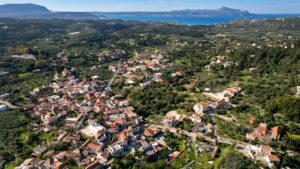
The low hill of Kastelli, to the east of the port, was an ideal location for the establishment of a prehistoric settlement, not only because it is adjacent to the sea, but also because it is surrounded by the rich Chaniotiko plain. The position gave Kydonia everything a Bronze Age city needed. Water, land, and a harbour. It explains why people never stopped living here, through every invasion and occupation the island endured.
Continuous human habitation from Neolithic times until today has been identified here, a period of about 5,000 years, interrupted only between the end of the Bronze Age and the Late Geometric Period (approximately 1150 to 735 BC).
Local tip: The name “Kastelli” comes from the Byzantine fortification built on this hill. The name “Kydonia” is far older. In fact, the word “quince” in English traces back through Latin to “Kydonian apple” — the quince fruit that this region was famous for in antiquity. You eat history without knowing it.
What the Excavations Have Found
The story of how archaeology came to Kastelli Hill is itself a good one. When World War II bombing rubble was cleared from the district, pieces of Minoan pottery were found. There was a major Minoan site less than a metre below the present ground level. The Germans, in destroying the neighbourhood, accidentally revealed what lay beneath it.
Yannis Tzedakis initiated excavations at Kastelli Hill in 1964 to 1969. The then director of the Swedish Institute at Athens was contacted to discuss a potential collaboration, and the Greek-Swedish programme began in 1969. It ran for decades. A Danish team joined in 2010.
What they have uncovered is extraordinary. The excavations were the first to firmly identify an important Minoan centre on western Crete. Previously it had been believed that Minoan influence was limited to the east half of the island. Kastelli changed that assumption entirely.
The five Linear B tablets discovered in 1989 to 1990 were the only ones found outside of Knossos since the beginning of the 20th century. Think about what that means. In the Mycenaean period, Linear B is only found at the Cretan sites of Knossos, Kydonia/Chania and Malia. This indicates a scriptorium and archive within a possible palace in Kydonia. Chania was not a provincial outpost. It was a palace city.
The Palace Emerging on Katre Street
The most significant recent work has centred on Katre Street, in the southwestern part of the hill. Excavations led by Dr Maria Andreadaki-Vlazaki have been progressively revealing what appears to be a substantial Mycenaean palace complex.
During the 2024 investigation, a significant discovery was made, confirming the existence of a large hypostyle space used for gatherings and rituals, which resembles a loggia. Walls constructed from very large, finely worked stones suggest at least a second storey. This is not a modest building.
The hypothesis, already made in the 1980s when the famous “Seal of the Despot” (or Master Impression) came to light, that it depicts the palatial centre of Chania located on the hill of Kastelli and seen from the sea, has now been confirmed. The seal is on display in the Archaeological Museum of Chania.
The Human Sacrifice Discovery
This is the finding that made international headlines. Excavations carried out in the autumn of 2023 produced a hoard of 37 gold and silver coins depicting Alexander the Great, as well as the first evidence of human sacrifice in Minoan history.
Archaeologists made the discovery of an extensive sacrificial site on the hill, where, in addition to a huge number of animal remains, were the bones of a young woman — possible evidence of a human sacrifice to appease the gods, carried out after the devastating earthquake of the 13th century BC.
Warning: Some information circulating online about the human sacrifice finding presents it as confirmed fact. The archaeological evidence is significant and taken seriously by specialists, but the academic debate is ongoing. Visit the Archaeological Museum of Chania for the most accurate presentation of the finds and their interpretation.
The Linear B Tablets and the Archive
The discovery of a corpus of Linear A and Linear B tablets points to the presence of an archive. A clay label inscribed with three signs in Minoan B script, found in a layer from the 7th century BC but dating to the destruction of the palace complex around 1250 BC, is a particularly significant document for the recognition of Kydonia as an important palace centre during the Creto-Mycenaean period (1400 to 1200 BC).
These tablets are not displayed at the site itself. The significant finds go to the Chania Archaeological Museum in Chalepa, which is where you will get the full picture.
What Can You Actually See on Kastelli Hill?
This is the honest part. Many visitors arrive expecting Knossos. That is not what Kastelli Hill is.
Admission to the Ancient Kydonia Kastelli Excavations is completely free. It is an open-air site integrated into the modern city. The main place for visitors to see, from the outside as the site is fenced off, is the excavations at Agia Ekaterini Square, only a few minutes’ walk from the harbour.
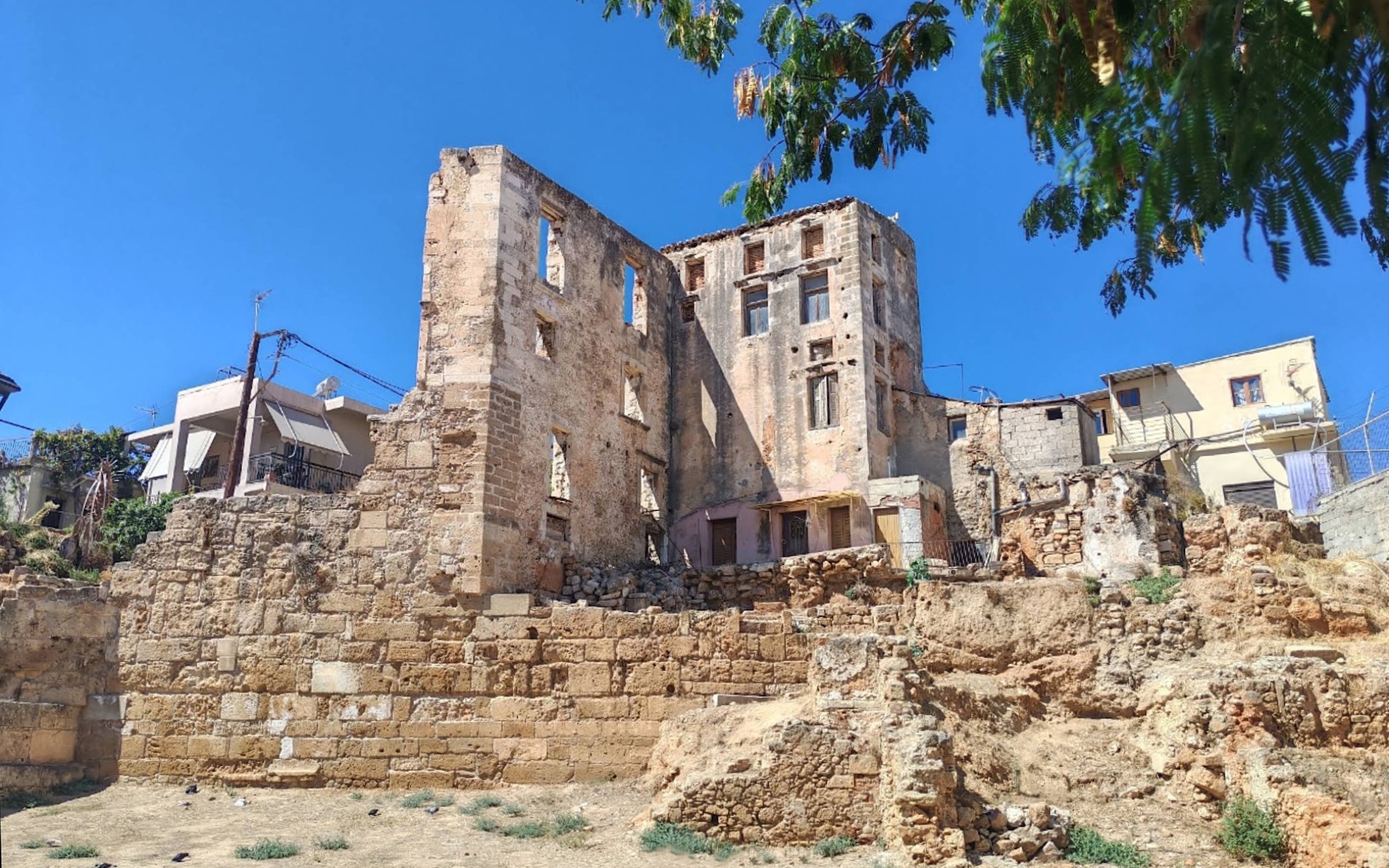
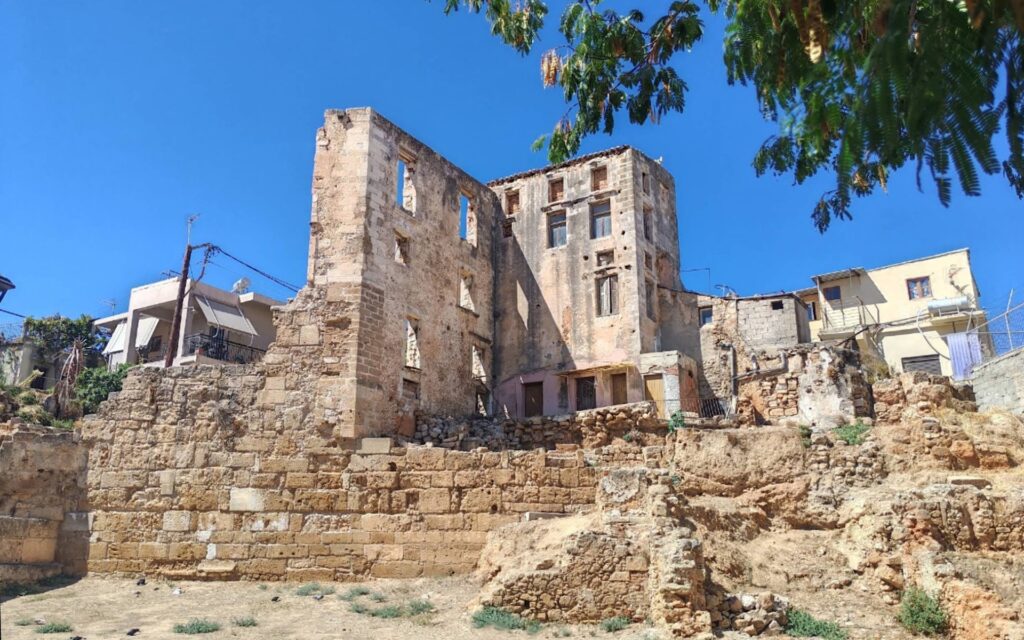
You can see well-preserved remains of the ancient Minoan civilisation, including walls, foundations, and other structures, right in the middle of modern houses. You look through the fence at the dig. There are information boards. The visual impact is modest. But the intellectual impact, if you understand what you are looking at, is substantial.
The site features densely packed and numerous layers of ancient habitation, dating back to the 4th millennium BC, sitting within the buildings of the Old Town of Chania. Part of what makes Kastelli extraordinary is also what makes it difficult to visit: it is not a cleared field of ruins. It is a living neighbourhood with excavations happening between people’s houses.
Beyond Kastelli Hill, archaeologists have conducted excavations in areas like Splantzia, Dikastiria, and around Andrea Papandreou Street. Among these, the main site at Agia Aikaterini Square on Kanevaro Street has revealed complete floor plans of multiple buildings and open public spaces.
Walk the hill itself. The streets are narrow and uneven. The cobblestone paths can be challenging, especially when descending. Wear proper shoes.
Local tip: The best view from Kastelli Hill is north-facing, looking out over the harbour toward the lighthouse. Come in the late afternoon when the light is soft and the harbour is at its most photographable. The height gives you a completely different perspective on the Venetian harbour than you get from the waterfront promenade itself.
The Layers of History on One Hill
Kastelli is not only Minoan. That is another thing worth understanding. The hill accumulated layers from every civilisation that passed through.
In 69 BC the Romans under Quintus Caecilius Metellus invaded Crete. The Cretan general Lasthenes confronted them in the battle of Kydonia, where he lost and retreated. This outcome forced Cretan general Panares to capitulate to the Romans and deliver the city without resistance. With the arrival of the Romans, the city expanded significantly. From the 1st to the 4th centuries AD, luxurious villas decorated with mosaics, theatres, baths, and aqueducts were built in the area around the hill.
The Byzantines came next. In the position of Kydonia, which continued to maintain its strategic importance, a fortress was later built by the Byzantines, which in many places stands on the ancient wall and has been constructed from the building materials of ancient Kydonia.
Then the Venetians. The public buildings were developed along the main road (corso, today’s Kanevaro Street) that crosses Kastelli from the east. The mansions of the oldest Venetian families were concentrated in Kastelli, built with the influence of Venetian Mannerism as it formed from the 16th century.
Unfortunately, most of the district was destroyed by German bombings during the Second World War and most of its old houses are gone. That destruction, terrible as it was, is what prompted the excavations that revealed Minoan Kydonia in the first place.
Kastelli Hill holds at least 5,000 years of continuous habitation: Neolithic, Minoan, Mycenaean, Greek city-state, Roman, Byzantine, Arab, Venetian, Ottoman, and modern Greek. No single hill on Crete packs in more history per square metre.
The Archaeological Museum of Chania: The Essential Companion Visit
Walking the hill is a starting point. The real depth of the story is at the Archaeological Museum of Chania, now located in the suburb of Chalepa.
In the first gallery, the narrative opens with the earliest human presence in Chania, continuing with the presentation of prehistoric settlement life. Ancient objects and reconstructions associated with public and private life reveal the splendour of the Minoan past of western Crete, the coming of the Mycenaeans, and highlight the importance of the palatial centre of Kydonia.
This is where you will find the Master Impression seal, the Linear B tablets, the coins, and the ceramics from the Katre Street excavations. Today, artefacts from Kydonia, including Minoan pottery, seals, and architectural remains, are displayed in the Archaeological Museum of Chania.
The museum is open from 8:00 to 20:00, closed on Tuesdays, from 1 April to 31 October. Check the official website for current ticket prices and any seasonal changes before you visit.
Warning: The Archaeological Museum of Chania moved from the old Venetian church on Halidon Street to its new purpose-built premises in Chalepa. Some older travel guides and maps still show the old address. The new museum is in Chalepa, several kilometres east of the old town. It is not walkable from the harbour. Take a bus or taxi.
Frequently Asked Questions
Is Ancient Kydonia Chania free to visit?
Admission to the Ancient Kydonia Kastelli excavations is completely free. It is an open-air site integrated into the modern city. You simply walk through the neighbourhood and view the fenced excavation areas. The Archaeological Museum of Chania, where the most significant finds are displayed, charges a separate entrance fee. Check the official museum website for current prices before visiting.
How long does a visit to Kastelli Hill take?
A visit to the Ancient Kydonia Kastelli excavations usually takes around 15 to 30 minutes to walk through and observe the ruins. Exploring the wider Kastelli Hill neighbourhood, including the narrow streets, the views over the harbour, and the Byzantine wall fragments, takes one to two hours. If you combine it with the Archaeological Museum, allow a half day in total.
Is Kastelli Hill worth visiting even if you are not a history enthusiast?
Yes, but manage your expectations. The excavation sites themselves are fenced and can look underwhelming without context. The real value of the hill is in the neighbourhood itself: the views, the quiet streets away from the harbour crowds, and the odd sensation of knowing what lies under your feet. If you want spectacle, go to Knossos. If you want the feeling of standing on genuinely ancient ground inside a living city, Kastelli does that better than anywhere else in western Crete.
Is it suitable for children?
Yes, the site is open and accessible, making it suitable for children to see. The neighbourhood is walkable and relatively flat once you are on the hill. The excavation pits viewed through fences can hold a child’s curiosity for a few minutes, especially with some explanation. The Archaeological Museum in Chalepa has reconstructions and digital media that work better for younger visitors.
What is the significance of the UNESCO status?
In 2025, Greece celebrated a major achievement: the inscription of the Minoan Palatial Centres of Crete onto the UNESCO World Heritage List. Officially registered under reference number 1733, this inclusion honours the importance of the Minoan civilisation the first advanced society in Europe. The six palaces Knossos, Phaistos, Malia, Zakros, Zominthos, and Kydonia — represent the political, religious, and economic heart of the Bronze Age Aegean world. Kydonia’s inclusion matters particularly because it is the only one of the six that lies beneath a living modern city.
Can you enter the excavation site itself?
No. The active excavation areas on Katre Street and around Agia Aikaterini Square are fenced off. The Kastelli Hill site offers limited access and is guided only for certain visits. Check with the Chania Ephorate of Antiquities for any guided access programme. For most visitors, viewing from the perimeter and then visiting the museum is the practical approach.
The Honest Notes
Kastelli Hill asks more of you than most archaeological sites. There is no grand entrance, no reconstructed columns, no clear path from start to finish. You are wandering a residential neighbourhood, peering through chain-link fences at trenches cut between apartment blocks. Some visitors describe stumbling upon these ruins when wandering through Chania, noting there is not a ton to see and that information signs provide only limited insight.
That is an honest assessment. Come without expecting Knossos.
Warning: The cobbled streets of Kastelli Hill are uneven, polished by centuries of use, and steep in places. They become particularly treacherous when wet. Sandals and flip-flops are a bad idea. Anyone with mobility difficulties should note that the hill has no accessible paths to the excavation viewing points.
The signage at the site is minimal. The information boards are adequate but not extensive. If you want to actually understand what you are looking at, either book a guided walking tour of the old town, or do your reading before you visit rather than relying on on-site interpretation.
Excavations at Kastelli Hill are known to be among the most challenging in their field. The complexity requires research to proceed carefully, as it encounters many contemporary issues in a heavily populated urban environment. This means active digging typically happens in autumn and is not something you will see during peak summer season.
Warning: Parking in the old town of Chania is genuinely difficult. Do not attempt to drive to the Kastelli Hill area in July or August. The streets are too narrow and parking is near impossible. Leave your car in the paid public car park near the Municipal Market and walk in, about ten minutes on foot.
Before You Go
- Shoes: The cobbled streets are uneven and can be slippery. Closed-toe shoes with grip are essential.
- Water: Bring a bottle, especially in summer. There are no water sources on the hill itself.
- Toilets: None at the excavation sites. Use facilities at a café in the old town before you start.
- Museum visit: Allow extra time to visit the Archaeological Museum of Chania in Chalepa — it is a separate trip and the best place to see what has been found here.
- Guided tour: Strongly recommended if you want depth. An independent visit without context can feel flat.
- Photography: Permitted at the open-air sites. No restrictions on the hill itself.
Getting There
On Foot
Kastelli Hill is in the heart of the old town of Chania, a five-minute walk east of the Venetian harbour. Use the harbour lighthouse as your orientation point and walk toward the eastern end of the harbour. The hill rises above the mosque (Yiali Tzami) on the waterfront. Kanevaro Street runs along the spine of the hill and is the main reference point. Agia Aikaterini Square, the primary excavation viewpoint, is signed from the harbour area.
By Car
Do not drive into the old town. It is officially restricted and practically impossible in peak season. Parking within the Old Town is extremely limited. Leave your car in one of the public parking lots in the New Town area and walk to the hill in about ten minutes. The paid car park on Kountourioti Street near the covered market is the most practical option.

By Bus
Local bus services from Chania’s main bus station (KTEL) and from the Municipal Market stop near the old town. It is a short walk from any drop-off point to Kastelli Hill. No specific bus route serves the hill itself.
By Organised Tour
Several walking tours of Chania’s old town include Kastelli Hill and provide the historical context that makes the visit genuinely worthwhile. This is probably the best approach for visitors with a serious interest in Minoan history.
Practical Information
| Kastelli Hill excavation sites | Free entry, open daylight hours, no restricted times |
|---|---|
| Main viewpoint | Agia Aikaterini Square, Kastelli Hill, Old Town |
| Katre Street excavations | Restricted access, fenced, view from perimeter only |
| Archaeological Museum of Chania | Chalepa suburb (not Old Town). Closed Tuesdays. Open 08:00-20:00 (April to October). Check official site for current prices. |
| Nearest parking | Paid parking near Municipal Market, Kountourioti Street |
| Nearest facilities | Cafés and restaurants throughout the old town |
| Accessibility | Limited. Uneven cobbled streets. No accessible routes to excavation viewpoints. |
| Best time to visit | Morning before the harbour crowds build. October when autumn light is good and summer tourists have thinned. |
Combine With
Kastelli Hill works well as part of a full day in the old town. These nearby stops sit within easy walking distance or a short drive.
Chania Archaeological Museum (Chalepa): The essential companion to any visit to Kastelli Hill. The Archaeological Museum of Chania is in Chalepa, a historic suburb, housed in an iconic building constituting a landmark for the whole city. This is where the finds from the excavations are displayed, including the Master Impression seal and Linear B tablets. Allow two hours minimum.
Venetian Harbour and Lighthouse: Directly below Kastelli Hill. The harbour itself is built on what was Kydonia’s ancient port. Walk the harbour front for the best perspective on the hill’s position and why it was strategically chosen.
Splantzia Quarter: The neighbourhood immediately east of Kastelli Hill. Archaeologists have conducted excavations in Splantzia as part of the wider Kydonia dig. The square with the plane tree and St Nicholas church (which has both a minaret and a bell tower, a legacy of Ottoman occupation) is ten minutes’ walk from the hill.
Aptera Ancient Site: If Kastelli Hill has opened your interest in ancient western Crete, Aptera is worth a half-day trip. Located about 20km east of Chania, it offers extensive, accessible above-ground ruins from the Minoan, classical, and Roman periods with sweeping views over Souda Bay. A rental car is needed.
Local tip: Most people who visit the excavation site on Kastelli Hill spend fifteen minutes looking through a fence and move on. The ones who get something lasting out of it are the ones who go to the Archaeological Museum in Chalepa afterwards. The two visits together — the ground itself, then the objects taken from it — form a complete picture that neither does alone. Plan for a half day and do both in sequence. It is one of the best ways to spend a morning in Chania that has nothing to do with sunbeds or beaches.