The Folklore Museum Chania is one of those places that most tourists walk straight past. It sits off the main drag on Halidon Street, tucked into a courtyard beside the Catholic Church, and there is no grand entrance to signal its presence. Easy to miss. Worth not missing.
This is a private museum, not a state institution. It is the creation of two women, Aspasia Bikakis and Irini Koumandraki, who built it with genuine passion for Cretan tradition. They traveled around the Cretan villages gathering folklore exhibits including embroideries, textiles, lace, handicrafts, and agricultural tools. The result is something that feels more like a family collection than a formal museum. That is both its charm and, for some visitors, its limitation.
You will not spend two hours here. You might spend thirty minutes. But those thirty minutes can tell you more about how ordinary Cretans actually lived two centuries ago than anything you will read in a guidebook. The key is going in with the right expectations.
| Location | Halidon Street 46B, Old Town, Chania (entrance from Catholic Church courtyard) |
|---|---|
| Distance from harbour | 3-minute walk |
| Time needed | 20 to 45 minutes |
| Best season | Year-round, good rainy-day option |
| Entrance fee | Small fee, check current price at door |
| Rental car needed? | No, walkable from anywhere in the Old Town |
| Family friendly? | Yes, especially for children aged 7 and up |
| Accessibility | Limited, building has stairs |
What Is the Folklore Museum Chania?
In the centre of the Old Town on Halidon Street, as you follow the road down to the port, you can find and visit the Folklore Museum, also known as the Cretan House. It is a private museum housed in a room of the Municipal Library, with the entrance lying in the courtyard of the Catholic church.
The building itself is part of the story. You enter from a quiet courtyard, climb an outside staircase, and step into a space that feels genuinely lived-in. You may be greeted by the curator, busy stitching a tapestry. That is the thing about this place: it is not a dead collection behind glass. Someone is here, working, keeping the craft alive.
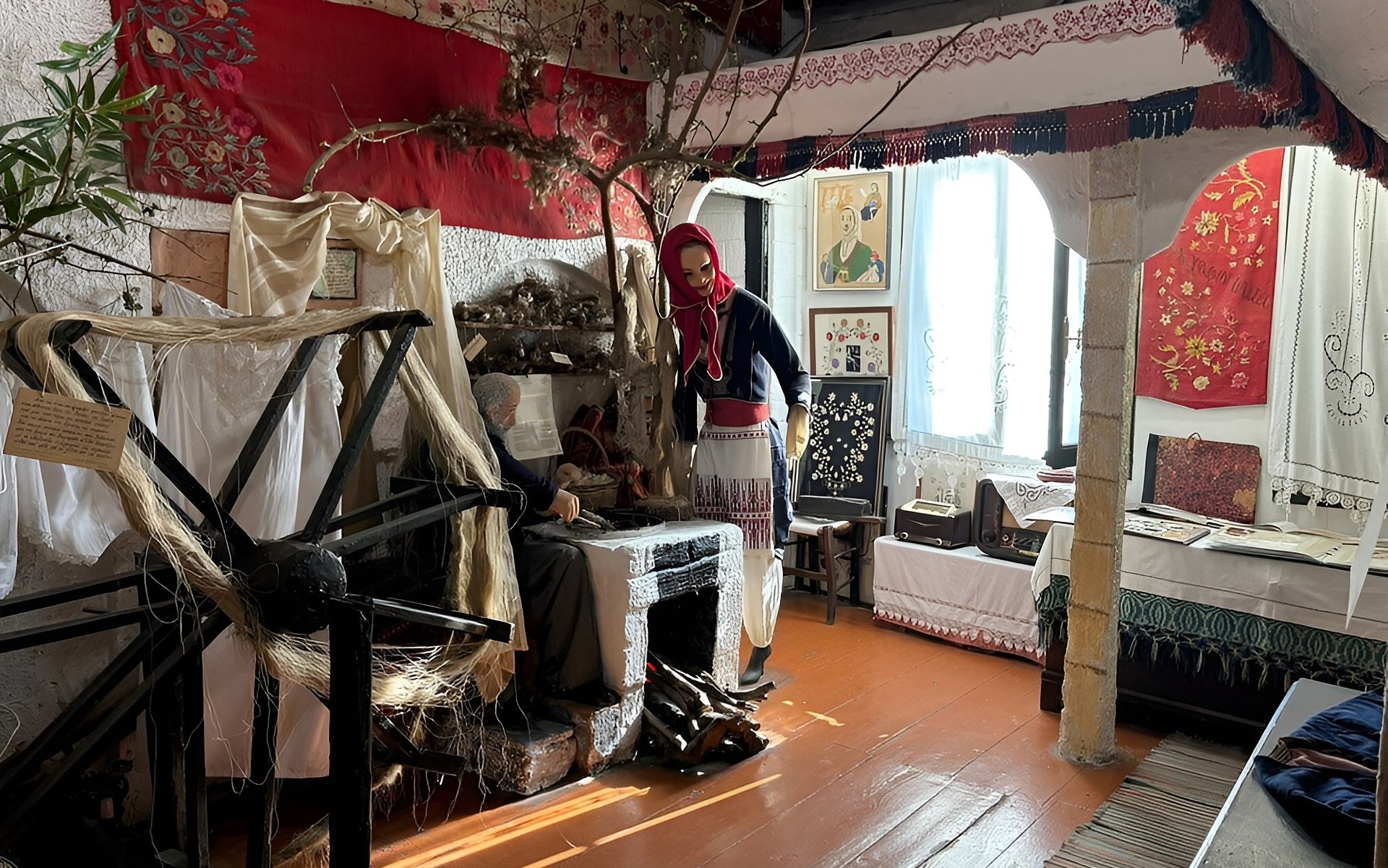
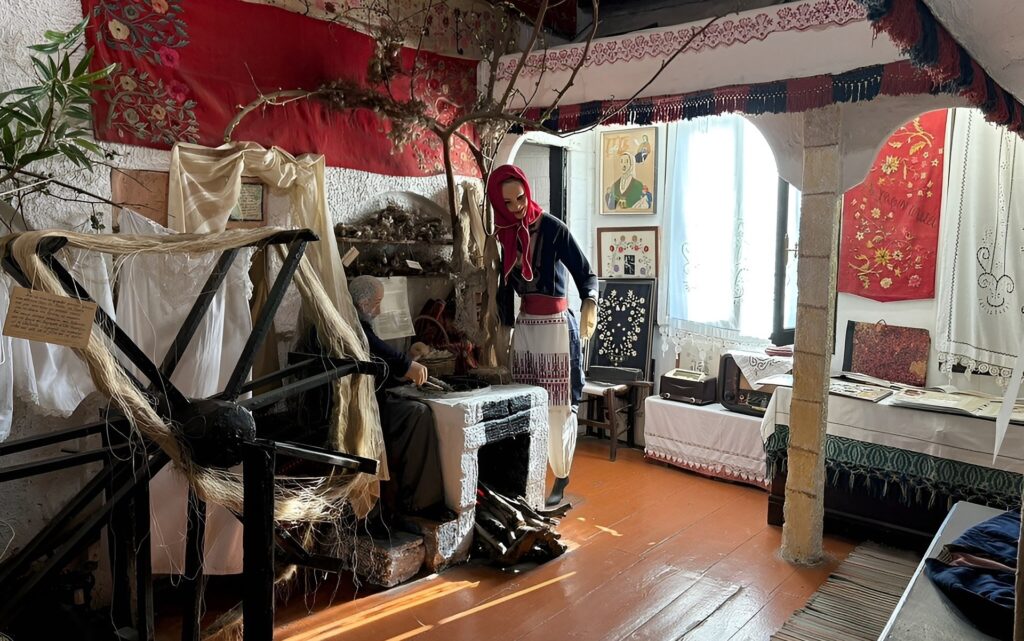
The museum houses folklore and traditional exhibits that allow visitors to have a representative picture of the way of Cretan life during the 18th and 19th century. The collection includes agricultural tools used for ploughing, sowing, harvesting, threshing and treading grapes, as well as depictions of traditional home occupations such as preparations for making the daily meal, or handicrafts such as weaving on the loom or the processing of raw materials used in embroidery and weaving.
Local tip: The entrance is easy to miss. Walk down Halidon Street from the market toward the harbour. Look for the Catholic Church on your left. The museum entrance is through the arch into the courtyard, not directly from the street. If you reach the harbour, you have gone too far.
What You Will See Inside
The museum is small. There are several small rooms, each dedicated to a part of past Cretan life, including agriculture and weaving. The scale is domestic, which is appropriate given the subject matter.
The house is divided into different sections, including a kitchen, a bridal bedroom, and a traditional living room where betrothal ceremonies used to take place. These are not theatrical reconstructions with spotlights. They are rooms laid out with the actual objects of daily life. A loom. A hearth. A bed dressed for a wedding.
There are also models of the workplaces of traditional professions, such as a cobbler, a tailor, and a rope and basket maker, as well as exhibits of various ornaments, objects of daily use, musical instruments, and furniture including the bridal bed and the sitting room settee.
The textile collection is the highlight for many visitors. Of great interest is the collection of woven and embroidered wall hangings. The museum workshop revives Cretan embroidery, and embroidery paintings are being created by freehand machining, with each piece unique. The owner paints and also creates needlework designs featuring local flora, fauna, and epic scenes from Greek mythology, including Europa and Zeus and the Minoan griffins. Visitors have even spotted silkworms producing silk in a small corner of the museum.
The embroidery work sold here is made on the premises. Each piece is different. It is one of the more genuine souvenirs you will find in a town full of mass-produced tourist shops.
In the workshop that operates under the museum, it is possible to see and purchase copies of old needlework. You can also find paintings in the form of embroidery, with scenes taken from local customs.
Who Is It For?
The honest answer is that this museum is not for everyone. Read the visitor reviews and you will find a clear divide. Some people consider it one of the highlights of their trip to Chania. Others feel it is too small, too disorganised, and lacking in proper labelling.
The museum is ideal for anyone who would like to find out a bit about how people have lived in Crete. It is ideal for families with younger children, as it comprises a small number of rooms, each containing a lot of original artefacts, meaning that there is not a lot of walking and standing around.
It is a small house filled with absolutely everything that is, and is not, a part of history and Cretan life. The rooms are quite claustrophobic and chaotic with objects placed throughout. There is limited information labelling. If you are the kind of person who needs context cards and audio guides, this will frustrate you. If you are happy to simply look, touch the atmosphere of a place, and ask the curator a question, you will enjoy it.
This is a small museum packed full of folklore and handicraft history from the island. Visitors can learn a lot about traditional village life. The embroidery lady, when present, is delightful to talk to.
Local tip: If you want to understand what is in front of you, ask. The curator or staff member present will often explain pieces in English and the conversation is part of the experience. Do not just drift through silently and then complain there is no labelling.
The Honest Notes
This is a privately run museum created and maintained by individuals, not an institution with a budget for interpretation panels and lighting designers. That means the experience depends heavily on who is there on the day you visit and how curious you are.
Warning: Several visitors have noted that English labelling is minimal or absent in places. You are looking at objects without much written context. If this matters to you, consider pairing the visit with a broader walking tour of the Old Town that provides historical background. That way the objects here gain meaning.
There is a large collection of items from the local area fitted into a small apartment just off the main street. There is a lot to see, but not a lot of information provided or space to move around.
Warning: Opening hours for small private museums in Greece can be irregular, especially outside peak season and on Greek public holidays. The posted hours are a guide, not a guarantee. If this is a priority for your day, call ahead on +30 2821090816 before making the trip.
One more thing worth saying plainly: some visitors have found the exhibition poor and felt the entrance fee was not justified for the time spent inside. That minority view exists and it is honest to mention it. The museum suits people who are already interested in Cretan cultural history. It will not convert someone who is indifferent to the subject. Plan accordingly.
Warning: The building has stairs and uneven surfaces. It is not suitable for pushchairs or for visitors with significant mobility issues. There is no lift.
Frequently Asked Questions
How long does the Folklore Museum Chania take to visit?
Most visitors spend between 20 and 40 minutes inside. The museum is very small and you can walk through it in less than 10 minutes if you move quickly, but taking time to look at individual pieces, and especially to speak with the curator if one is present, will extend that comfortably to 30 or 45 minutes.
Is the Folklore Museum Chania worth it?
That depends on your interests. If you are curious about how ordinary Cretan families lived, worked, cooked, and celebrated in the 18th and 19th centuries, it is worth every cent of the entrance fee. It is very quirky and interesting, and a nice break from the busy streets of Chania. If you are primarily interested in ancient history, ancient archaeology, or Venetian architecture, your time is better spent at the Archaeological Museum or simply walking the Old Town.
Is the Folklore Museum good for children?
Children will enjoy this small museum located in a courtyard next to the Catholic Church. The rooms are tactile and visual, with models of real domestic scenes and working tools. Young children who would struggle to stand still in a large formal museum generally do well here precisely because the space is compact and the objects are approachable. Children under about six may find it less engaging.
What is the difference between the Folklore Museum and the Archaeological Museum in Chania?
They cover completely different ground. The Folklore Museum focuses on everyday life in the 18th and 19th centuries: domestic objects, tools, textiles, and handicrafts. The Archaeological Museum displays artefacts from ancient Crete, including Minoan pottery and Roman statues, giving a glimpse into 5,000 years of history. The new Archaeological Museum of Chania is located in the suburb of Chalepa, a short drive or taxi from the Old Town. Both are worth visiting, but they tell very different stories.
Can I buy anything at the Folklore Museum?
Yes. The owner stitches original scenes which you can watch her create, and buy some of her art if you like. This is one of the few places in Chania where you can buy handmade embroidery that has genuinely been produced on site, not imported from a warehouse somewhere.
Is the Folklore Museum Chania open in winter?
Reported opening hours are daily from 9:00am to 3:00pm and 6:00pm to 9:00pm, with closure on some holidays. That said, as a small private operation, hours can vary in the off-season. Always verify before visiting in winter months.
Getting There
The museum sits in the heart of the Old Town, a few minutes’ walk from the Venetian Harbour. It is located on Halidon Street at number 46B. From the Venetian Harbour, walk inland along Halidon Street, passing the Catholic Church. The entrance is from the courtyard of the Catholic church.
No car needed. No bus needed. If you are staying anywhere in the Old Town or within reasonable walking distance of the harbour, you are already there. Halidon Street is the main pedestrian artery running from the central bus station down to the waterfront. The museum is roughly halfway along it.
If you are coming from outside the Old Town by car, parking in the Old Town itself is extremely limited in summer. Use one of the car parks on the edge of the old city and walk in. The museum is a 10-minute walk from most of them.
A taxi from further out in the city will drop you at the top of Halidon Street or at the harbour and you walk from there.

Practical Information
| Address | Halidon 46B, Old Town, Chania (entrance via Catholic Church courtyard) |
|---|---|
| Phone | +30 2821090816 |
| Opening hours | Daily 9:00am to 3:00pm and 6:00pm to 9:00pm (verify in low season) |
| Entrance fee | Small fee, check at door for current price |
| Time needed | 20 to 45 minutes |
| Nearest landmark | Catholic Church of Chania, Halidon Street |
| Accessibility | Stairs, not pushchair or wheelchair accessible |
| Photography | Generally permitted |
Combine With
The museum is in one of the busiest parts of the Old Town, so combining it with other nearby visits is straightforward.
The Catholic Church of Chania is right next door. Once you leave the museum, you can also step into the Catholic church next door. It takes five minutes and the contrast between the Venetian interior and the street outside is striking.
The Old Town and Venetian Harbour are a three-minute walk downhill. The harbour area is best in the morning or early evening when the light is good and the crowds are manageable. July and August at midday are best avoided.
The Byzantine and Post-Byzantine Collection of Chania is a short walk away on Theotokopoulou Street, housed in the church of San Salvatore. It covers a completely different period of Cretan history and pairs well with the Folklore Museum for a half-day of culture.
The Municipal Market of Chania (Agora) is a five-minute walk in the opposite direction and worth at least thirty minutes. The covered market building dates from 1913 and still functions as a working market, not a tourist shopping hall. Local butchers, fishmongers, and cheese sellers alongside the souvenir stalls.
Local tip: Halidon Street is wall-to-wall tourists in summer. The museum visit gives you a legitimate reason to step off the main drag and into the Catholic Church courtyard, which is genuinely quiet even in August. Sit on the steps for a few minutes before or after your visit. You will not find that kind of stillness anywhere else on that street.