
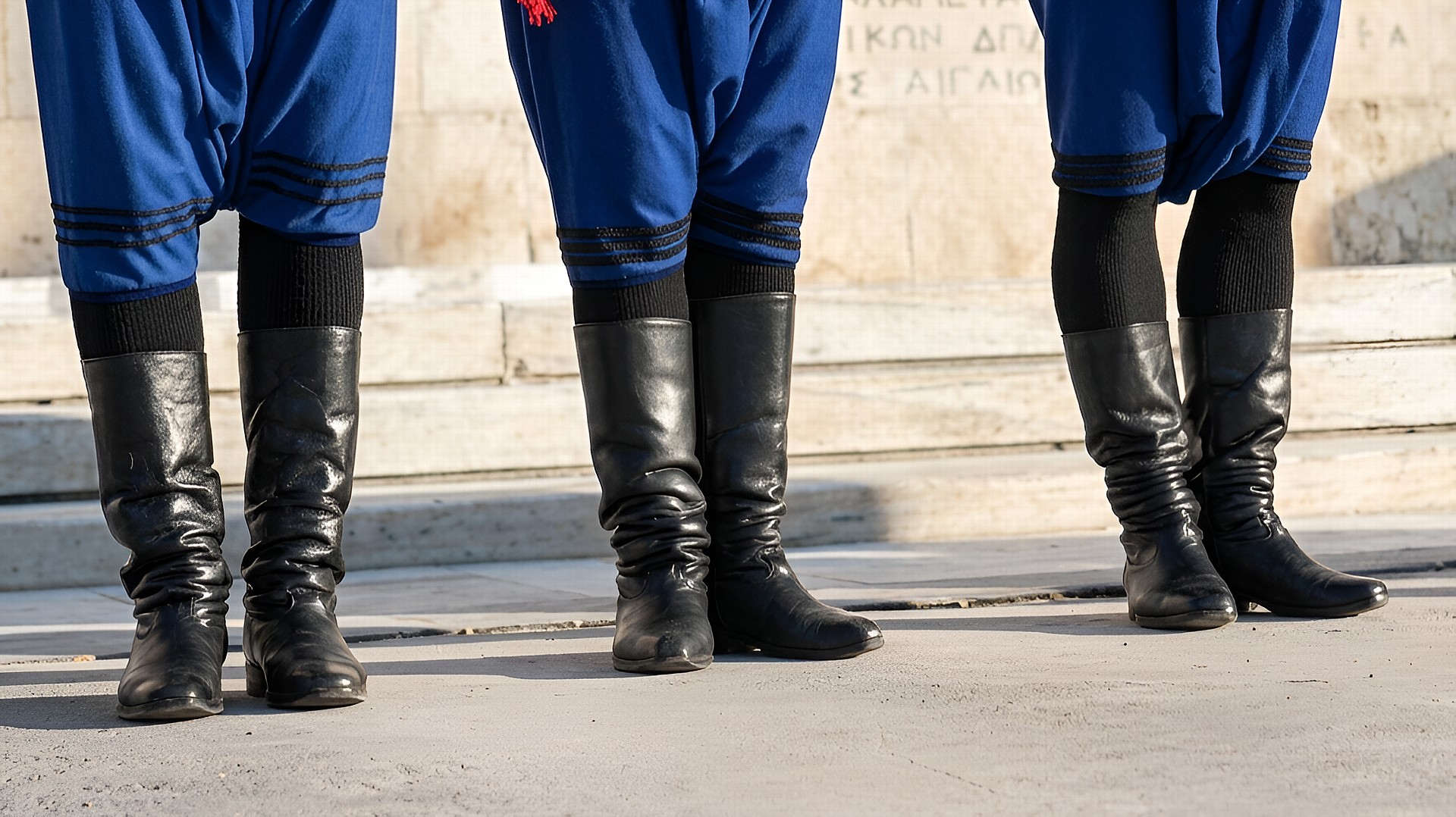
Stivania Cretan boots are one of the few souvenirs from Chania that you will actually use when you get home. Not a fridge magnet. Not a bottle of olive oil that leaks in your luggage. A pair of handmade leather boots, stitched by craftsmen who learned the trade from their fathers, built to last decades. If you spend any time walking the old town and spot a Cretan man in traditional dress, look down. He is almost certainly wearing stivania.
This is not a niche craft kept alive for tourists. Stivania are genuinely worn in Crete. At festivals, at weddings, at religious celebrations, and in the villages of the interior where the old ways hold. The boots have a specific look: high shaft, soft leather, often with a tasselled toe cap. The sole is thick and functional. They were made for mountain terrain and rough ground. They still are.
For visitors to Chania, buying a pair is one of the most interesting things you can do in the old town. It takes time. It costs real money. And it gives you something with an actual story.
| Location | Chania Old Town, Leather Street (Odos Skridlof) and surrounding lanes |
|---|---|
| Time needed | 30 to 90 minutes depending on whether you are browsing or buying |
| Best season | Year-round, but workshops busiest April to October |
| Price range | Significant investment. Check individual workshops for current pricing |
| Rental car needed? | No, walkable from anywhere in central Chania |
| Family friendly? | Yes |
What Are Stivania Cretan Boots
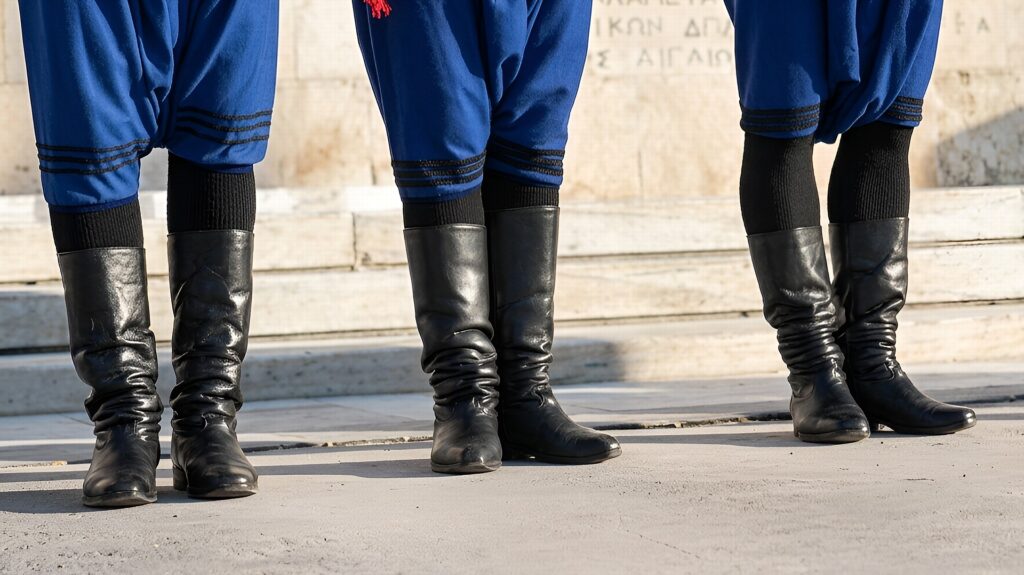
Stivania are traditional Cretan riding and working boots with a history that runs back centuries. The basic design has not changed much. High leather shaft, typically reaching mid-calf or just below the knee. A rounded or slightly pointed toe, often decorated with a small leather tassel or pompom called a phourkhia. The leather is thick and the construction is entirely handmade in the traditional workshops.
They were originally practical footwear for the Cretan highland farmers, shepherds, and fighters who needed boots tough enough for the White Mountains. The leather was local. The craft passed through families. You can find references to this style of boot in Cretan folk art and portraits going back several hundred years.
Today the boots are still worn during the Cretan feast days known as glentia, at Easter celebrations, and at village festivals across the island. You will see older men wearing them with the full traditional dress: breeches tucked in at the knee, a wide sash at the waist, a black headscarf. The stivania are not costume. They are the real thing.
The tassel on a pair of stivania is called a phourkhia. It is purely decorative now, but older accounts suggest it had practical uses on horseback. Every workshop has its own style of finishing the tassel.
Where to Find Stivania in Chania
The best place to look is Odos Skridlof, the lane in the old town known informally as Leather Street. It runs parallel to the main harbour road and has been a centre for leather goods in Chania for generations. You will find sandals, bags, belts, and at the specialist end of the street, the stivania workshops.
Not every shop on Leather Street makes stivania. Some sell machine-made imports. The difference is visible if you know what to look for. A handmade pair will have irregular stitching patterns, slight variations in the leather grain, and a craftsman on the premises who can talk you through the construction. The workshop will smell of leather and wax. If it smells of nothing in particular, keep walking.
Local tip: Ask directly whether the boots are made in the workshop or brought in from elsewhere. The honest workshops will tell you. The ones who are vague about the question are usually selling imported stock. A craftsman who makes stivania by hand will almost always want to talk about the process.
The old town around the Splantzia neighbourhood also has a couple of workshops slightly removed from the main tourist traffic on Leather Street. These tend to be quieter and the craftsmen have more time to talk if you are genuinely interested. Worth the extra ten minutes of walking.
How Stivania Cretan Boots Are Made
The construction of a traditional pair of stivania takes considerable time. The leather is cut and shaped by hand, with the shaft formed separately from the sole and upper. The stitching on a quality pair is done with waxed thread, pulled tight by hand, and the sole is attached using a combination of stitching and lasting rather than glue alone.
The leather used in the best workshops is sourced from tanneries that still process hide using traditional methods. The finished leather has a natural, slightly matte quality. It is not the polished, buffed look of a shop-bought boot. It breathes. It moulds to the foot over time.
Local tip: If you are buying a pair to wear rather than display, ask the craftsman about breaking them in. Traditional leather stivania need time to soften and conform to your foot. A good maker will give you honest advice about this, including how to treat the leather at home.
A new pair of stivania fresh from the workshop will be stiff. That is correct. The leather will soften with wear and with the right conditioning oil. Many of the workshops sell or recommend a specific leather treatment. Take it with you.
What to Look For When Buying
There are a few things that separate a genuinely handmade pair of stivania from tourist-grade imitations.
First, the stitching. On a handmade boot, the stitching is visible and the individual stitches have a slight variation in spacing. Machine stitching is perfectly regular. Look closely at the shaft seam.
Second, the leather quality. Genuine vegetable-tanned or naturally processed leather has a subtle grain and a slight irregularity to its surface. Heavily processed or synthetic leathers look too uniform and feel hollow when you press them.
Third, the sole. A well-constructed sole is attached in layers and has visible stitching around the welt. A glued-only sole is a shortcut and will not last.
Warning: Some shops in the old town display stivania prominently but sell mass-produced versions imported from mainland factories. The price will be noticeably lower. The quality difference over time is significant. If you are going to spend money on this, spend it on the real thing.
Finally, ask whether the boots are made to measure or from stock sizes. The best workshops will offer both. Stock sizes are fine for most people. Made to measure is worth considering if you plan to wear them regularly, and the lead time is usually a few days to a week.
Stivania as a Souvenir From Chania
Most souvenirs from Crete are forgotten within a month of getting home. A pair of stivania is different. They are functional objects with a real craft tradition behind them. If you buy from a genuine workshop, you are buying something that connects directly to Cretan culture in a way that a bottle of raki or a painted ceramic plate simply does not.
They are also a conversation piece. In a northern European or North American context, a pair of handmade Cretan leather boots with a tasselled toe is unusual enough that people ask about them. That is the point.
Warning: Stivania are not lightweight footwear. Factor in the weight when packing. A quality pair is substantial. If you are travelling with hand luggage only, plan accordingly. Some workshops can arrange shipping, though this adds cost and complexity.
The price for a genuine handmade pair is not small. This is not a cheap souvenir. You are paying for craft skill, quality leather, and time. If the price seems too low to be true, it probably is.
The Honest Notes
The stivania trade in Chania is genuine, but it is also surrounded by tourist-grade imitations. The old town has expanded significantly in terms of leather goods shops over the past two decades, and not all of them are selling what they appear to be selling.
Warning: A workshop with a craftsman visibly working inside is the best sign you are in the right place. If the shop is large, brightly lit, staffed by sales assistants with no craft work happening on the premises, treat the stock with scepticism regardless of what the labels say.
The genuine workshops are small. Often one or two people work in a space that is part showroom, part studio. There will be leather offcuts on the floor, tools on the workbench, and the smell of the trade in the air. These are the places to spend your money.
Getting There
Leather Street and the surrounding old town lanes are entirely walkable from anywhere in central Chania. If you are staying in the old town or the harbour area, the walk is at most ten to fifteen minutes. From the Splantzia quarter, even less.
There is no useful bus service directly into the old town pedestrian lanes. If you are coming from outside the city, park at one of the paid car parks on the edge of the old town, near the Municipal Market or along Tzanakaki, and walk in from there.
A taxi from the new town or from your hotel will drop you at the edge of the old town. From there it is a short walk. No organised tours specifically cover stivania shopping, but a walking tour of the old town will typically pass through Leather Street.

Practical Information
| Location | Odos Skridlof (Leather Street), Chania Old Town |
|---|---|
| Opening hours | Typically 9am to 8pm in summer. Some close for an afternoon break. Check individual workshops |
| Payment | Cash preferred in smaller workshops. Cards accepted in most |
| Made to measure | Available from the best workshops. Allow several days |
| Shipping | Some workshops offer international shipping. Ask in person |
| Language | English spoken in most tourist-facing workshops |
Combine With
If you are spending time in the Chania old town for stivania shopping, combine it with a few hours exploring the surrounding area.
The Municipal Market (Agora) is a five-minute walk and worth a visit for local produce, honey, herbs, and olive oil. The market building dates from 1913 and the interior is genuinely impressive.
The Venetian Harbour and lighthouse are a short walk from Leather Street and best visited in the evening. The light changes and the harbour crowds thin.
The Splantzia Quarter is the residential heart of the old town, slightly removed from the main tourist drag. The church of Agios Nikolaos is worth a look and the square in front of it has a couple of good coffee spots.
The Archaeological Museum of Chania is housed in the former Venetian church of San Francesco and covers Minoan finds from western Crete. A good hour’s visit, particularly if the heat in the middle of the day is getting uncomfortable.
Local tip: If you are seriously interested in buying stivania, visit the workshops early in the morning before the tour groups come through. The craftsmen are less rushed, more willing to talk, and you will get a better sense of the real quality of what they make. The conversation alone is worth getting up an hour earlier for.