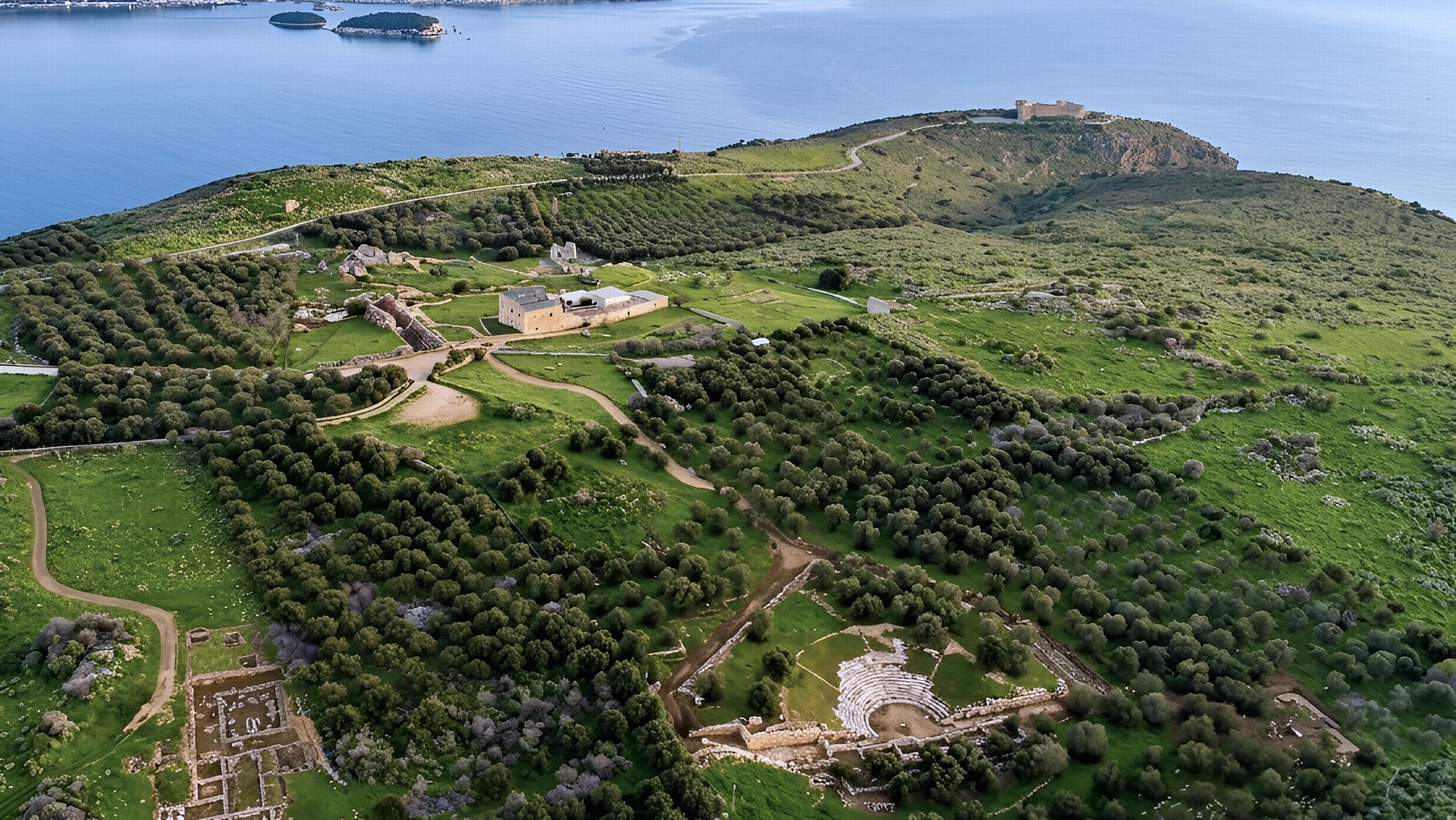
Aptera Chania is one of the most layered historical sites in all of western Crete, and most visitors driving the national road to Rethymno pass within two kilometres of it without knowing it exists. That is a genuine shame. Perched on a plateau 200 metres above Souda Bay, Aptera was a fascinating ancient city-state with a history stretching back to the Minoan era. What you find here is not just one period of history but a continuous accumulation of human presence across three thousand years. Minoan traces. Greek city walls. Roman cisterns. A Byzantine monastery. An Ottoman fortress. Two World War II bunkers. All on the same windswept hilltop.
It takes roughly two hours to see properly. The site is never crowded. And the views alone make the drive worth it.
| Distance from Chania | 13 to 16km, about 25 to 30 minutes |
|---|---|
| Difficulty | Easy to Moderate (uneven paths, open ground) |
| Time needed | 1.5 to 2.5 hours |
| Best season | March to June, September to November |
| Parking | Free, large car park at the entrance |
| Entrance fee | Small fee; check the official site ancientaptera.gr for current prices |
| Rental car needed? | Yes |
| Family friendly? | Yes, with older children |
What Is Aptera Chania and Why Should You Visit
Aptera was inhabited since Minoan times. The first reference to the city, written as A-pa-ta-wa, is traced in Linear B tablets from Knossos in the 14th to 13th century BC. But it only became a significant city around the 8th century BC.
According to Strabo and Pliny, Aptera had two harbours, Minoa (today’s Marathi) and Kissamos (between Kalami and Kalyves), controlling the movement of trade. As a city-state it ruled over a large area, with its territory probably extending from the borders of Kydonia (present-day Chania) in the west, to Lappa (Argyroupoli) in the south and Cape Drapano in the east.
Written sources and excavations show that the city’s greatest prosperity was during the Hellenistic period, at the end of the 4th to 3rd centuries BC, when it began to mint its own coins, becoming economically and politically stronger. Aptera was famous for its keen archers who fought as mercenaries in various areas outside Crete, bringing wealth to their homeland. The introduction of valuable silver by the returning mercenaries gave the city the ability to mint its own coins. These were elaborate and usually depicted the goddess Artemis on one side and the city’s founder King Apteras on the other.
The name itself is worth knowing before you arrive. The most charming myth is delivered by Stefanos Byzantios, according to which the name derives from a mythic battle between the Muses and the Sirens on the hill of Aptera. The defeated Sirens threw their feathers, remaining featherless, and their white feathers fell into the sea, forming the islets of Souda Bay called Lefkes (White). Look down from the site toward the bay. Those small white islets are right there.
Aptera’s decline as a commercial and political centre started during Roman times and was accelerated after it was destroyed by an earthquake in 365 AD. However, it wasn’t completely abandoned until the Byzantine years, when pirate raids drove its inhabitants away.
Local tip: The site is open year-round, but spring is the best time to come. Visitors consistently mention that the wildflowers in April and May are extraordinary, covering the ruins in colour. If you visit in summer, go first thing in the morning. The plateau has little shade and gets very hot by midday.
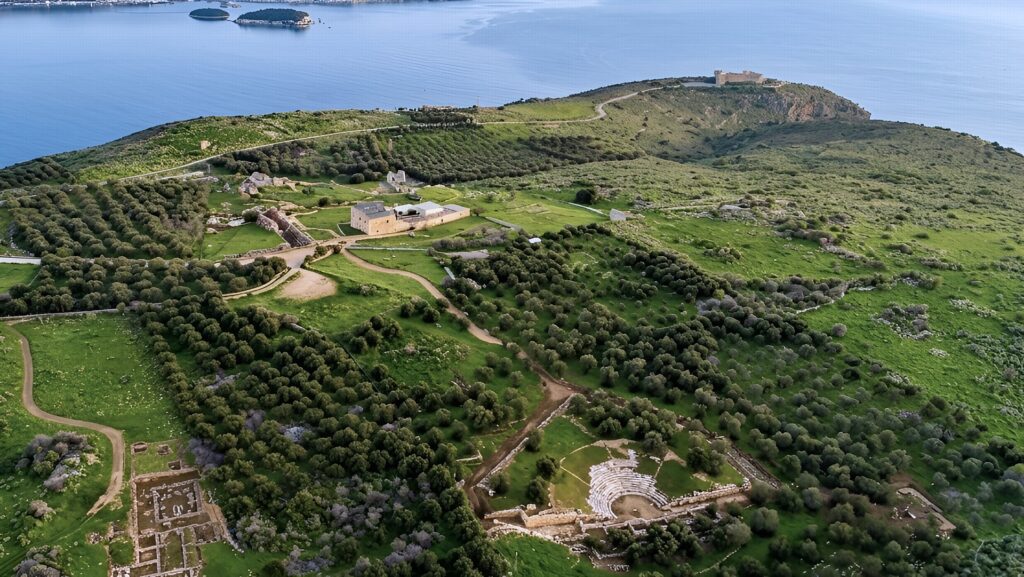
What You Will Actually See at the Site
The enclosed area covers approximately 37 acres, though the enclosed area is only a small part of the very large site which encompasses the whole hill. Give yourself at least two hours to see the main features properly. Here is what matters.
The Roman Cisterns
These are the highlight for most visitors, and rightly so. The most impressive of the preserved ancient buildings are the two Roman cisterns that served the needs of the city and supplied the facilities of the public and private baths. Step inside. The triple barrel-vaulted chambers are remarkably intact. The engineering is still impressive two thousand years later. One visitor described the acoustics inside as extraordinary. Stand in the centre and speak. You will understand what they mean.
The Theatre
The theatre was constructed from the Hellenistic to the Roman period and was damaged by the earthquake of 365 AD. It was made entirely out of limestone and is located at the south-eastern entrance of the city. It is believed to have seated around 2,500 people. Recent restoration work has made it walkable again. Sit in the stone seats. The view across the bay from here is one of the better unexpected moments in Crete.
The City Walls and Temple
The city walls still standing are made of large polygonal stones and echo the walls of Tiryns and Mycenae. The surviving fortification of the city is almost 4km in length. The “double-parted sanctuary”, a small two-room temple, dates back to the 5th to 4th century BC. There are also remains of a colonnaded Roman villa currently under excavation. The work is ongoing. Excavations began around 1850 and are still going on, as large sections of the city remain under the ground.
The Monastery of Agios Ioannis Theologos
This is the first structure you encounter when entering the site. The monastery was constructed with material taken from the ancient city. It belonged to the monastery of Patmos and was in use up to the mid-1960s. Today it has partially been restored. Inside there is a small exhibition room with an audio-visual presentation of the site’s history. Watch this before you walk the grounds. It gives context to what is otherwise a confusing spread of ruins across a large open area.
The Ottoman Fortress (Koules)
The fort was built by the Ottomans after the Cretan Revolution of 1866, during a large-scale programme to control Crete through a network of defensive towers called koules. To get to Koule, you will have to turn left at the last intersection before the archaeological site. It is a few hundred metres from the main entrance. The fortress houses a cultural exhibition called “The Guardians of Souda Bay”, which highlights the fortress’s role alongside the other castles protecting Souda Bay, as well as the rich history of the surrounding area. The view from the fortress walls down to Souda Bay is among the best at the whole site.
The World War II Bunkers
On the western side of the plateau, there are also two German pillboxes from the Second World War. Most visitors do not expect them. Several TripAdvisor reviewers specifically mention that finding the machine gun positions was a surprise. They are accessible on foot from the main site. Worth the short detour.
Local tip: Start your visit at the monastery information room to orient yourself. Then walk to the theatre, the cisterns, and the Roman villa ruins in that order. Leave the Koules fortress and the bunkers for last. That way you finish at the far end of the plateau with the best views over Souda Bay before walking back to your car.
The Archaeology Museum in Chania
You will not see the most important finds at the site itself. Many of Aptera’s most fascinating finds, including vases, coins, figurines, sculptures, and inscriptions, are on display at the Archaeological Museum of Chania in the Halepa district. The museum is closed on Tuesdays. Among the pieces from Aptera are statues of Apollo in marble and Artemis in bronze, the protectress of the ancient city-state, which come from a niche of a domestic shrine in a Roman house at Aptera.
If you are seriously interested in Aptera’s history, visit the museum either before or after the site. The objects give scale to what the city actually produced. The coins in particular are remarkable for their quality.
The Honest Notes
Warning: The site is closed on Tuesdays. This catches visitors out regularly. At least one recent visitor drove from Chania specifically to find the gates locked. Do not assume it follows standard Monday closure rules like some other Greek sites. Tuesday is the closed day. Confirm on the official website ancientaptera.gr before you drive out.
Warning: The signage within the site is limited. Some visitors find the lack of explanatory signs at individual ruins frustrating. The information room in the monastery helps, but much of the site still requires you to navigate by the printed site map or a downloaded guide. Do not expect Knossos-level interpretation. Bring a smartphone with the official site pulled up, or book a guided tour to get proper context from the ruins.
Warning: There is no food or drink available within the archaeological site itself. There is reported to be a small kiosk near the entrance, but do not rely on it. There is a large parking area but no place onsite to buy drinks or food, so make sure to bring plenty of water. The village of Megala Chorafia (now called Aptera village) has a few tavernas just before the turnoff to the site.
The paths between monuments are unpaved and uneven in places. Trainers are fine. Sandals are not a good idea. In summer the open plateau offers almost no shade between structures. The heat is serious from late June through August. Go early, before 9am if possible.
On the question of value: some visitors find the entrance fee steep relative to what is explained on site. Others feel the fee is reasonable given the ongoing excavations. The honest answer is that if you arrive with good background knowledge and approach it on its own terms, Aptera is excellent. If you arrive expecting a polished visitor experience with clear interpretive trails, you may be disappointed. It is not the largest site, but it has some spectacular ruins. The views are lovely and it is a peaceful area to wander.
Before You Go
- Water: bring at least 1.5 litres per person. No reliable water source on site.
- Shoes: trainers or walking shoes. The ground is uneven. No sandals.
- Sun: minimal shade across the plateau. Hat and sunscreen essential in summer.
- Food: nothing reliable on site. Buy provisions in Chania or from the village tavernas before the final turn to the site.
- Closed day: Tuesday. Every week. Do not arrive on a Tuesday.
- Summer hours: 08:00 to 20:00 (April to October). Winter hours: 08:30 to 15:30 (November to March). Always verify at ancientaptera.gr before visiting.
- Cash: bring some. Card payment cannot be guaranteed at smaller Greek archaeological sites.
Getting There
By Car
The best way to reach Aptera is by car. The drive from Chania takes about 20 to 30 minutes on the national road. There is ample parking available at the site. Take the E75 towards Rethymno, exit at the Megala Chorafia/Aptera signs, and follow the road up the hill. Free parking at the entrance. The Koules fortress requires a short additional drive of a few hundred metres. To get to Koule, turn left at the last intersection before the archaeological site.

By Taxi
You can visit by car or taxi. Unfortunately there is no bus connection. A taxi from Chania town will get you here, but plan your return in advance. There is no taxi rank at the site and mobile signal can be unreliable on the plateau. Agree a collection time with your driver or have a working local SIM with a taxi number saved before you leave Chania. No Uber or Bolt operates in Crete.
By Organised Tour
There are not many organised tours for Aptera, so you will probably need to organise it yourself. Some operators in Chania offer combination tours pairing Aptera with the Apokoronas villages or with Chania old town. These are worth considering if you want an expert explaining what you are looking at.
Frequently Asked Questions
How long does a visit to Aptera take?
Plan for one and a half to two hours to cover the main archaeological site. Add another 30 to 45 minutes if you walk to the Koules fortress. Usually one to two hours are enough to walk through the theatre, cisterns, and main ruins. Take longer in spring when the wildflowers are out. There is no reason to rush.
Is Aptera worth visiting if I am not a history enthusiast?
Yes, for the views alone. Many visitors come mainly for the views over Souda Bay as much as for the archaeology. The hilltop, about 150 metres above the sea, commands views of Souda Bay and the Akrotiri Peninsula to the north, the White Mountains to the south, and Kalives and the Turkish Izzedin Fortress to the east. The combination of ancient ruins and panoramic views makes it worth the 30-minute drive from Chania regardless of your interest in archaeology.
Is Aptera suitable for children?
With some caveats, yes. The site is open, walkable ground. Children will likely enjoy the scale of the cisterns and the theatre. The German bunkers are a genuine surprise for older kids. The paths are uneven in places, so very young children or pushchairs are impractical. Some paths are uneven but manageable with comfortable walking shoes.
What is the best time of year to visit Aptera?
Spring, specifically March through May, is ideal. The site has well-preserved remains, but in spring it is the abundance and colour of wild flowers that make it spectacular. Autumn is also good. In July and August the plateau is exposed and hot. If you visit in peak summer, arrive as close to opening time as possible.
Is there a bus to Aptera from Chania?
No. There are no public buses to Aptera. It is best reached by car. You could in theory take any bus to Rethymno and get off at the crossroad that leads to Aptera, but it will take you around 45 minutes to walk up the hill to the archaeological site. A rental car or organised tour is the practical option.
Is the Koules fortress included in the entrance ticket?
The Koules fortress is included with the Aptera site ticket. You do not pay separately. Drive to it after the main site. Turn left at the last junction before the archaeological entrance.
Combine With
Aptera sits in a genuinely useful position for combining with other half-day destinations east of Chania.
Kalyves Beach. Aptera combines easily with Kalyves beach or a Chania town visit. Kalyves is 10 minutes by car from Aptera. Shallow water, a long beach, good seafood tavernas on the front. Good for families. Use it for lunch after the site.
Lake Kournas. About 30 minutes east of Aptera. Crete’s only freshwater lake. Kayak hire available. Peaceful in spring and autumn, busy in August. Worth an hour.
Georgioupolis. Another 10 minutes beyond Kournas. A proper coastal town with good restaurants, a long beach, and a Sunday market. Good for a late lunch before the drive back to Chania.
Apokoronas villages. The villages of the Apokoronas region, including Vamos, Gavalochori, and Kefalas, are within 15 to 20 minutes of Aptera. Quiet, traditional, popular with people who have spent time in Crete before and want to see beyond the coastline.
Practical Information
| Address | Aptera, 730 03, Chania Prefecture, Crete |
|---|---|
| Official website | ancientaptera.gr |
| Opening hours (summer) | Daily 08:00 to 20:00 (April to October) |
| Opening hours (winter) | Daily 08:30 to 15:30 (November to March) |
| Closed | Every Tuesday, year-round |
| Entrance fee | Small fee. Check ancientaptera.gr for current prices |
| Parking | Free, large car park at site entrance |
| Koules fortress | Included in the Aptera ticket |
| On-site facilities | Small kiosk (not reliable). Toilets near entrance. |
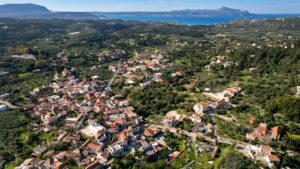
| Nearest village | Megala Chorafia (Aptera village), with tavernas |
| Distance from Chania | 13 to 16km, 25 to 30 minutes by car |
Local tip: The drive back from Aptera to Chania at dusk, with Souda Bay below you and the White Mountains going pink in the light, is one of those accidental moments that make you glad you took the detour. There is a small pull-off above the village with an unobstructed view west toward Chania. If the light is good, stop. It costs nothing and takes two minutes.