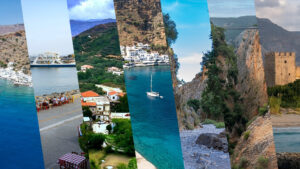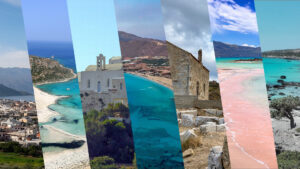
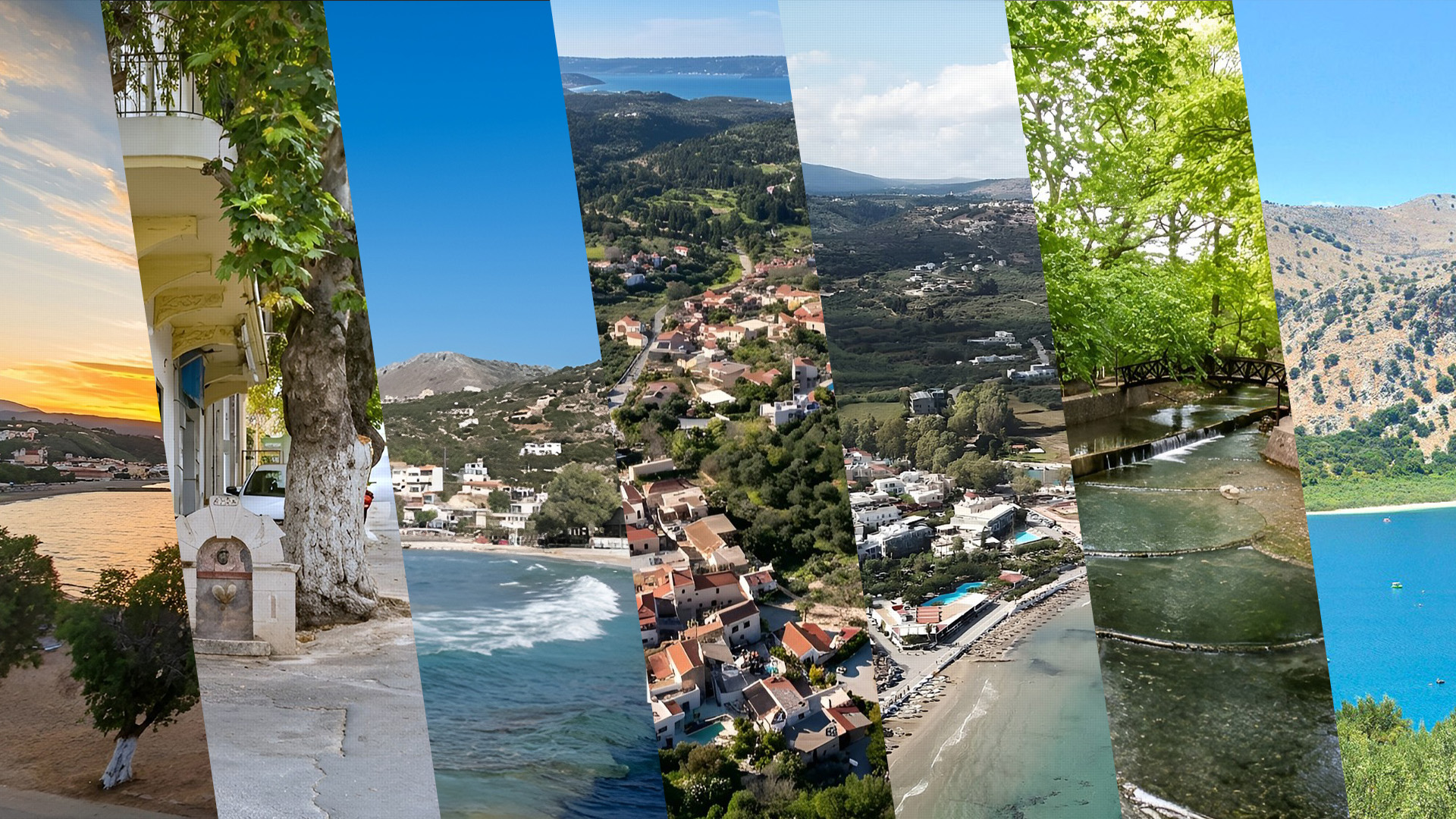
The Apokoronas region Chania sits just east of the city, starting from the foot of the White Mountains and running down to a coast of calm bays and sandy beaches. Most people drive straight through on the E75 heading for Rethymno without stopping. That is a mistake. This is one of the most varied and genuinely interesting parts of western Crete. Villages that have been lived in continuously for over a thousand years. The district of Apokoronas in the north-eastern corner of the Chania prefecture contains some interesting sights, including Lake Kournas, the island’s only freshwater lake, picturesque villages, and small beach resorts. You can combine all of it in a day, or use the area as a base for an entire holiday.
What makes Apokoronas different from the resort strip west of Chania is that it still functions as a real place. The villages have post offices, schools, and people who live here all year. The Apokoronas villages are a collection of 34 settlements either by the coast or in the valleys of the White Mountains. So close to the city of Chania, you will be astonished how completely they have kept their traditional ways. That is not marketing copy. It is simply true.
| Distance from Chania | 20 to 45 km, about 25 to 50 minutes by car |
|---|---|
| Time needed | Half day for coast only; full day for villages and coast combined |
| Best season | May, June, September, October |
| Parking | Free in most villages; paid or limited at Kalyves and Georgioupolis in peak season |
| Entrance fees | Small fee at Gavalochori Folklore Museum; Lake Kournas is free to access |
| Rental car needed? | Yes, strongly recommended |
| Family friendly? | Yes |
What Is the Apokoronas Region Chania?
Apokoronas roughly comprises the territory between Chania town and Georgioupolis, stretching from the foot of the White Mountains to the north shore. It is a very green and fertile region, with many rivers and villages. The landscape changes as you move through it. The coast is low and sandy. The hills behind it are covered in olive groves and orange trees. Higher up, the villages sit on terraces with views across the sea. The White Mountains rise behind everything, still snow-capped in early spring.
The water which flows from fountains descends from the mountains and creates a unique natural lake, Lake Kournas. Then it crosses the region until it finds a way out in the sea. That is why Apokoronas is greener than most of Crete. The water runs year-round here.
The region has roughly 34 villages. You do not need to visit all of them. But you should know the main ones, because they are all different and serve different purposes depending on what you are looking for.
Kalyves: The Practical Base
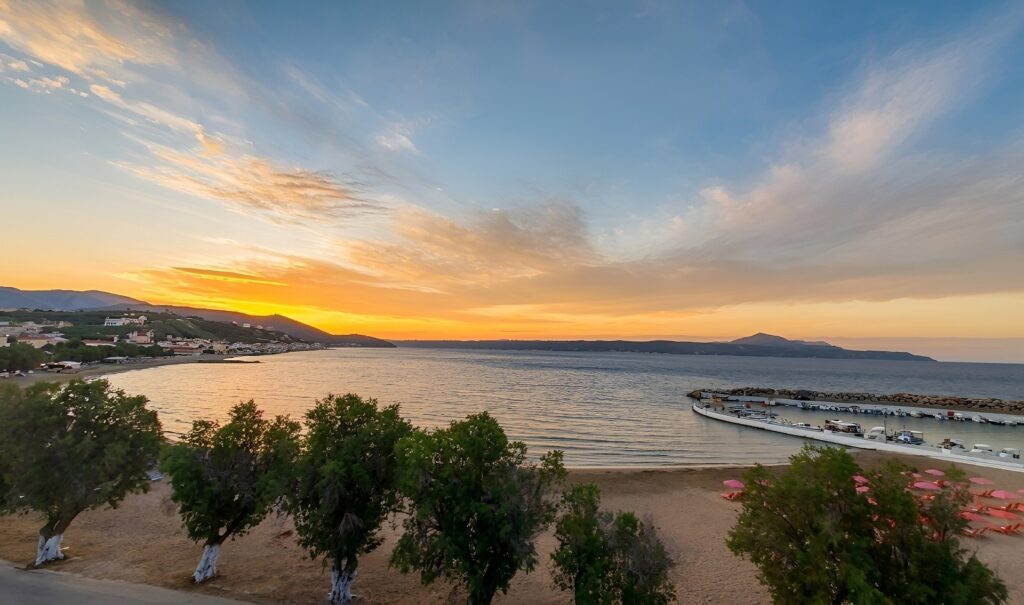
Kalyves is a seaside village located 20 km south-east of Chania town. Today it is known as a calm resort, ideal for families, with many modern amenities and a long sandy beach.
That description is accurate. Kalyves is a proper working village that has grown into a resort without entirely losing itself. It has a river running through it, a small harbour, a decent-length beach, and a main street with shops that are actually useful. Butchers, supermarkets, a pharmacy. Not just souvenir shops.
Kalyves is a proper town with a good local feel. The beach is safe and sandy, but pretty average. There is a good selection of restaurants and tavernas, shops, and attractive cafes. That is the honest version. The beach works well for families. It will not blow you away visually. It has nice sand and on most days very clear, fairly calm sea. Plenty of sunbeds with umbrellas, free in at least some cases provided you buy food or drinks from the associated taverna or bar.
The beach splits around a river outlet. The river outlet splits the beach in half. It is either grin and bear it and walk through the fairly fast, up to knee-deep water, or take the easy option and wander over the bridge to the other side. With children, use the bridge.
You can get to Chania from Kalyves easily by bus, with about five per day in September and fewer at weekends. If you do not want a car, Kalyves is one of the few places in Apokoronas where that is actually manageable. You will still be limited though.
Almyrida: Smaller, Quieter, More Focused on the Beach
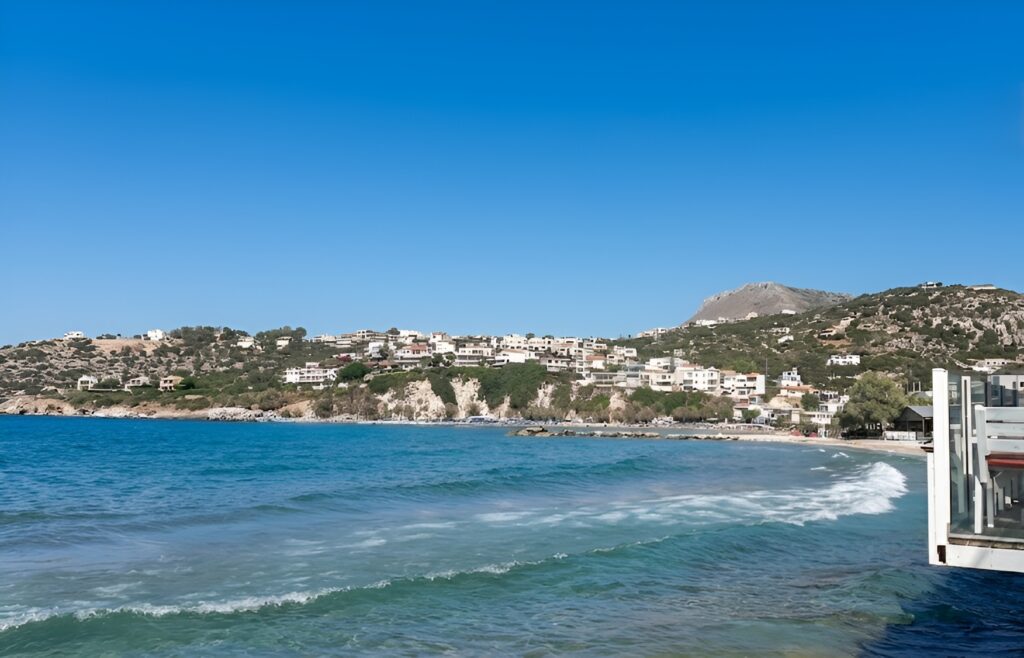
Almyrida is much smaller than Kalyves. It has a lovely shallow sandy bay lined with tavernas, a few bars and coffee shops, as well as a mini market, a fantastic bakery, and ice cream parlour. Perfect for a quiet, relaxing beach holiday.
That is exactly what Almyrida is. A small cove, shallow entry, usually calm water. The row of tavernas faces the sea. You eat, you swim, you eat again. There is not much else to do there, and that is the point. Almyrida is located 23 km east of Chania and 4 km east of Kalyves, on the north coast of the Drapano peninsula.
Local tip: Almyrida beach faces roughly north-west. On days when the meltemi wind picks up in July and August, it can get choppy quickly. Kalyves, which is slightly more sheltered, holds up better in wind. If you see the sea getting rough at Almyrida, try driving the 4 km back to Kalyves.
The villages immediately inland from Almyrida, particularly Plaka on the hillside above, are worth the short drive. The views from up there across the bay are very good, and Plaka has a small square with a kafenio where almost nothing happens. Which is the entire appeal.
Vamos: The Capital of Apokoronas
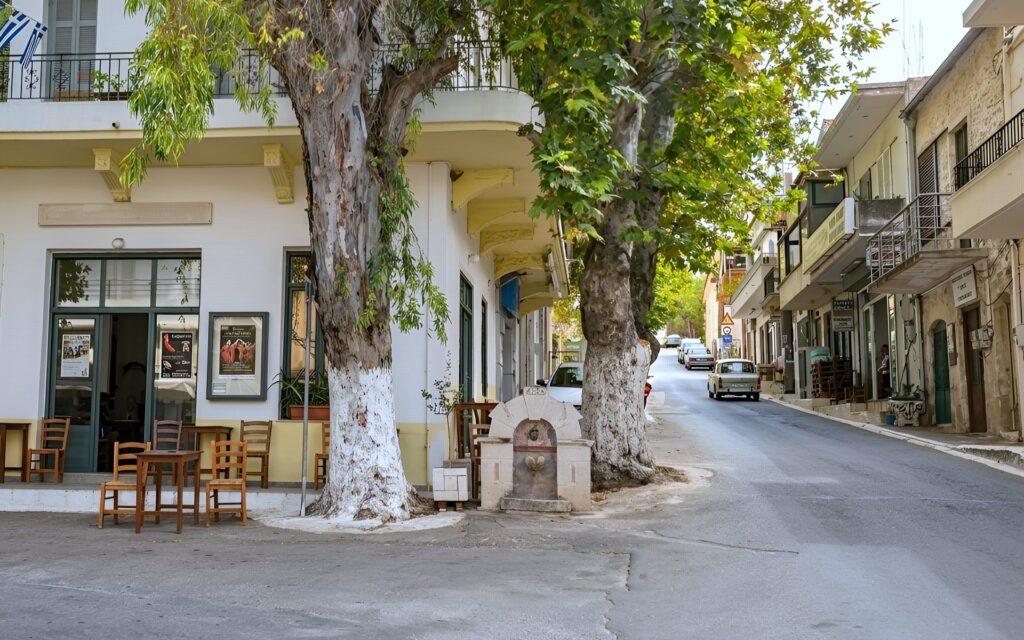
Vamos is the capital of the district. In 1995 a group of villagers started a project to preserve the traditional way of life of Vamos. With funds from the European Union, they started a project to showcase the crafts and products of the region and restored old stone buildings using traditional materials and crafts, turning them into guest houses.
That project turned Vamos into something rare. It is a village that decided to take its own heritage seriously, before it disappeared. The result is a place that looks genuinely old because most of it is. Vamos is not on the tourist trail so remains relatively unspoiled, though the cafes around the village square are welcoming to all visitors. It is good to sit under the shade of a eucalyptus tree, watch the comings and goings in the square, and feel you have found real Crete.
Every July, Vamos organises the largest Jazz Festival in Crete. If you happen to be there for it, do not miss it. If not, the Sunday market is worth knowing about. Every Sunday, from 9am until 2pm, the village of Vamos comes alive with the bustling atmosphere of its open market. Local producers, herbs, cheese, honey, olive oil. The real thing, not tourist market goods.
Vamos also functions as a practical base. Here there is the town hall for the Vamos municipality, a post office, bank, cash machine, a large medical centre, the court, and the high school for the region. There are about 800 permanent residents. It is a real village with real infrastructure, not a museum.
Vamos sits about 28 km from Chania, roughly 35 to 40 minutes by car. It is the administrative capital of Apokoronas and a logical midpoint for exploring the inland villages.
Gavalochori: The Most Historically Interesting Village
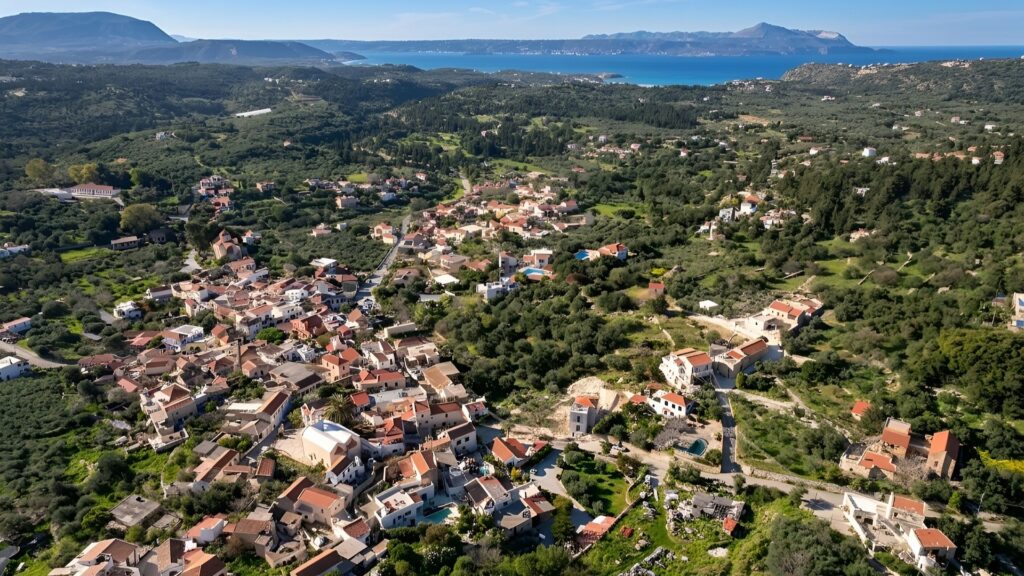
Gavalochori is a Byzantine village founded in 913 AD. It was named after the royal family of Gavalades, who acquired it when Crete was divided between the 12 Byzantine princes. That history is still visible in the architecture. Stone houses, vaulted lanes, Ottoman-era fountains alongside Venetian arches. Several layers of occupation in a single street.
The main reason to come here is the Folklore Museum. The Historical and Folklore Museum in Gavalochori was founded in 1968 and was officially opened in September 1993. It is housed in a building that is a typical sample of the local architecture, housed on two floors. Part of the building was built during the Venetian period; the first floor was built during the Turkish era.
The museum includes seven rooms with the themes: the arched house, silk, pottery, kopaneli lace, stone carving, church, wood carving, and history. It is well done for a village museum. Not a polished international attraction, but genuine. It gives a real sense of what traditional life was like in this area.
The museum is open April 1 through October 31. The hours are Mondays to Saturdays, 10:00 am to 6:00 pm, and Sundays, 11:00 am to 3:00 pm. Admission is charged; children under the age of 12 are free. Always verify current hours before visiting, as they can change seasonally.
Warning: Google Maps lists two locations for the Gavalochori Folklore Museum. One of them will take you up a rough dirt track that ends nowhere useful. Search specifically for “Folklore Museum of Gavalochori” and verify with the address: The Old Square, Gavalochori. Beware if using Google Maps to find it, as it lists two locations for this museum, one of which is up a rough dirt track. Look out for the “Folklore Museum of Gavalochori” instead.
The village of Douliana, just a couple of kilometres from Vamos, has about 40 houses and a total population of 200. You could just soak up the atmosphere of the central square but you should also try one of the short walks from the village. There is one that passes through a forest to Gavalochori. It takes about 30 to 40 minutes on foot. Easy, shaded, worth it in spring.
Vrisses: Stop Here, Even If Just Briefly
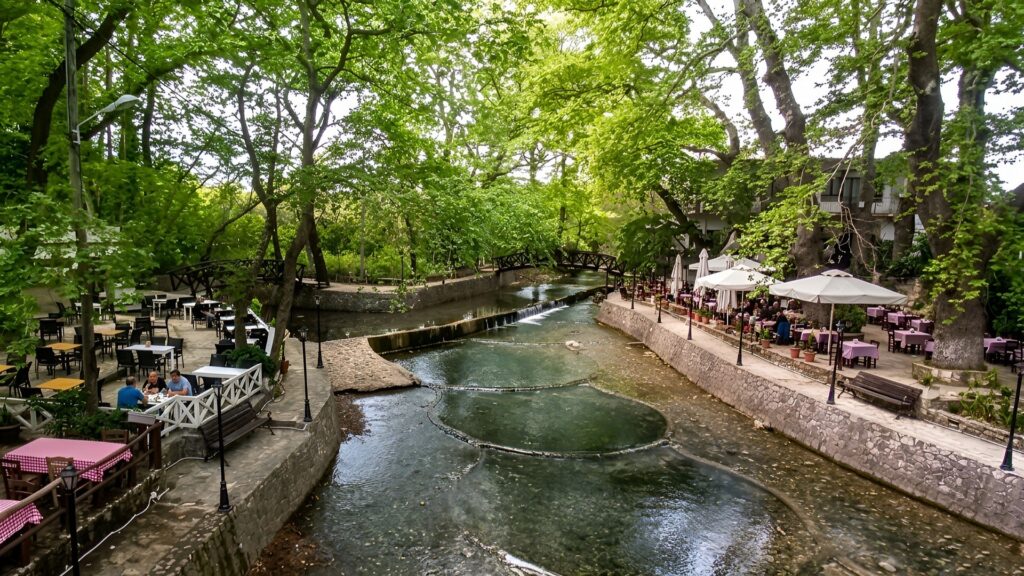
About 30 km south-east of Chania, Vrisses is a lovely village with running springs and lush greenery that consists mostly of plane trees. Vrisses is famous for its tavernas and cafeterias next to the running water.
This is where the road from the north coast splits for the south. One road continues east toward Rethymno, the other turns south for the Askifou Plateau, Imbros Gorge, and Sfakia. If you are doing any kind of drive through the White Mountains, you pass through Vrisses. Stop. The trees here are enormous. The water runs cold even in August. Sit under a plane tree, eat something, and then continue.
From Vamos, the route south to Vrisses and on toward Askifou and Imbros is an easy asphalt road featuring dramatic natural contrasts, passing through the White Mountains. That stretch of road, from Vrisses up into the Askifou Plateau, is one of the most dramatic drives in western Crete.
Georgioupolis Beach
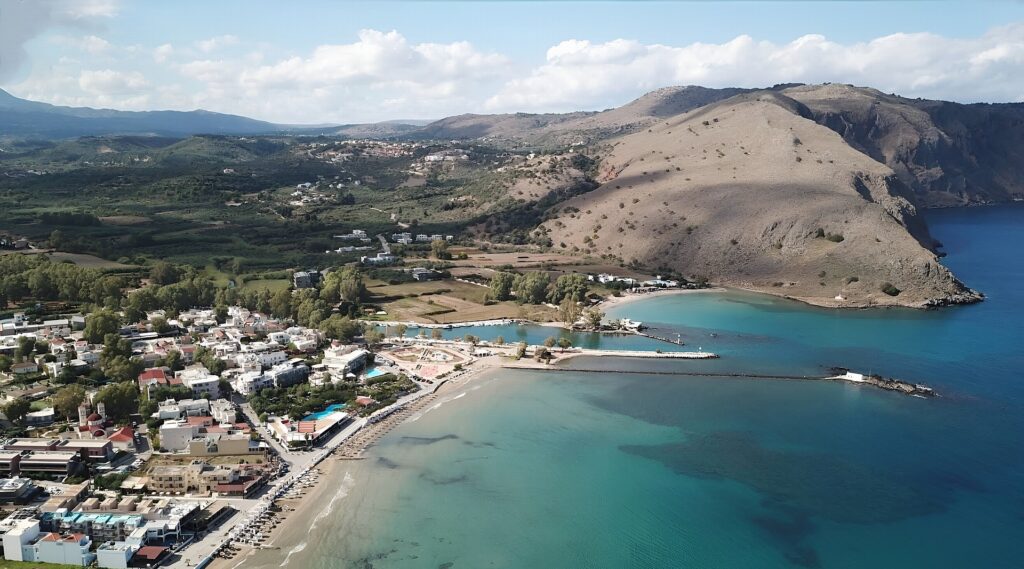
Georgioupolis, at the eastern end of the district of Apokoronas, used to be a sleepy little fishing village but its long sandy beach has seen massive development in hotels. That is the polite version. Georgioupolis is now a proper resort. Busy in summer, with the large hotels along the beach road making it feel distinctly different from the villages just inland.
That said, the beach is excellent. The towering eucalyptus trees along the river banks and the golden sand beach extending from the river mouth for 10 km eastwards make it a pleasant place for sun and sea, especially the dune beach beyond the big hotels.
Driving from the old main road, you will pass through an impressive avenue of fragrant eucalyptus trees. These were planted at the beginning of the 20th century, in order to drain the moor landscape which was expanding at that time. The village centre itself, around the small port and the kafenion-lined square, is still worth half an hour on foot.
Warning: Beware of the waves at Georgioupolis beach, and pay attention to the coloured flags. There may be undefined currents. The beach is long and flat, and shelves gently, but conditions can change. With children, stay close to the village end where a lifeguard is more likely to be posted.
Lake Kournas: Crete’s Only Freshwater Lake
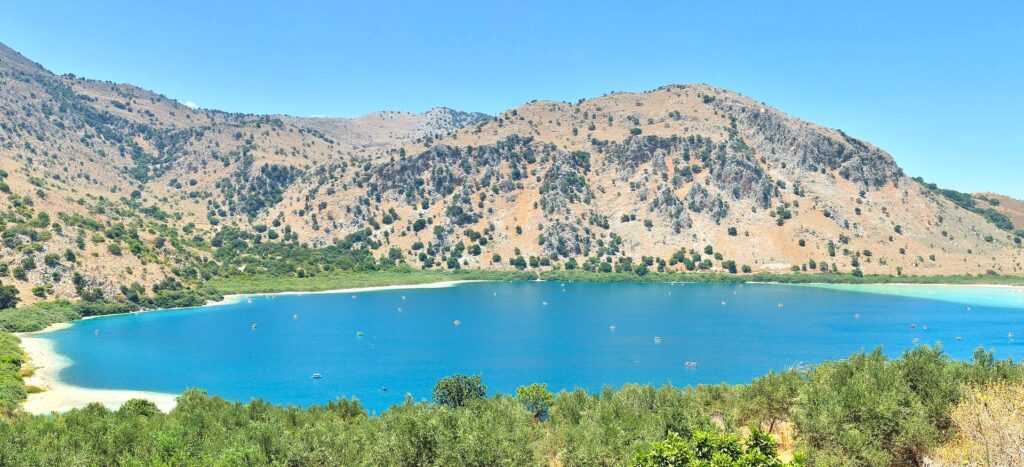
Lake Kournas is located 3 km inland from Georgioupolis at the foot of the mountain and is the only freshwater lake in the whole of Crete. That alone makes it unusual. But what keeps people there longer than expected is the setting.
Lake Kournas is Crete’s sole freshwater lake, a striking contrast to the island’s rugged, sun-scorched landscape. Terrapins bask on rocky outcrops, water birds drift across the surface, and the surrounding hills reflect in the still water with an almost mirror-like quality.
You can swim in it. You can rent a pedalo. You can eat at the tavernas on the eastern shore with the water right in front of you. In summer it becomes popular, especially mid-morning when the coach tours arrive. Arrive before 9 am in summer if you want the lake to yourself. The tour groups from Georgioupolis and Rethymno typically arrive between 10 am and 11 am, and the shift in atmosphere is immediate.
The lake’s water increases during winter from adjacent sources in the mountains and decreases in summer, revealing a golden sandy strip. This means the swimming area in late summer is actually pleasant, with a small sandy shore forming as the water level drops.
The turtles. Yes, there are terrapins. Try to go as early as possible to see the turtles out and about. They are most visible in the morning along the shallow edges. By midday they retreat.
The lake is not reachable by public bus from Chania in any direct, practical way. A car or scooter is the realistic option for most visitors.
Warning: The lake bed can feel a bit slippery or unfamiliar in some places, but this is part of the natural character of the lake. Water shoes are useful, especially for children. The lake floor is silty in parts.
The Ancient Site of Aptera
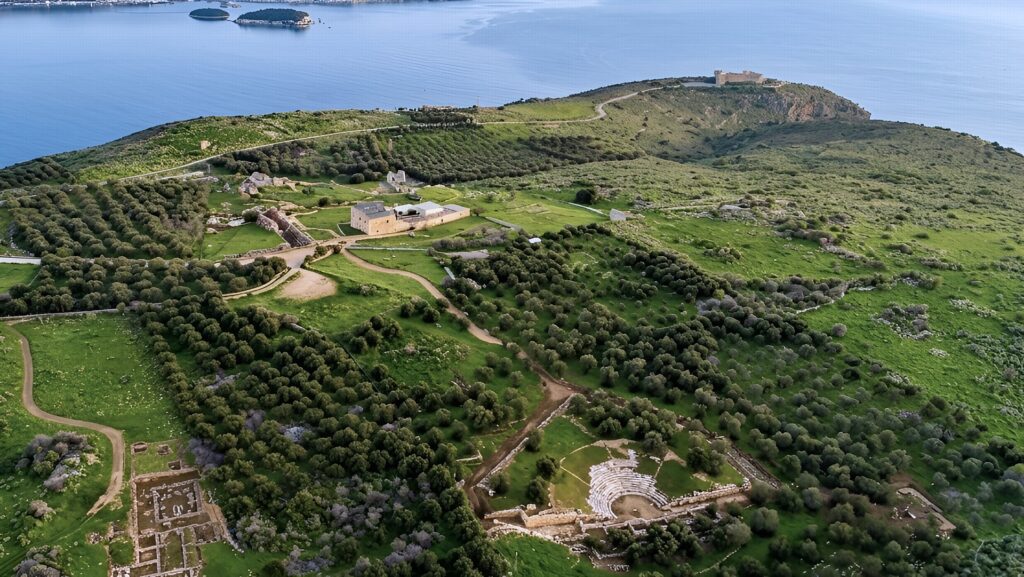
On the way into Apokoronas from Chania, just above the Bay of Souda, lies one of the most significant and least-visited ancient sites in western Crete. The ruins of ancient Aptera are located on a hill above the bay of Souda. Founded in the 7th century BC, Aptera was one of the largest city states in Crete and was continuously inhabited until an earthquake destroyed it in the 7th century AD. A monastery was established there in the 12th century. Most of this very large site has not been excavated yet, but you can see an impressive Roman cistern, a Greek temple, various other buildings, and massive defensive walls.
At the north-western end there is a Turkish fortress with superb views of Souda Bay. The archaeological site of Aptera is open Tuesday to Sunday from 8 am to 2:30 pm and entrance is free. Confirm current opening times before you go, as these can change.
Frequently Asked Questions
Do I need a rental car to visit Apokoronas?
For the coastal resorts of Kalyves and Almyrida, a car is helpful but buses do run from Chania. For the inland villages, Vamos, Gavalochori, Kefalas, Douliana, and Lake Kournas, a rental car is essential. Lake Kournas is not reachable by public bus from Chania in any direct, practical way. A car or scooter is the realistic option for most visitors.

How long does Apokoronas take to explore properly?
A half day covers the coast at Kalyves or Almyrida. A full day lets you combine a morning at the beach with an afternoon in Vamos, Gavalochori, and Douliana. Two days is enough to explore the whole region comfortably, including Lake Kournas and Georgioupolis. It is worth dedicating two days to the countryside and villages of the area.
Is Apokoronas good for families?
Almyrida is one of the most popular resort destinations for holidays with kids. Its close proximity to some of Crete’s most sought-out attractions makes it a perfect home base to explore the island. Kalyves is also well set up for families, with a shallow beach and a lifeguard. Lake Kournas is a good half-day excursion for children.
What is the best village to stay in?
It depends on what you want. Kalyves for a working village with beach access and more amenities. Almyrida for pure beach relaxation. Vamos for an inland village experience with good restaurant access. Vamos may be the place for you if you prefer to be a little away from the beach and more touristy resorts, but still close to excellent facilities. You will be at the centre of many villages while still only minutes from the beaches at Almyrida, Kalyves, and Georgioupolis.
When is the best time to visit Apokoronas?
May, June, September, and October. The beaches are quieter, the tavernas have room, and the villages function normally. In July and August everything works, but the coast at Kalyves and Georgioupolis gets busy. The inland villages remain calmer even in peak season. Even during the peak holiday period of July and August, you will find the villages of Crete quiet and an excellent change of tempo to the popular beaches and cultural sites.
Are there good restaurants in Apokoronas?
Yes. There are tavernas in Kalyves, most of which do good food and are good value for money, but it is not fine dining. The same applies in Vamos and Almyrida. Vamos has several well-regarded tavernas in the old part of the village. The village of Agioi Pantes, between Vamos and the coast, has a highly-rated small restaurant that locals recommend.
The Honest Notes
Apokoronas is genuinely one of the best parts of western Crete for visitors who want something beyond the beach. But there are a few things to know before you go.
Warning: The coast at Kalyves and Georgioupolis in July and August is busy. Kalyves beach in particular gets covered with hired sunbeds from the tavernas along the front. During the day the beach can be overrun with loungers from restaurants. There is almost no room for a personal umbrella. If you want free space on the beach, either arrive before 9am or walk towards the ends of the beach, away from the village centre.
Warning: Most of the inland villages have very narrow roads. Douliana and Gavalochori in particular have lanes that two cars cannot pass each other on. Drive slowly, be prepared to reverse, and park at the edge of the village before walking in. Do not attempt the inland roads in a large van or campervan.
Warning: Lake Kournas gets very busy mid-morning in summer. It gets very busy so arrive early. The parking area near the lake fills quickly. If you arrive after 10:30am in July or August, you may end up parking on the road down and walking. Go early or go in September.
The other honest note is about Georgioupolis. It is in Apokoronas in name, but in character it is a full resort. If you are staying there and hoping for the quiet village feel of Vamos or Douliana, you will need to drive to find it. The village centre around the port is still pleasant, but the main beach road is lined with large hotels for several kilometres.
Before You Go
- Car: A rental car is strongly recommended. Buses reach Kalyves and Georgioupolis but the inland villages and Lake Kournas require your own transport.
- Cash: Carry some. Smaller villages may only accept cash at the kafenio or local taverna.
- Shoes: Cobbled streets in Gavalochori and Vamos are uneven. Wear proper shoes, not flip-flops, for village walking.
- Water: No taps or fountains on the walking routes between villages. Carry water, especially in summer.
- Museum timing: The Gavalochori Folklore Museum is closed November through March. Check current hours before visiting.
- Roads: Some roads between villages are narrow and partially unmade. Take the main routes if you are unsure. The GPS will sometimes route you through tracks that only make sense on a moped.
Getting There
By car: From Chania city centre, take the E75 east toward Rethymno. For Kalyves, take the exit at Souda and follow signs (about 25 minutes). For Vamos and the inland villages, continue past Kalyves and follow signs to Apokoronas and Vamos (about 35 to 40 minutes). For Georgioupolis and Lake Kournas, continue on the E75 east for about 45 minutes. The roads in and around the coast are good. Inland roads are mostly paved but narrow in places.
By bus: KTEL buses from Chania central bus station run to Kalyves and Georgioupolis several times daily. You can get to Chania from Kalyves easily by bus, with about five per day in September and fewer at weekends. There is no direct bus to Lake Kournas. Coming from Chania, you take a bus to Georgioupolis, which is the closest town. There is no direct bus to the lake itself. From Georgioupolis, the lake is 3 to 4 km inland, accessible by taxi or local hire.
By taxi: Taxis from Chania to Kalyves cost a set fare; ask your hotel for current rates. There is no Uber or Bolt operating in Crete. For village touring, a taxi is expensive for a full day. A rental car is significantly more practical.
By organised tour: Several operators run tours through the heart of Apokoronas with convenient pickup points in the Chania area, visiting villages, a cheese factory, and a traditional bakery. These are a reasonable option if you do not want to drive and prefer to have someone explain what you are looking at.
Practical Information
| Region | Apokoronas, Chania Prefecture, Crete |
|---|---|
| Main towns | Kalyves, Almyrida, Vamos, Gavalochori, Douliana, Vrisses, Georgioupolis |
| Distance from Chania | 20 to 45 km depending on destination |
| Best months | May, June, September, October |
| Gavalochori Museum hours | Mon-Sat 10:00-18:00, Sun 11:00-15:00 (April to October) |
| Aptera archaeological site | Tue-Sun, 8:00-14:30, free entry |
| Lake Kournas | Open year-round; lake access free, pedalos for hire |
| Bus service | Regular buses to Kalyves and Georgioupolis from Chania KTEL station |
| Car hire needed? | Yes, strongly recommended for inland villages and Lake Kournas |
| Petrol stations | Vamos has two. Georgioupolis and Kalyves also have stations. |
| ATMs | Vamos, Kalyves, Georgioupolis |